

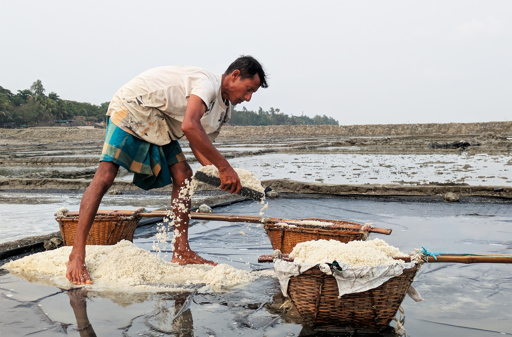
Bent over a salt bed, a 55-year-old farmer, Nasir Uddin, was scooping up and throwing out water with a hand-made pot His field was flooded by a few hours of heavy overnight rain. On his 0.5 hectares (1.2 acres) of salt plot located in southeastern Bangladesh, nearly 18 maunds of salt (each maund is equal to 40 kilograms, or 88 pounds) had been washed away just a day before harvesting. “I was expecting to collect salt today [April 16]. But the rain has damaged all the salt,” said Nasir, a farmer from Moulabir Gona village of Kutubdia subdistrict in Cox’s Bazar district. The farmer said the rainfall on April 15 happened when production is usually at its peak. “We didn’t experience rainfall in March-April in the past. But over the last 8-10 years, rain has started occurring during this time, even in December and January, during winters,” said Nasir, who has been cultivating salt for around 28 years. Like Nasir, thousands of salt farmers across the coastal belt are now facing similar losses from unseasonal rain, as erratic weather increasingly disrupts production. A salt farmer carries harvested salt from the field, transporting it for storage in nearby pits. Image by Sifayet Ullah. Climate variability emerges as a growing threat Salt farming is one of the largest seasonal livelihoods in the country. In the ongoing season, farming has taken place on more than 27,520 hectares (68,000 acres) of land across Cox’s Bazar’s Sadar, Kutubdia, Maheshkhali, Chakaria, Pekua, Eidgaon and Teknaf subdistricts…This article was originally published on Mongabay
From Conservation news via This RSS Feed.