

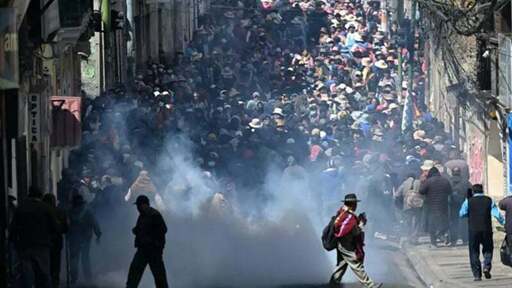
This Monday, May 18, a massive march made its way from El Alto to downtown La Paz, with a slogan that spread from the ranks in the unified chant of “Paz, get out!” and “Resign or we’ll kick you out,” once again defying a heavy-handed police crackdown that only served to deepen the anger and social unrest.
However, following brutal repression during a police and military operation on May 16, which left four dead, the government has failed to quell the protests. On the contrary, on May 19, Bolivia woke up to more roadblocks and new forms of resistance.
Paz’s Austerity Plan and the Exhaustion of Promises
The discontent now erupting in the streets did not arise overnight. “When the price of bread went up, people held on, they waited. But now it’s the last straw,” said a resident participating in the roadblocks.
Many working-class sectors initially placed their faith in the campaign promises of president Rodrigo Paz and vice president Edman Lara, who assured voters they would end the long lines for fuel and improve the economic situation by promising “capitalism for all.” But the reality, just a few months into the administration, is completely different. Far from turning the population into “prosperous capitalists,” what Paz has been openly doing is governing for the rich while shifting the cost of the crisis onto the backs of working families. Pure and simple capitalism.
The government began by eliminating the Tax on Large Fortunes, followed by a gas price hike, attacks on education and public health, an attempt to facilitate “fast-track” looting, and the promotion of Law 1720 to favor land concentration in the hands of agribusiness and large-scale landownership.
The government was able to impose a drastic gas price increase last March despite the move sparking protests all over the country. The advance of the law came thanks to the leadership of the “Central Obrera Boliviana,” the union federation led by Mario Argollo that negotiated behind the backs of the mobilized masses.
The Decree not only made fuel even more expensive, but has also led to growing complaints about the poor quality of the gasoline circulating in the country. The people denounce it as “junk gasoline.” Transport workers, farmers, and peasants see the rising prices affecting their income, while the low quality fuel damages their vehicles, and lines to obtain fuel and shortages continue.
Social anger is growing because it is clear that the government wants to put the burden of the crisis onto working people, benefiting big business, agribusiness, and landowners with tax exemptions and new measures favorable to big capital.
“They call us Indians because we’ve come out to fight, but we’re not fighting just for ourselves. We’re fighting for our families, for our children, for the entire people,” summarized another protester from the blocked highways.
Racism, Criminalization, and Repression
As popular mobilization grows, so does the campaign of criminalization driven by the government and the mainstream media.
Bolivia made international headlines, and much of the mainstream press echoed a discourse steeped in racism to attack those resisting Rodrigo Paz’s anti-worker austerity measures. Videos and messages began circulating on social media in which right wing sectors label mobilized peasants, residents, and communities as “vandals,” “violent extremists,” “terrorists,” “drug traffickers,” “Evo supporters,” and “savage Indians.”
The government attempts to justify militarization and repression under the excuse of defending “democracy” and ensuring “free movement,” while accusing the protests of “sedition,” “terrorism,” and “destabilization.” As part of this repressive plan, arrest warrants are being issued against union leaders, including Argollo, chair from the COB, while hundreds of people detained during the protests are being criminally prosecuted.
In this context, former president Evo Morales has become a prime target of the government’s attacks. Paz needs a scapegoat to blame for the protests and to definitively eliminate a dangerous rival from the political scene. With that goal in mind, criminal proceedings against him have been reactivated, and they seek to pin the leadership and responsibility for the demonstrations on him. However, Evo Morales took it upon himself to debunk these narratives by stating that he does not seek Paz’s resignation, but simply wants him to address the demands.
The social unrest and anger in the face of the serious economic and political crisis goes beyond Evo Morales’s agenda. They are rooted in deep popular discontent. The narratives put forward by the right-wing government not only expose the deep-seated racism that intensifies in contexts of polarization, but also reproduce the perspectives of the elites who deshumanize the protesters and refer to them as cattle.
However, far from weakening, the movement continues to grow. Throughout El Alto, Senkata, Ventilla, Puente Vela, Puente Bolivia, and various blockade sites, town hall meetings, gatherings, and spaces for discussion and decision making are taking place, driven by neighborhood, union, and peasant grassroots groups. People want to fight; the spirit is to sustain and deepen the struggle until the government’s austerity plan is defeated and Paz is ousted.
As our correspondents in Bolivia are reporting: “blockades remain in place to the east at various points from Huayllani, San Isidro, Aguirre, Colomi, and already in the tropics at the checkpoint. On Tuesday, May 19, the OTBs (Grassroots Territorial Organizations) of Quillacollo decided to set up roadblocks, joining several roadblocks in that region. The old highway from La Paz to Santa Cruz is blocked in several sections — the largest in Tiraque — including interprovincial sections such as in Vacas.”
Rodrigo Paz, Like Javier Milei, Works for Donald Trump
As soon as he took office, Paz placed himself at the service of those who are driving the genocide in Palestine and view our region as their backyard. He re-established diplomatic relations with the Zionist state of Israel and bowed down before the imperialist military alliance, “Shield of the Americas.” During Paz’s campaign the entire reactionary right wing had labeled him a “Masista,” associating him with the MAS, Evo Morales’s party. Now the right welcomes Paz to their events and defends him through the mainstream media. That is why the business chambers, agribusiness, and the old neoliberal right have closed ranks behind Rodrigo Paz. In just a few months, his government managed to advance measures that these sectors had unsuccessfully demanded for years, such as the elimination of the Financial Transactions Tax and the deregulation of exports of agro-industrial and livestock products to the detriment of domestic consumption.
Donald Trump, Javier Milei, along with several right-wing governments in the region were quick to come out in support of the Bolivian government. From Washington, they spoke of an alleged “destabilization plan” and launched a campaign in defense of “democracy,” while from Argentina, Milei’s government sent Hercules aircraft to “back” Paz’s government.
But this international support — from the United States, Netanyahu’s genocidal government, and the right-wing governments across the continent does not stem from any democratic concern. Trump seeks to pave the way for the plunder and theft of the resources of the Bolivian working class and the oppressed, just as the United States has been doing in Venezuela, which is being turned into a protectorate of U.S. imperialism. They aim to do the same in Cuba with a criminal blockade that is pushing the Cuban people to the brink of a humanitarian crisis. But we see it in Argentina as well, where the puppet Milei is moving forward with handing the country on a silver platter to the voracity of U.S. corporations and big capital, and leaving millions without jobs or healthcare.
However, this brutal, pro-imperialist, continent-wide austerity plan is being pilloried in Bolivia. The struggle waged by workers, peasants, Indigenous people, communities, and so on — demanding Paz’s resignation and rejecting the entire austerity plan — serves as a powerful example for the millions of rural and urban workers across South America and beyond who today face the same attacks that could topple the regime in Bolivia.
Dozens of roadblocks and increasingly bold and radicalized mobilizations are seeking to unify and coordinate their actions of struggle. Hundreds of people — whether self-organized or mobilized by some new unions or neighborhood leaderships — are manning the roadblocks, discussing how to defend themselves, thinking about what political path will follow in the face of the possible fall of Rodrigo Paz, rejecting their lukewarm leaderships, and building new instruments of struggle such as blockade committees, organized with a steering committee, which seek to coordinate with other mobilization committees that are emerging. In the city of El Alto, this type of organization is beginning to emerge in a very embryonic form, and from the LOR-CI, part of the Permanent Revolution Current, we call for supporting them with all our strength.
The post Bolivia Is Leading the Way in a Continent-Wide Fight Against the Far Right appeared first on Left Voice.
From Left Voice via This RSS Feed.