

A national fact-finding mission organized by human rights groups revealed that the Armed Forces of the Philippines used excessive military force on April 19. Residents also confirmed that at least six of the 19 killed were civilians.
Part 2: What were civilians doing in Toboso, Negros Occidental
TOBOSO, Negros Occidental – ‘Bullets were raining’ was how local residents of sitio Plaringding described the government troops’ operation on April 19 that left 19 dead.
Sitio Plaringding was the location where 19 individuals reportedly died. Some were found submerged in the water and others were in a dry area. Among those killed were peasant advocates Errol Wendel and Maureen Santuyo, University of the Philippines student leader Alyssa Alano, community journalist RJ Ledesma and Filipino-Americans Lyle Prijoles and Kai Sorem, and 13 others, including two minors.
The residents told the national fact-finding and solidarity mission (NFSM) on May 14 that they heard the first volley of fire at around 9 a.m. on April 19. The soldiers reportedly were firing gunshots indiscriminately in the direction of the fishpond.
According to the NFSM initial report, a resident together with a 14-year old boy and his mother went to the fishpond to harvest some shellfish. But when they were seen by the soldiers along the way, they were accosted and were illegally detained in the uphill part of the sitio overseeing the vast fishpond down below. They were reportedly interrogated by the soldiers about the alleged presence of the New People’s Army (NPA) in the area.
While being detained, the three residents observed another group of soldiers positioned near the cemetery area also in the uphill part of Sitio Plaringding.
The NFSM gathered that the bodies were left in the area until April 21.
Karapatan Deputy Secretary General Ma. Sol Taule said that the residents were evacuated from the area from April 19 to April 22.
“For two days it is only the military that was in the area that’s why we are raising doubts on how they handled the crime scene. There are possibilities that this was staged,” she said during a press conference, May 15 in Bacolod City.

In another sitio three kilometers away from Plaringding is sitio Sinugmawan, where local residents reported hearing gunshot at past 3 a.m. on the same day.
“It was around 3:58 until 6 in the morning and then silence,” said a female resident who sat for an interview with members of the NFSM. She said there were intermittent gunfire until 7 a.m.
“We were filled with fear and very scared that the military might come back,” the resident said in Hiligaynon, adding that the gunshots were really loud. “We would hear it echoing and we would hear it hit trees and even our homes,” she said.
An elderly woman in her 70s also said that her grandchildren were too scared and wanted to run away. “But I told them that we should just stay inside the house and duck near the floor, the cement floor, for safety. Because once we go out and run, we might get killed. We might get shot by the military,” she told the NFSM.
How the 19 all ended up in sitio Plaringding is a big question.
Residents of sitio Plaringding told the NFSM that Errol, Santuyo, Alano, Prijoles, Sorem and Ledesma were not armed, contrary to the claims of the military that they were members of the New People’s Army (NPA).
Earlier, forensic pathologist Raquel Fortun, in a press conference following the autopsy of five victims, noted that the bodies recovered in sitio Plaringding were not properly handled. One of the bodies was wrongfully identified, the clothes of the five were also missing.
Lawyer Kristina Conti of the National Union of Peoples’ Lawyers (NUPL) also raised the question if sitio Plaringding was really the primary crime scene.
“Residents said that the fishpond is an open area, if someone got hit once they may eventually die because they may fall into the fishpond. But why do some of the dead have multiple gunshot wounds?” Conti said during the May 15 press conference in Bacolod.

A member of the fact-finding mission measures the bullet mark that hit this mango tree in sitio Sinugmawan also in barangay Salamanca. This is only one of the many bullet marks that hit the said tree. (Photo by Anne Marxze D. Umil/Bulatlat)
“So this raises the question: Was this really the primary crime scene? Or were there other locations where these individuals were killed? The victims were just too many to conclude that they were killed all at once (in the area). Were they there for over 11 hours?” Conti said, adding there is so much more to uncover in this case.
Read: Forensic expert raises questions on Toboso killings
A day before the incident, residents of sitio Sinugmawan told the NFSM that soldiers from the 79th and 303rd Infantry Battalion conducted house-to-house visits asking about the whereabouts of the members of the NPA.
Taule said that residents also reported seeing drones hovering the community a few days prior to the April 19 incident.
Lives disrupted
After April 19, a 58-year-old woman, also a resident of sitio Sinugmawan, said that soldiers went to their residence asking them about “terrorists.”
“They went into our houses looking for more terrorists. They asked all of us inside the house to go out. They took my husband and poked a gun in his back and went inside the house as they commanded him to let those inside the house to go out. I told the soldiers that we do not take anyone (inside the house),” the woman said.

More than 100 delegates participate in the National Fact Finding Solidarity Mission last May 14 in Toboso, Negros Occidental. (Photo by Anne Marxze D. Umil/Bulatlat)
Due to fear, the residents have not been able to go back to their normal lives as they would still see soldiers roving in their area.
Marina (not her real name) said that her community was peaceful until April 19 happened. “We were really afraid (when we heard the shots),” Marina told Bulatlat in an interview.
Marina is in her early 20s living with her parents in sitio Sinugmawan, barangay Salamanca. She said her mother almost had a heart attack when they heard the shots nearby. At 3:00 a.m. on April 19 when they heard the shots, she said they all gathered together in one house to be safe.
She said they were not able to see who was killed after the gunfire because they did not go out. They were also not able to evacuate. The incident traumatized and saddened them, Marina said. Their livelihood was interrupted as soldiers have been frequenting the area where her father works. She recalled that in some areas, grocery packs were distributed right after the military operation. Her family did not receive one.*“*It seems that they just selected those who were to be given,” she said.
“There has been a drone every day since April 19. Our dogs are barking because of that,” Marina said, adding that their dogs are usually not like that.
Soldiers were also roving on foot even at night, according to one resident of Sitio Sinugmawan.

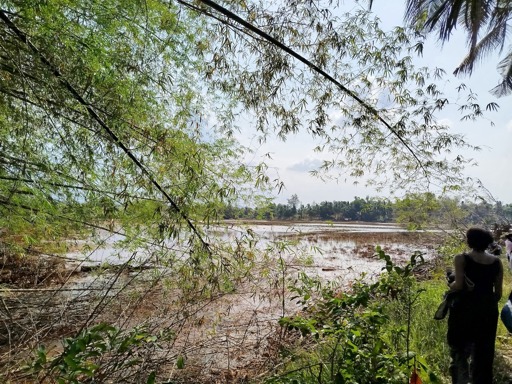
Overlooking fishpond area where the 19 people were killed on April 19 in sitio Plaringding, barangay Salamanca, Toboso, Negros Occidental. (Photo by Anne Marxze D. Umil/Bulatlat)
Meanwhile, Marina’s father was not able to get back to work on the fields because of the heavy presence of the military.
“It has been weeks, he cannot go back to the fields to gather bamboo,” she said in Filipino. Gathering bamboo was their main source of livelihood. Her older sibling who is in Cebu is the one who helps them to get by, sending groceries.
“We really do not have anything to eat sometimes. It was really difficult,” she said.
The mothers from sitio Sinugmawan want to live in peace without the military.
“Our kids are traumatized. They’re scared to even take a bath, to even visit the comfort room because of fear,” one mother said. She added that there are nights when men would peek through their houses at night and would run away when they put flashlights on to see them.
They also hoped that they could resume their livelihood without fear. “We also hope that they stop visiting our houses, stop sleeping at our homes because our children would get scared,” she added.
“We hope that militarization will stop because without them, there would be not any issue in our area,” they said. (With translation from Hiligaynon to English by Cris Bayaga) (RTS, RVO)
Author’s note: Real names of the residents interviewed in this article were withheld due to serious threat to safety and security.
The post Bullets rained down in Toboso, residents tell fact-finding team appeared first on Bulatlat.
From Bulatlat via This RSS Feed.