

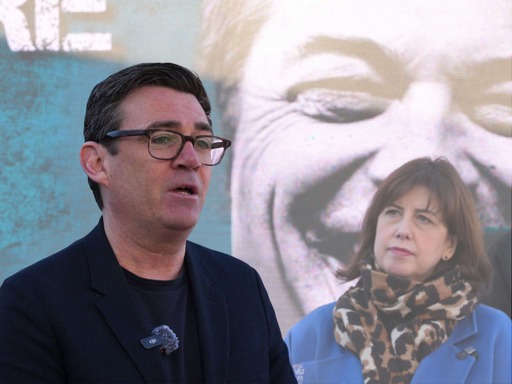

People have a very hazy idea of what Andy Burnham plans to offer as prime minister. The latest example of this is his vague stance on potential wealth taxes.
Andy Burnham’s commitment to uphold the UK’s borrowing limits may win the would-be PM a reprieve with bond investors, but it raises new questions about whether he’d need to raise taxes to fund a more ambitious agenda https://t.co/6KE1bruycA
— Bloomberg (@business) May 19, 2026
Burnham-ism
Andy Burnham is the mayor of Greater Manchester. He’s also running to become the MP of Makerfield, in Wigan. If you’re out of the loop, he’s doing this so he can return to parliament to challenge Keir Starmer for the Labour leadership.
Should he be successful, Burnham will become the new UK prime minister. As such, it’s obviously very important that we scrutinise his policy positions.
As the Canary has reported, Burnham has made it clear he will not support the introduction of proportional representation this parliament (a system which would make voting fairer). According to him, the public would need to vote on such a change in a general election.
Burnham has also been vague on renationalising key utilities and industries. While the media is claiming he wants to ‘renationalise’ them, in his own words Burnham said (emphasis added):
The country gave away its control of basic things people depend upon every day. And that was a big mistake in my view.
Put more things back under public, stronger public control: energy, housing, water, transport. I’ve done that with the buses in Greater Manchester…We’ve got two pound fares.
While it would obviously be better to have “stronger” public control, it wouldn’t be enough. If we don’t have full ownership, the private companies will simply claw back more and more control every year.
What has Burnham said?
On the subject of taxes, a spokesperson for Burnham said:
Andy is fully focused on working hard for every vote in Makerfield so he can represent them in Parliament. Andy is not standing on a national manifesto at this election; he is standing to make a difference for the people of Makerfield and to bring the change he has delivered in Greater Manchester to the national stage.
We’re sorry, but we all know he’s running for national office, so he needs to own that and tell us what he has planned.
As journalist Alex Wickham noted:
Burnham has recently called for the top rate of tax to be hiked to 50p and a council tax reevaluation to target the wealthy. “We have overtaxed labour and undertaxed wealth,” he said last year.
The problem is that Burnham has said a lot of things. While it’s true Burnham has brought the bus network back under public control in Greater Manchester, he’s also allowed tax-exile developers to build skyscrapers with zero affordable housing.
‘the gmca housing investment loans fund actually isn’t supposed to create affordable housing!’ yes that’s what’s being criticised here, the council making loopholes for developers to make millions with little/no benefit to the taxpayer who lends them the money to do it.
— sarah
(@sazza_jay) May 19, 2026
Manchesterism
Burnham’s political ideology is known as ‘Manchesterism’. One of the proponents of this ideology is Matthew Lawrence of the Common Wealth think tank.
Writing in New Statesman, Lawrence said:
Against the grain of national policy and with limited powers, [Manchester] has begun delivering affordability and economic dynamism in tandem by regaining public control of essentials.
This is not just a project to tackle the cost of living crisis, but an institutional basis for a more inclusive, resilient and democratic society – one in which belonging is built through what we experience in common rather than divided by what we can afford.
Manchesterism is the theory in motion and the political project capable of carrying it. The argument that follows is the case for taking its logic to national scale, and for building the coalition that can do so.
As someone who’s lived in Manchester and still visits, ‘affordable’ isn’t a word I’d use to describe it. While it’s great public transport is now cheaper, housing certainly isn’t. When I left the city in 2015, I was paying £700 for a two-bedroom semi in South Manchester. When I looked the other day, that was roughly how much you’d pay for a single room in a house share.
Would house prices be more affordable if the city had focussed on affordable homes over unaffordable skyscraper condos? I guess we’ll never know!
On the topic of wealth taxes, Lawrence told Novara this week:
I think we should recognise that a wealth tax, even the sort of, you know, sort of more upper tier estimates, doesn’t really raise, sort of, that much, and obviously its role might be sort of to discipline, but actually this is about saying let’s be about production.
Let’s produce affordable council housing at scale. Let’s build clean public power at scale. Let’s think about public transport networks to connect cities.
‘Disciplining’ the rich is precisely the point.
The reason we don’t get affordable housing is because billionaire property developers use the power wealth grants them to ensure they don’t have to build any. Unless we make these people less powerful, they will continue to suck up wealth and assets like a black hole.
What’s on offer?
Andy Burnham is running to become the British prime minister, and yet we have very little idea of what he plans to do when he’s in power. Given that the Labour Party is talking about ‘coronating’ Burnham if he wins in Makerfield, we need answers now.
As much as we want cheaper buses, they won’t be enough to counter the decline which results from widening wealth inequality.
Featured image via Christopher Furlong/ Getty Images
By Willem Moore
From Canary via This RSS Feed.