

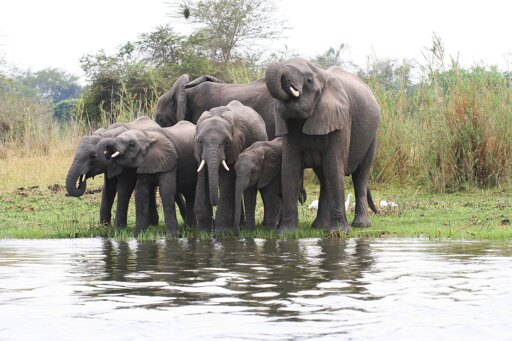
LUNDAZI, Zambia — “It’s not possible [to coexist with elephants], because they are animals and we are human beings — they should have their own home,” says Esnart Banda, a Zambian farmer whose maize and tobacco fields lie 5 meters, just 16 feet, from the boundary of Malawi’s Kasungu National Park. Just two thin strands of orange, plastic-coated wire now stand between Banda’s crops and Kasungu’s elephants. The wires, known as polywire fencing and supplied by conservation group IFAW and Zambia’s Department of National Parks and Wildlife (DNPW), are strung taut between straight, evenly cut fence poles that Banda and her helpers erected. To the uninitiated, they hardly seem capable of stopping a herd of elephants. But Banda herself attests to their effectiveness. “It’s strong, it helps us,” she tells Mongabay. “If somebody touches it, they fall.” Farmer Harry Msimuko stands in front of wires that carry a powerful electric charge, protecting his own crops and those of 19 other households from elephants from nearby Kasungu National Park. Image by Ryan Truscott for Mongabay. On a neighboring farm, within sight of the bare granite faces of Malawi’s Miwonde Hills, Harry Msimuko shows off the “power house” in his living room: two solar-powered batteries with wiring snaking up the wall. When he flicks a switch at night, pulses of electricity run along 6 kilometers (nearly 4 miles) of fencing enclosing not only his crops but those of 19 neighbors. The only recent conflict, he says, has been with hyenas crossing from…This article was originally published on Mongabay
From Conservation news via This RSS Feed.