


At a time when Western media and political discourse insist on marketing the narrative that the Russian-Ukrainian conflict has settled into a permanent stalemate and a mutual swamp of attrition, facts on the ground reveal a completely different trajectory.
This prevailing perception represents a flawed strategic reading: Russia has not merely managed a local war of attrition, but has used it as a historical lever to massively restructure its military and industrial power. Today, the result is manifested in a decisive Russian superiority in the defence.
By manufacturing war, and through intensive preparation for a potential (and more conventional) confrontation with NATO, Russia reveals how the European continent is structurally helpless, militarily depleted, and unqualified to fight a conflict of this scale.
The Russian Military-Industrial Revolution: The Numbers Speak
The first of these leaps was manifested in human mobilisation and structural expansion, as the size of the Russian army jumped from 900,000 soldiers on the eve of the conflict’s outbreak to 1.6 million, with a relentless target of reaching a solid regular force of 2.2 million troops. This increase is supported by a complex logistical infrastructure and deep strategic stockpiles of conventional and advanced ammunition, which are capable of sustaining various large-scale emergencies.
Reflecting plans for a long-term confrontation with NATO, Russia has established the ‘New Leningrad Military District‘ along the Finnish border. This district includes a massive military corps, which some analyses estimate to be between 20,000 and 70,000 soldiers, formed by merging and expanding Soviet-era units, depots, and military enclaves in Karelia and Murmansk. On completion, this would produce an integrated front equipped and ready to fight a wide-ranging conventional war.
On the drone warfare and ‘aerial flooding’ strategy front, Russia has tripled the area of its Shahed-136 manufacturing facilities (known in Russia as ‘Geranium’) outside the city of Kazan. Although official documents and conservative estimates indicate production rates ranging between 100 and 600 drones per day (averaging 4,500 drones per month, with the ability to mobilize 1,000 drones in concentrated attacks), the entry of advanced jet-powered generations into service gives Moscow the future capability to raise the pace of attacks to record levels, aimed at completely paralysing Western air defences.
European Fragility: Feeble Armies and Empty Depots
On the flip side, generous and continuous support for Kyiv has emptied the conventional weapons and interceptor missile depots of European nations, exposing sharp structural flaws in the continent’s military readiness.
The United Kingdom, for example, suffers from a severe depletion of resources that prevents it from concluding major new heavy equipment procurement deals until 2030. A striking numerical shrinking has also left the entire British Army small enough to fit inside a modern football stadium, with thousands of empty seats remaining.
As for France, despite the efficiency of its forces, it lacks domestic logistical sustainability and strategic airlift capabilities, leaving it unable to deploy more than 7,000 troops to any external theatre of operations without declaring general mobilisation.
In Germany, despite the allocation of a €111 billion special fund in 2022 to modernise the army, bureaucracy and political divisions have prevented tangible results. Berlin’s plans to deploy a military brigade to Lithuania face logistical obstacles, immense pressure on production lines, and delayed contracts as a result of the war’s repercussions and the tremendous strain the defence industry is undergoing following the war in Ukraine.
The most dangerous vulnerability lies in the fact that Europe today does not possess a real air defence umbrella capable of withstanding a sustained Russian flooding attack of drones and updated cruise missiles, such as the ‘Iskander-K‘ and hypersonic systems. This imbalance has enabled Russia to possess a conventional destructive capability that could level Europe’s strategic infrastructure, with no equivalent conventional deterrence options available to the West.
The Deterrence Dilemma and Breaking Red Lines
For decades, European security doctrine has been built on the sanctity of ‘Article 5‘ of the NATO Treaty and the American nuclear umbrella. However, these calculations face a fatal logical challenge today.
Washington has sent a clear message that any Russian use of tactical nuclear weapons inside Ukraine would be met with a conventional US response using long-range missiles – the very same missiles whose stockpiles the West has critically depleted.
Should Russia launch overwhelming conventional strikes against the European depth, Western leaders will find themselves facing an existential dilemma akin to a political ‘checkmate’. Any French or British nuclear response would automatically mean an immediate Russian counter-retaliation that would annihilate their capitals. With European intelligence networks penetrated and domestic political decision-making fragmented, Moscow moves with the certainty that European leaders will ultimately choose to retreat and swallow a conventional defeat rather than commit collective nuclear suicide.
This understanding coincides with a radical shift in the tone of the Russian leadership. While Russian discourse has historically been characterised by caution and pragmatism, the Western permission for Ukraine to cross red lines and strike deep inside Russian territory has led to a decisive shift in Moscow’s stance. It has transitioned from a posture of managing a local conflict to actual psychological and military readiness for a broader war aimed at punishing European capitals directly.
The Historical Trajectory: How Ukraine Became a Thorn in the Side
The current crisis was not born by chance. It is the culmination of a long-term Western strategy that has used Ukraine as a platform for geopolitical targeting against Russia.
Since 1948, American intelligence circles viewed western Ukraine as an ideal arena for guerrilla warfare against the Soviet Union. This approach deepened through intelligence-driven political interventions in the 2004 Orange Revolution, leading to the 2014 Maidan events that overthrew Kyiv’s neutral government to install hard-line nationalist factions, officially transforming the country into an advanced confrontation front and a ‘thorn in Russia’s side’.
Despite Moscow’s attempts in the spring of 2022 to reach a flexible political settlement via the ‘Istanbul Communiqué‘ – in which Russia expressed a willingness to withdraw from Kherson and Zaporizhzhia in exchange for Kyiv’s neutrality and recognition of the Donbas’s independence – direct NATO intervention, the pumping of billions in aid packages, and intelligence efforts to launch counter-attacks aborted the diplomatic opportunity for peace.
This Western insistence on escalation later forced Moscow to permanently integrate those regions into the Russian Federation through the September 2022 referendums.
Strategic Conclusion: Bitter Choices to Save the Continent
Current data proves that the Ukrainian gamble has reached its end. Russia has already settled the war of attrition in its favour. In order to avoid a catastrophic military clash on European soil, decision-makers on the Old Continent must wake up from the offensive American vision and execute a courageous strategic pivot to save face, anchored on three inevitable realities:
- First – Realism in the Energy File: It must be acknowledged that the United States is incapable of providing a sustainable and affordable energy alternative for Europe, especially with global maritime straits – like the straits of Hormuz, Bab al-Mandeb and the Suez Canal – remaining at the mercy of regional powers and sudden closures at any time.
- Second – Strategic Reconciliation with Moscow: Europe’s industrial survival depends entirely on abandoning the framework that treats Russia as a permanent strategic enemy, and reintegrating it as a vital, indispensable partner for achieving economic stability and energy security.
- Third – Accepting the Eurasian Reality of Ukraine: The West must stop the futile pursuit of integrating Ukraine into the Western system. History and geography prove that Ukraine’s long-term stability lies in its return as a bridge state that achieves balance alongside Russia and Belarus, rather than remaining a depleting front line for a NATO alliance going through its worst structural and logistical crises.
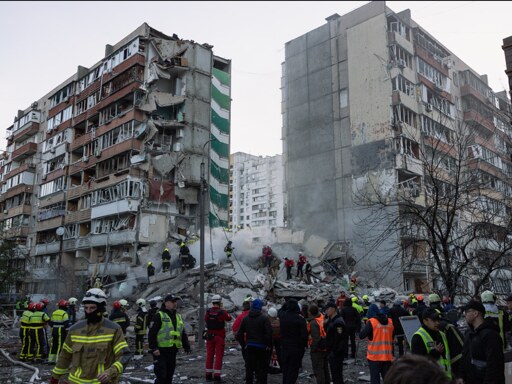
Featured image via Diego Fedele / Getty Images
From Canary via This RSS Feed.