

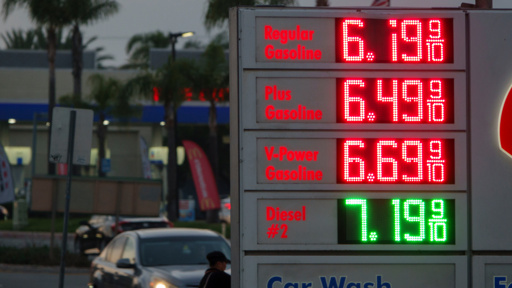
With the average price of gasoline in the United States above $4.50 a gallon — about a 40 percent rise since the Iran war began in late February — Americans have been climbing into their cars less often, and stepping into trains and buses instead. It’s been declared the largest oil supply disruption in history, with U.S. drivers paying $45 billion more for gasoline and diesel compared to last year. Some 44 percent of U.S. adults say they’ve cut back on driving because of high gas prices, according to a survey in late April from ABC News, the Washington Post, and Ipsos.
Cities across the country have seen rising numbers of people riding public transit, from Cincinnati to Los Angeles. Sales of used electric vehicles and hybrid cars have grown substantially over the past couple of months. People are replacing car trips with bikes and scooters; railroads like Amtrak have reported more riders than usual. Much of America is built around highways and suburbs, however, making alternative transportation difficult. So, many people are cutting down on driving without ditching their vehicles, by carpooling, consolidating errands, or working remotely more often.
It could be the start of a green, global shift, according to some experts — even if most Americans eventually end up hopping back in their cars. That’s because the crisis is hitting the hardest in Asia, which was projected to account for nearly all the increase in oil and gas use over the coming decades, but is now rethinking its reliance on fossil fuels.
“If Asia turns around and says, ‘No, we’re not going to grow with fossil fuels, we are going to grow with electrotech,’ that means fossil fuels will peak, and will peak sooner than we think,” said Daan Walter, who leads strategy research on the future of energy for the think tank Ember. “It’s very likely that if this crisis continues to be as bad as it is, and we see this conversion happening, that we’re currently living in the peak year of oil, and that demand will just never come back to the level that it was just before Hormuz closed.”
With roughly 20 percent of the world’s oil shipments choked off in the Strait of Hormuz, households and industries have found ways to use less of it. This can create what economists call “demand destruction” for oil — meaning that the world simply won’t need as much as it used to. The phenomenon is already happening across the globe, according to the International Energy Agency. Last week, the agency reiterated that demand for oil is being destroyed, forecasting a contraction of 420,000 barrels a day this year. It’s a silver lining in an otherwise grim situation: Price shocks driven by conflict in the Middle East are nudging people away from fossil fuels.
While people sometimes use “demand destruction” as a dramatic way to refer to a short-term drop in demand, the phrase more accurately describes a deeper economic shift. “To me, the term demand destruction really only makes sense if you’re talking about it as a longer-term thing. Like, it’s truly destroyed the source of demand,” said Kenneth Gillingham, a professor of environmental and energy economics at Yale University.
The destruction in global oil demand has been concentrated in Asia rather than in the U.S., where the country’s overall wealth enables people to pay more for fuel relative to much of the world, even as it strains the budgets of low- and middle-income Americans. Factories in Japan are producing fewer petrochemical products — demand for naphtha, used to make plastics and chemicals, fell by a quarter year-over-year — amplifying the country’s “long-term declining trend” in oil demand, according to the International Energy Agency. Its report notes that gasoline demand in South Korea fell by about 5 percent as prices rose at the pump, suggesting that behavioral changes are also contributing to demand destruction. As the crisis in the Middle East deepened, South Korean President Lee Jae Myung called for a sharp shift to renewable energy, saying, “Our future will be at serious risk if we continue to rely on fossil fuels.”
Countries and companies are also decreasing their oil use in response to the crisis. Pakistan, the Philippines, and Sri Lanka have all introduced four-day work weeks to encourage fewer commutes.

A woman puts makeup on while riding the D line subway train in New York City on May 15, 2026. Charly Triballeau / AFP via Getty Images
To what extent these fuel-saving adjustments stick around is an open question. President Donald Trump has promised that oil prices will “drop like a rock” once the war in Iran ends. But even after shipping through the Strait of Hormuz resumes, oil supplies could remain tight for months as facilities are repaired and wells get restarted. The Iran war is also the second oil shock in recent years, following Russia’s invasion of Ukraine in 2022, and experts say that this pattern of oil crises is more likely to lead to a prolonged fall in demand.
“If prices are low for a very, very long time, and then you have a shock, it’s easy to write it off as not a big deal, not going to happen again. But if you continue getting shocks, then you’re like, ‘Maybe I should really start thinking about making some changes,’” Gillingham said.
A report from Ember, co-written by Walter, makes the case that the “twin fossil shock” of the 2020s opens up new political possibilities, just as the double oil shocks in the 1970s prompted investments in energy efficiency and nuclear power. “The parallels with the 1970s oil shocks are striking. But so too is the difference,” the authors write. “For the first time, there are scalable, cost-competitive alternatives. Solar, wind, batteries, EVs, and other electrotech offer a permanent route out of fossil dependence.”
The report predicts that Asia, affected the most by the current oil crisis, will fast-track electrification, switching to EVs and pushing liquefied natural gas out of power generation. The first sign that may already be happening: After the start of the bombing campaign in March, China’s exports of solar, batteries, and electric vehicles surged.
“It really shakes countries and companies around the world out of this complacency of thinking that there is a path back to a normal stable fossil system,” Walter said. “Import dependency is just incredibly risky at the moment, and the second crisis kind of confirms that.”
And some of the new routines people adopt during the oil crisis could endure. “A shock like the big increase in gas prices, or an earthquake that closes a freeway, is really helpful in getting people to change behavior,” said Susan Handy, a professor of environmental science and policy at the University of California, Davis. “It is really hard to get people to change behavior without those kinds of shocks — not that we want these things to happen, but it is what pushes behavior change.” When a bridge that collapsed reopens, for instance, most people will go back to driving, but some of them will keep their new biking routine, she said.
So what determines whether a habit sticks? It comes down to what people grow to like, Handy said. People might realize they enjoy riding a bike around town or reading on the bus, as opposed to sitting behind the wheel in traffic, once they have reason to try it. “I think there are probably more alternatives out there than people realize, or the alternatives may be better than they realize,” Handy said. Rising prices can also prompt people to adopt more energy-efficient vehicles or appliances, locking them into lower fuel usage going forward.
Of course, Americans are still driving a lot — and will probably continue to do so. “We’ve seen oil prices go up and down many, many times in our history, even in recent history,” Gillingham said. “Generally, those shorter-term behaviors tend to bounce back to where they were before.”
But in the global picture, it’s looking more and more likely that the second oil crisis in half a decade, at a moment when alternatives to fossil fuels are becoming cheaper and widespread, may lead to more lasting changes, accelerating the decline of oil — and the rise of cleaner replacements. As the author Rebecca Solnit wrote in a recent newsletter: “What if in a decade or a century people remember this as the point when the world really turned away from this filthy, corrupting, unreliable, destructive resource?”
This story was originally published by Grist with the headline The Iran war is destroying oil demand. Could it also spark a shift to clean energy? on May 20, 2026.
From Grist via This RSS Feed.