

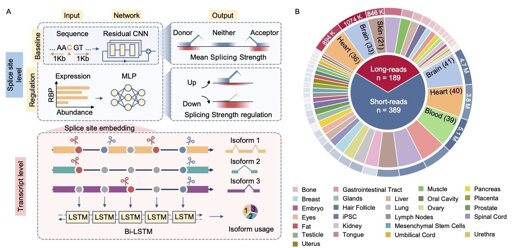
RNA is the means of translating the genetic code embedded in DNA into proteins, which serve as enzymes, transporters, signaling molecules, receptors, structural components, regulators, and gene-expression controllers, among many other roles. Yet one gene is not limited to producing one RNA variant. The process of RNA splicing—in which different coding RNA segments (exons) are joined together after noncoding regions (introns) are removed—allows for the generation of a large array of RNA transcript isoforms with distinct sequences, and consequently, distinct functions in tissue- and cell-type-specific patterns.
From Biology News - Evolution, Cell theory, Gene theory, Microbiology, Biotechnology via This RSS Feed.
You must log in or # to comment.