


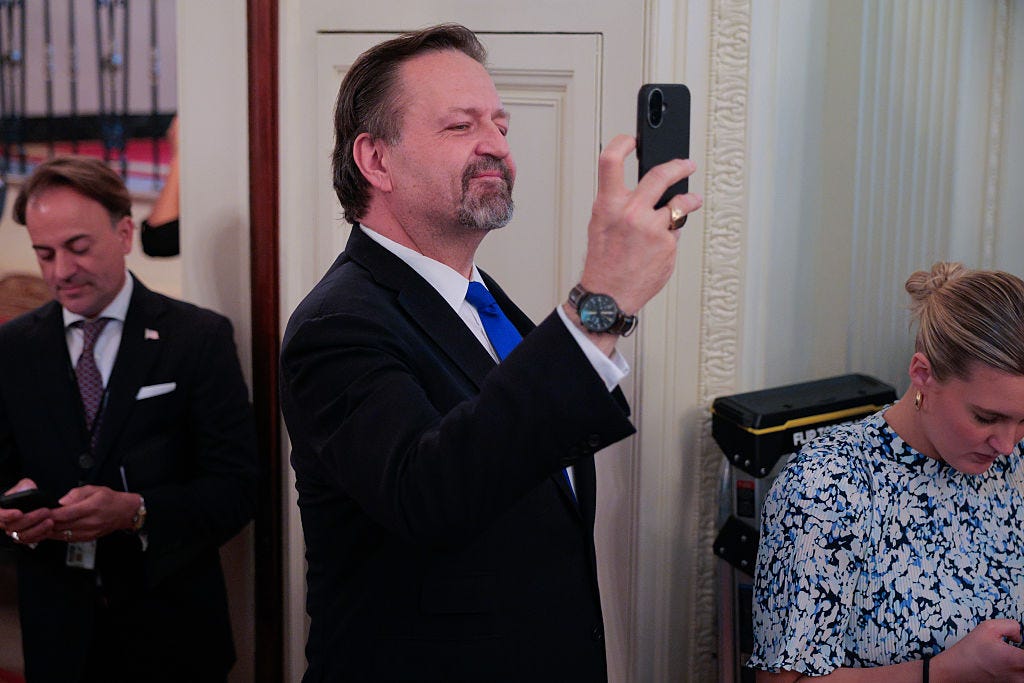
White House counterterrorism czar Sebastian Gorka
The Trump administration is bumping off terrorists at an unprecedented rate, so it says, eliminating 860 across the world since it took office.
“We are bringing down the hammers of hell on our enemies,” White House counterterrorism czar Sebastian Gorka told Newsmax last week.
“Since our first operation on day 11 of this administration, a scant 15 months ago, we have killed 860 jihadis across the globe,” Gorka continued, divulging a number that is normally classified.
And that’s what it’s come down to: numbers. In Gorka’s telling, the bestest, mostest, biggest, and baddest Trump administration has unleashed the dogs of war in a “body count” contest to beat Sleepy Joe Biden. The number is unverifiable by design — targeted killings are rarely disclosed, and when they are, the administration decides how to characterize the targets.
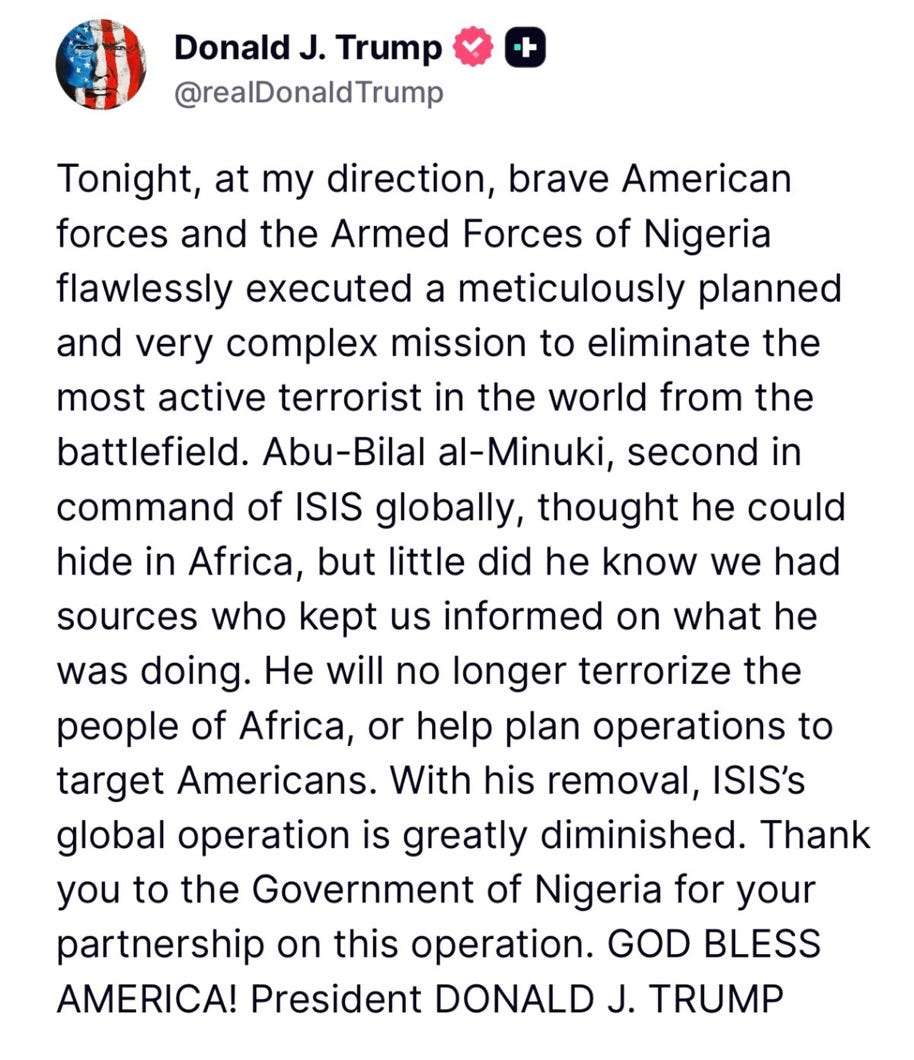
Consider Abu-Bilal al-Minuki. Trump announced in a Truth Social post last week that he’d been killed in Nigeria, the president calling him “second in command of ISIS globally.”
Trump’s Truth Social post
“With his removal ISIS’s global operation is greatly diminished,” Trump said.
This would be a big deal — if it were true.
Trump’s “second in command of ISIS globally” label is, at best, a stretch. It derives from a disputed claim that al-Minuki may have been elevated to head a single ISIS directorate after another figure’s death in March 2025 — a regional bureaucratic promotion that HumAngle, a Nigerian investigative outlet, describes as “a political claim, pitched to an American domestic audience that requires a recognizable villain.”
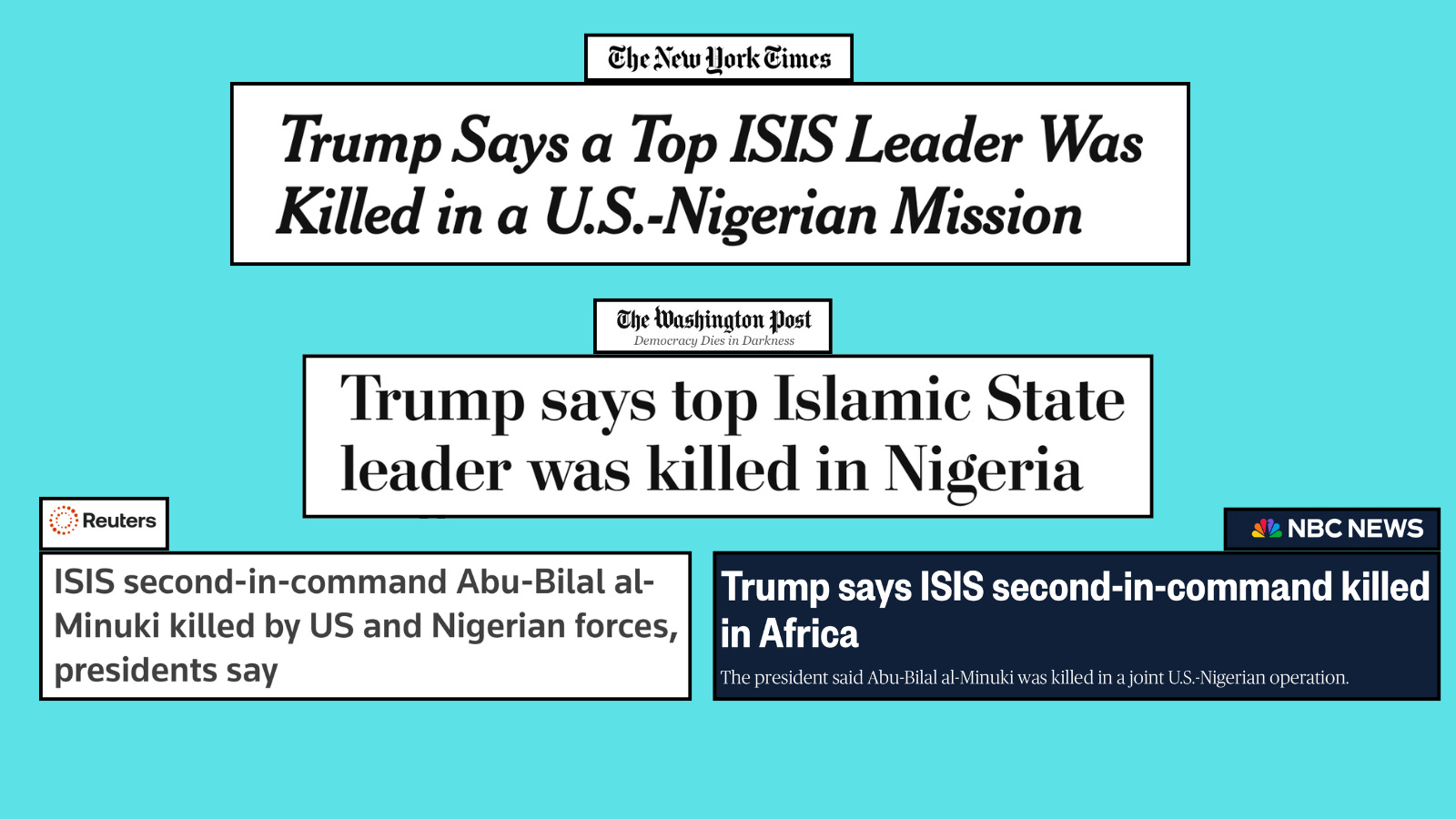
None of this is mentioned in virtually any of the mainstream media reporting on al-Minuki’s death, which dutifully echoes the White House’s “second in command” rhetoric.
Trump says
“Trump Says a Top ISIS Leader Was Killed in a U.S.-Nigerian Mission,” a representative headline in the New York Times reads.
The picture gets more complicated still. Al-Minuki wasn’t some global operative skulking around Africa in hiding, as Trump’s Truth Social post implied (“thought he could hide in Africa”). He was a Nigerian, born in the town of Mainok in Borno State, and killed in his home country. He rose through the ranks of the indigenous Boko Haram movement before pledging allegiance to ISIS in 2015. Describing him as a figure who “hid” in Africa is like saying a Kansas farmer “hid” in the Midwest.
Then there’s the question of what “brave American forces” actually undertook the operation, as Trump brags. The Nigerian military, in its own statement said flatly that there were “no foreign boots on the ground” (which could, of course, be a smokescreen). Though Americans provided intelligence, surveillance, and reconnaissance support, Nigerian forces executed the mission themselves. In other words, the Trump administration helped Nigeria in its own terror war, one that hardly threatens the United States.
Hilariously, the Nigerian military in 2024 actually claimed that al-Minuki had already been killed — a falsehood that lingered until Trump’s announcement. In April 2024, then Nigerian Director of Defense Media Operations Edward Buba publicly announced that al-Minuki had been killed on February 21, 2024, during operations in the Birnin Gwari Forest in Kaduna State. Nigeria’s presidential office, now scrambling to square the two announcements, attributes the 2024 claim to “mistaken identity or misattribution in the fog of sustained counterinsurgency operations.” But this time, Nigeria says, it is “100 percent certain.”
Whoops!
It’s worth noting this kind of uncertainty is a pattern in the game of counterterrorism, not a one-off. Longtime Boko Haram leader Abubakar Shekau was declared dead multiple times across more than a decade. ISIS’s founding caliph, Abu Bakr al-Baghdadi, was reported killed or seriously wounded on several occasions before he actually was killed in 2019.
All of which points to a deeper problem with the Trump administration’s approach to counterterrorism, embodied by Gorka himself. His kill-count boosterism — the “860 jihadis” figure, his repeated boasts about terrorists being turned into “a cloud of red mist” and stacked “like cordwood,” his reported NSC lanyards reading “WWFY&WWKY” (for: We Will Find You and We Will Kill You) — is bluster bordering on desperation. And in the mind of gun-toting yet desk-bound Gorka, it is “information warfare,” a Pentagon source tells me. “Their definition of deterrence is ranting about how tough they are,” the former officer tells me, “even though there’s no evidence ISIS cares about the message.”
Meanwhile, the actual terrorism threat landscape tells a different story than the one Gorka is selling. ISIS and its affiliates remain the world’s deadliest terrorist organization. In Africa alone — the very theater where Trump is claiming his greatest wins — the Islamic State Sahel Province has grown from an estimated 425 fighters in 2018 to somewhere between 2,000 and 3,000 today. In March 2025, ISIS formally launched a new military campaign it called “Burning Camps,” explicitly focused on Nigeria, Niger, Cameroon, and Mozambique. Six of the ten countries most impacted by terrorism globally are now in sub-Saharan Africa.
Expect more of this. Gorka in a recent interview following the release of the National Counterterrorism Strategy remarked: “Now the real work can begin.”
So let’s be clear: The same administration that has spent months decrying the nihilistic assassination culture spawned by Luigi Mangione and the killing of Charlie Kirk is making numbers-driven assassination its official doctrine of statecraft — complete with branded merchandise.
We will find you and make you subscribe
— Edited by William M. arkin
From Ken Klippenstein via This RSS Feed.
Leaves falling could captivate that audience.
