

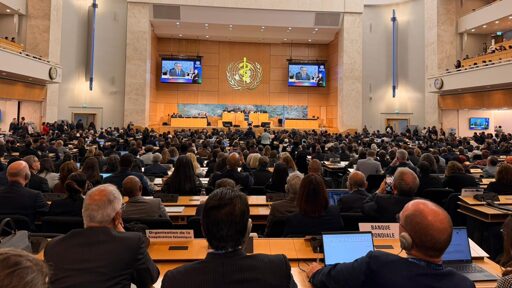
The 79th World Health Assembly (WHA79) will take place from May 18-23, 2026 in Geneva. The meeting is taking place in the context of a World Health Organization (WHO) overburdened by many competing crises, a decreasing budget and staff, and the uncertainties of preparing for the election of a new Director-General in 2027.
For the People’s Health Movement (PHM), Primary Health Care (PHC) as envisioned under the 1978 Declaration of Alma-Ata remains the guiding vision for a just and equitable global health system. Yet the WHO faces a fork in the road as we approach 50 years since the Declaration’s adoption.

Halfdan Mahler, WHO Director-General 1973-1988. Source: WHO Watch team/Gayatri Sharma
What will Member States do to preserve the organization in light of the scorched earth politics of international health funding cuts, efforts to change the global health architecture, and national austerity policies? Will they acquiesce to outside influences that seek to diminish its role as a global health leader – or recommit themselves to those progressive principles of Health for All upon which the WHO was founded?
Reforming the global health architecture
This year, the Assembly will be asked to consider a proposal for a joint process that will transform the global health architecture (GHA). The “joint process” refers to a “structured and inclusive approach engaging Member States, representatives of global health initiatives, United Nations entities, regional health organizations, and other major constituencies, including civil society.” It is aimed at streamlining and increasing the coherence of the many global health actors and reform initiatives currently crowding this space, frequently resulting in unaccountable decision-making power. This fragmentation is not new – it reflects decades of restructuring driven by powerful states, corporations, philanthropic actors, and financial institutions.
The joint process will establish options and recommendations for:
“(i) enhancing the alignment of the mandates and capacities of GHA actors with the essential GHA functions and across global, regional and national levels;
(ii) enhancing coordination and decision-making to strengthen collaboration, accountability and coherence across global, regional and country levels;
(iii) aligning financing with national, regional and global priorities to advance national self-reliance and ensure sustainable and predictable support for global public health goods and regional functions.”
The specific approach for the joint process is not entirely democratic or equity-driven. The joint task force will be composed of 25 members: 14 representatives of WHO Member States (two from each region and two additional members from the regions providing the co-Chairs), five representatives of global health initiatives (Gavi, the Vaccine Alliance; Global Fund to Fight AIDS, Tuberculosis and Malaria; the Coalition for Epidemic Preparedness Innovations; Unitaid; and the Pandemic Fund), four representatives of the United Nations, including WHO, and one representative each of the World Bank and a regional health organization.
Read more: People’s Health Movement at 25: the struggle for Health for All continues
This inordinate prioritization of global health initiatives with very little, if any, space for civil society does not prioritize democratic governance. Although the report itself identifies “risks” associated with the process including “uneven participation” by low and middle-income countries (LMICs) and CSOs, the proffered solutions of “proactive outreach, support… and careful design of task force processes” is insufficient for revitalizing and re-imagining a WHO that works for all. Instead, it sets up the WHO for multistakeholderism.
Financing for justice, not dependency
At the heart of WHO’s embrace of multistakeholderism is its financing model. The dominance of earmarked voluntary contributions has entrenched dependency and distorted priorities. Restoring independence requires increasing assessed contributions and ensuring funding aligns with collective public health needs. Financing should support equitable, sustainable systems rather than short-term, donor-driven outcomes. At the same time, investment must shift toward long-term system strengthening, including health workforce development, infrastructure, and community-based care.
This includes WHO workforce strengthening. Financing should ensure that WHO can staff its various offices with sufficient staff members who have the institutional knowledge, technical skills and working conditions that enable the institution to fulfil its mandate. For example, proposals to reduce “the number of stand-alone technical products (e.g. technical products in the areas of environment, climate change, One Health and migration), while prioritizing fewer, more integrated, higher‑impact guidance outputs aligned with the GPW 14 and country demand”, seem misguided, as this list suggests WHO might neglect key health drivers in future.
Read more: 75 years after its foundation, WHO struggles for sovereignty
Another proposal offers that WHO should be “decommissioning selected in‑house digital platforms, tools, apps and analytical products, where equivalent or superior solutions are available through partnerships, academic institutions or shared platforms, with WHO shifting to stewardship and validation roles.” The embrace of “partnerships” with digital service providers is presented without acknowledging the potential conflicts of interest and complications regarding data ownership that might arise from them.
Re-imagining WHO requires restoring its ability to prioritize based on public health needs rather than donor or market interests. It also demands reaffirming the role of Member States – especially those from the Global South – in shaping global health agendas. WHO must function not only as a technical body but as a normative institution addressing structural determinants of health, including inequitable trade, austerity, and corporate practices. Re-imagining global health governance is not a technical exercise but a political project. The current orientation of re-imagining global health architecture and UN80 must recognize that real transformation depends on confronting entrenched power structures and reclaiming WHO’s foundational principles.
Primary Health Care: a call to action
The radical, transformative vision of PHC has been systematically eroded to a depoliticized, technocratic agenda reducing a revolutionary sociopolitical struggle to a narrow model focused on digital tools, selective interventions, and market-oriented financing.
The PHC progress report informing this year’s discussion (EB158/14) celebrates “catalytic support” for digital transformation and celebrates a package of toolboxes and pilot projects, but fails to identify the active drivers of inequity – land-oppression, neoliberalism and corporate power.
Recent Executive Board resolutions (EB158.R1–R5) deal with highly specific issues like precision medicine, teleradiology, and stroke, which narrow the scope of PHC to ‘essential packages’ that fails to address foundational needs like ambulance services, blood transfusions, and emergency obstetric care, and add to default privatization and catastrophic out-of-pocket expenditure for already vulnerable communities.
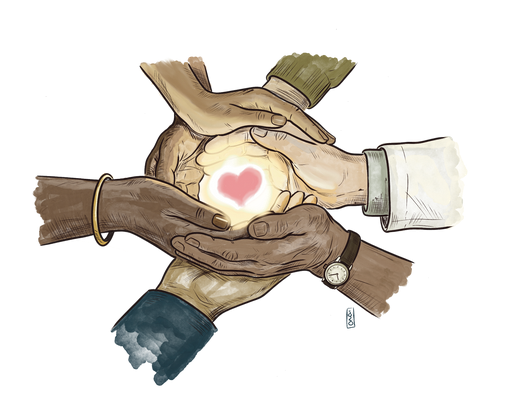
Foundations of PHC. Source: WHO Watch team/Gayatri Sharma
In contrast, the 50th anniversary of the visionary Alma-Ata Declaration and the history that led to the declaration is an opportunity for us to re-imagine health architecture that facilitates bottom-up, community-led, publicly financed, decentralized health systems.
The WHO-Watch team members are Alicia Maldonado, Ben Verboom, Jacob Alhassan, Gayatri Sharma, James Van Duuren, Rahaf Bashir, Chapa Ruberu, Jan Wintgens, and Juliette Mattijsen. To learn more about this year’s program, visit this page.
People’s Health Dispatch is a fortnightly bulletin published by the People’s Health Movement and Peoples Dispatch*. For more articles and to subscribe to People’s Health Dispatch, click* here.
The post Democratizing global health governance: mission impossible? appeared first on Peoples Dispatch.
From Peoples Dispatch via This RSS Feed.