

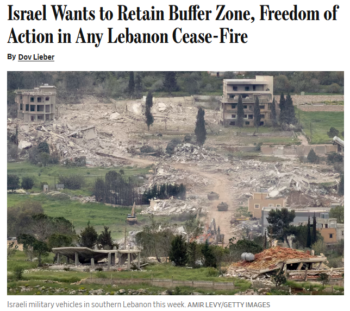
Wall Street Journal (4/16/26): “Israel’s military wants to retain its hold on a deep security buffer zone inside southern Lebanon in the event of a cease-fire with Hezbollah militants.”
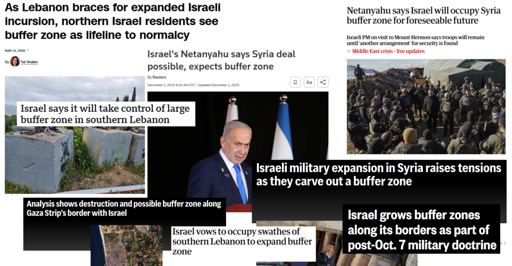
Since October 2023, Israel has occupied vast stretches of territory in Gaza, Syria and, most recently, Lebanon. Corporate media have been reluctant to use clear, direct language to characterize US-backed Israeli land grabs in each of these places, preferring to describe Israel’s policies with euphemistic terminology.
“Buffer” is chief among these. For instance, a Wall Street Journal article (4/9/26) told readers that “Israeli forces now hold buffer zones inside Gaza, Lebanon and Syria.”
Merriam-Webster defines a “buffer zone” as “a neutral area separating conflicting forces.” The UN defines it as “neutral space created by the withdrawal of hostile parties or a demilitarized zone.”
The Journal‘s uncritical use of the term makes it sound as if these Palestinian, Lebanese and Syrian lands are demilitarized zones, when in reality they have been taken over by a belligerent foreign army that intends to remain for the long term.
‘Setting up a buffer zone’
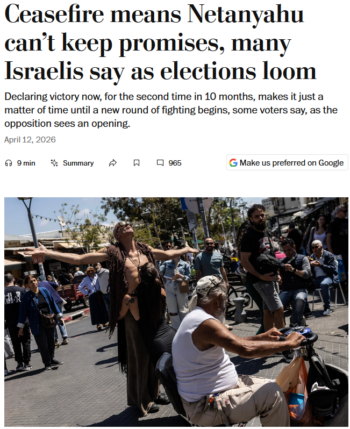
The Washington Post (4/12/26) reports that “Israel is continuing military operations in south Lebanon, where it says a bigger buffer zone is needed to prevent strikes by Hezbollah on northern Israel.” Hezbollah’s missiles have a range of at least 300 kilometers (186 miles), which implies a “buffer zone” larger than all of Lebanon.
A Boston Globe piece (4/5/26) noted that
Israel has said even after the war with Hezbollah, it plans to occupy part of southern Lebanon, setting up a buffer zone inside the area and keeping security control over the territory. Some analysts say that the move could lead to the permanent displacement of communities from the region.
“Setting up” is part of the same obfuscatory process as “buffer zone.” Amnesty International’s Kristine Beckerle (3/6/26) offered this account of the evacuation orders Israel issued to over 100 villages and towns in Lebanon’s south and east, and the entirety of Beirut’s southern suburbs, key components of how Israel has gone about “setting up a buffer zone”:
The sweeping evacuation orders have sown panic and terror, displaced hundreds of thousands of people and fueled yet another humanitarian catastrophe for a population already exhausted and reeling from multiple crises.
And it’s not just “some analysts” who say that creating this “buffer” could lead to “permanent displacement.” Israeli Defense minister Israel Katz (BBC, 3/31/26) said that the state plans to maintain control over Lebanon south of the Litani River, a 19-mile stretch of territory, even after Israel’s current war on the country ends. Katz added that Israel will demolish “all houses” in Lebanese villages near the Lebanon/Israel armistice line, a move that would make the displacement of the residents of those houses seem awfully permanent. That’s not a “buffer zone”—that’s occupation.
A Washington Post report (4/12/26) noted that Israel was “continuing military operations in south Lebanon, where it says a bigger buffer zone is needed to prevent strikes by Hezbollah on northern Israel.” The article amplified Israel’s benign description of its policies in Lebanon without offering anything to contradict this description.
Another Post report (4/20/26) said “the Israeli military published a map Sunday delineating a buffer zone in southern Lebanon that it called a ‘forward defense line.’” By the time this article was published, it was clear that Katz’s threats had been actualized. A team of UN experts described Israeli actions in Lebanon thusly:
The issuance of blanket evacuation orders, combined with the destruction of urban and village housing that displaced persons would have returned to, is consistent with the pattern of domicide that was initiated during the genocide in Gaza.
“Delineating a buffer zone” sounds like part of a peace-making process, but what the UN described were acts of war.
‘Security zone’
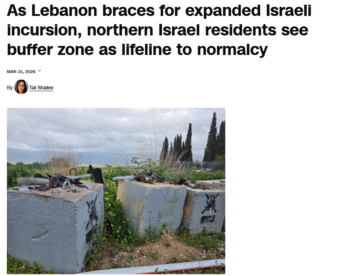
CNN (3/31/26): “Israeli Prime Minister Benjamin Netanyahu announced another expansion of the military buffer zone inside Lebanon to ‘finally thwart the threat of invasion and to push the anti-missile threat away from our border.’”
“Security zone” is another euphemism. Who, after all, wouldn’t want to live somewhere secure? The trouble is that the “security” being created isn’t for the zone’s inhabitants. CNN anchor Lynda Kinkade (4/2/26) told viewers:
The United Nations says more than a million people, that’s about 20% of Lebanon’s population, have now been displaced. Many of them won’t be able to return home right away, even after the war, because Israel plans to set up a security zone in much of the south of Lebanon.
As Human Rights Watch (3/23/26) noted, those displaced people “have sought refuge with friends and relatives or in government-run shelters, or have simply set up camp along the coastline of Beirut, itself the site of a recent Israeli strike.”
In sum, Israeli aggression drove Lebanese people from the south of the country, causing some to camp on a beach that Israel then bombed, and CNN blithely adopted Israel’s language to sanitize it as “set[ting] up a security zone.”
A front-page Chicago Tribune piece (4/17/26) read:
Netanyahu said Israeli troops will stay in an expanded security zone in southern Lebanon “much stronger, more extensive and more continuous than before.”
“That is where we are, and we are not leaving,” he said.
The article offered no counter to Netanyahu’s characterization, nor did it put the term “security zone” in quotation marks. After a two-paragraph interval, the authors wrote, “It’s unclear when the 1 million people displaced by the war will be able to safely return.”
But the million people weren’t simply “displaced by the war.” Nor were they displaced, as in CNN‘s formulation, by some unidentified force. They were displaced by Israel’s US-backed military. Without such obscurantism, the fiction that Israel is simply “setting up a security zone” would fall apart.
Ethnic cleansing erased
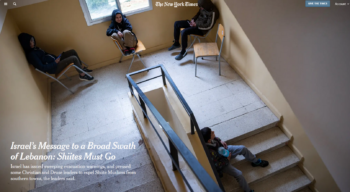
In the New York Times (4/1/26), rather than carrying out ethnic cleansing, Israel is issuing “evacuation guidance.”
Such accounts also omit a rather important facet of what Israel has done in its war on Lebanon, which is to target Lebanon’s Shia Muslims. As Human Rights Watch (3/23/26) pointed out:
On March 16, Israeli Defense Minister Israel Katz said, “Shiite residents of southern Lebanon who have evacuated…will not return to their homes south of the Litani area until the safety of Israel’s northern residents is guaranteed.” Through this lens, the displacement of the Shia population looks less like a temporary military necessity and more like a move to permanently displace the civilian population based on their religion.
“Permanently displac[ing] the civilian population based on their religion” is another way of saying “ethnic cleansing,” a point raised by the UN experts (4/15/26) who condemned Israel’s forced displacements as war crimes and crimes against humanity .
BBC Verify (4/16/26) said that satellite and video images they obtained showed that “towns and villages in southern Lebanon are being leveled by Israeli demolitions.” The outlet quoted professor Ben Saul, UN Special Rapporteur on counter-terrorism and human rights:
In places the pattern of attacks appears aimed to “cleanse” predominantly [Shia] villages and populations from the south, collectively punishing civilian populations within which Hezbollah fighters may be mingled.
A New York Times article (4/1/26) headlined “Israel’s Message to a Broad Swath of Lebanon: Shiites Must Go” painted a similar picture. The paper reported:
In private calls to local leaders across southern Lebanon, Israeli military officials have assured several Christian and Druse communities that they could remain in the evacuation zone. They have pressed them, however, to force out any Lebanese from neighboring Shiite Muslim communities who have sought refuge among them as Israeli bombardments flatten Shiite towns, according to local Christian, Druse and Shiite leaders who spoke to the New York Times. The Shiites make up the majority of southern Lebanon.
Local leaders took the messages as a clear signal: Israel is trying to force out one group in the south—Shiites, who are from the same sect as Hezbollah.
That’s a textbook case of ethnic cleansing—down to the injunction against giving “refuge” to Shia Anne Franks—but the Times inexplicably falls short of using the term.
They are hardly the only corporate media outlet with this failing. I used the media aggregator Factiva to search the New York Times, Wall Street Journal, Washington Post, Boston Globe, Chicago Tribune and CNN for coverage that describes Israeli policy in Lebanon as “ethnic cleansing.” I looked at material published since April 15, the day the UN officials used that term. None of the coverage in that period gave voice to the perspective that Israeli actions in Lebanon constitute ethnic cleansing, even though a search that pairs “Lebanon” and “Israel” returns nearly 1,800 results.
It’s not only the many UN experts who say that Israel is carrying out an ethnic cleansing in Lebanon. That’s the position of Rep. Rashida Tlaib, the Council on American-Islamic Relations and independent journalists based in the region, like Qassam Muaddi (Mondoweiss, 4/4/26) and Lylla Younes (Drop Site, 4/2/26). But it’s a view that’s subject to de facto censorship in the corporate media.
Gaza’s ‘Yellow Line’
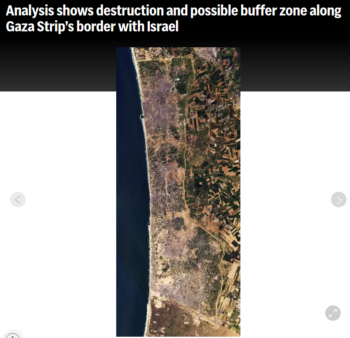
“Buffer zone” appears to be AP‘s language (2/2/24), not the Israeli government’s, as “Israel’s military declined to answer whether it is carving out a buffer zone when asked by the AP.”
Similar rhetorical sleights of hand are at work in coverage of Gaza.
The October 2025 Israel/Hamas ceasefire required Israel to withdraw its troops beyond a boundary in Gaza called the “Yellow Line.” Under the agreement, Israel’s presence in Gaza is supposed to be temporary, but Israeli military chief Eyal Zamir called the Yellow Line “a new border” on which the Israeli military “will remain”; this location gives Israel control of most of Gaza, including the majority of its agricultural land as well as its border with Egypt (Guardian, 12/8/25).
In the same vein, Katz (Ynet, 12/25/25) said that “Israel will never leave Gaza territory. There will be a security strip surrounding inside Gaza to protect the settlements.”
Israel has frequently moved the yellow blocks demarcating the line deeper into Gaza, producing what the UN called “‘new waves’ of displacement.” By January 2026, 16 Israeli occupation forces’ positions had been moved to take control of more Palestinian land (BBC, 1/15/26).
Katz (BBC, 1/15/26) also said that anyone who crossed the Yellow Line would be “met with fire.” Because of the constantly shifting line, many of Gaza’s residents are “struggling to know” where what Israeli occupation forces call a “dangerous combat zone” begins, where they might be killed without warning.
As of late April, Israel had killed over 700 Palestinians during the supposed “ceasefire,” 269 of whom were shot near the Yellow Line, more than 100 of whom were children (Guardian, 4/22/26). That Israel’s stated policy is to remain in the Gaza Strip, and to shoot Palestinians who approach the ever-shifting Yellow Line, suggests de facto Israeli annexation of the majority of Gaza (Al-Shabaka, 4/21/26; Euro-Med Human Rights Monitor, 4/16/26).
Nevertheless, coverage such as that from Associated Press (1/18/26) and Reuters (4/29/26) referred to a “buffer” in Gaza, even as these sources report on aggressive Israeli violence and land theft.
Corporate media have tended to avoid language like “annexation” or even “occupation” to describe Israeli policy in the “Yellow Line.” I used Factiva to search Gaza coverage in the New York Times, Wall Street Journal, CNN, Associated Press and Reuters from the beginning of the year through the time of writing on May 12. The outlets ran a combined total of 4,863 pieces that refer to Gaza, but none engaged with the idea that Israel is attempting to annex part of the Strip.
Of these pieces, 853 (less than 18%) included variations on the term “occupied,” such as “occupation” or “occupying forces.”
Erasing occupation in Syria
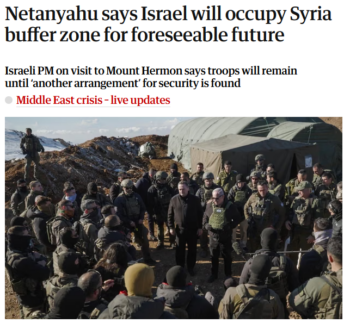
Guardian (12/18/24): “Benjamin Netanyahu has said Israeli troops will occupy a recently seized buffer zone in Syria for the foreseeable future.”
Discursive parallels in Syria coverage are hard to miss.
Israel has illegally occupied and settled Syria’s Golan Heights since 1967, declaring it had annexed the nearly 500-square mile territory in 1981, in violation of international law. Since the Assad government fell in December 2024, Israel has “effectively taken control” of several southern Syrian towns, “in a widening military occupation that shows no sign of reversing” (+972, 12/23/25). Notably, Israel took Syria’s strategically significant Mount Hermon immediately after the change of regime (CNN, 12/17/24).
To do so, Israel launched airstrikes throughout Syria, invading with ground troops, occupying territory in violation of the 1974 Israel/Syria disengagement deal, “confiscating land and homes, killing farmers,” sowing sectarian discord and “expanding [Israeli] road networks and other communications infrastructure” (+972, 4/10/25).
By late 2025, the Israeli army had “set up seven or eight permanent bases” (Le Monde, 11/10/25) in Syria. Israel now occupies 177 square miles more Syrian territory than it did when the Assad government was in power (Truthout, 4/28/26).
Over the period of this land grab, outlets like CNN (3/13/26) and Reuters (4/19/26) have called the Israeli-held territories in Syria a “buffer,” while the New York Times (7/15/25) and Reuters (8/25/25) have labelled them a “security zone.”
I used Factiva to search CNN, New York Times and Reuters coverage of Syria and Israel since the Assad government’s overthrow, and there were 3,127 results. When I added some version of “occupation,” “occupied” and “occupying,” I got only 427 hits, or 14% of the results.
To see how much of the coverage that includes references to occupation mentions not only the long-standing occupation of the Golan Heights, but also Israel’s more recent usurpations of Syrian land, I expanded the search terms to include variations on the phrase “southern Syria.” I got 43 results, or 1% of all articles with the words “Syria” and “Israel.” In other words, 99% of the material that refers to both Syria and Israel failed to clearly state that Israel has used the post-Assad period to dramatically expand its military occupation of the southern portion of the country.
US corporate media consistently muddy Israeli expansionism in Gaza, Syria and Lebanon through a combination of abstruse language and linguistic balms like “buffer zone” and “security zone.” That doesn’t ensure that the US populace will continue to allow their government to go on underwriting such crimes, but obscuring occupation with euphemisms makes it harder for readers to see that that’s what’s happening.
From FAIR via This RSS Feed.
You must log in or register to comment.