

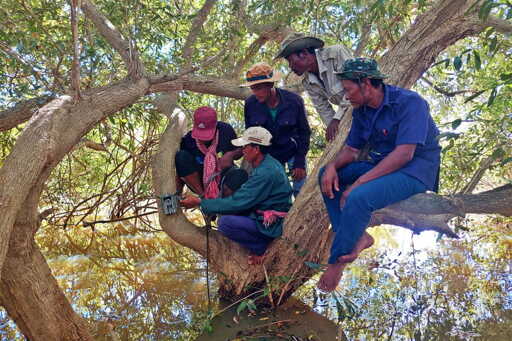
“When the forest [is] healthy, fish can breed and grow. But if the forest burns, the fish disappear — and that affects the livelihoods of our whole community,” says Luon Chanleng, a fisher from Tonle Sap. “I can’t imagine our life without the forest.” Tonle Sap in Cambodia is the largest freshwater lake in Southeast Asia. Each year, when the dry season sets in from around January to June, the waters of the flooded forest recede, the mangrove roots poke out through the mud, and the flooded forest turns into a tinder box. More than a million people live around the lake and depend on it for their livelihoods, homes and nutrition. Yet, the freshwater mangroves or “flooded forest” that surround the lake are shrinking. A study by the Wonders of the Mekong project, led by the University of Nevada in the U.S., found that nearly a third of forests in flood plains like the Tonle Sap area were lost between 1993 and 2017. “It primarily seems to be driven by two activities: One is conversion of flooded forest for agriculture, and then the second is forest fires,” says Zeb Hogan, director of the Wonders of the Mekong project. Now, the Tonle Sap community is fighting back. Seventy-eight people, including Luon, have trained as community firefighters, and are now using satellite wildfire alerts to help them curb the devastation. According to records kept by U.S.-based NGO Conservation International, which receives the satellite alerts and forwards them to the patrol team,…This article was originally published on Mongabay
From Conservation news via This RSS Feed.