

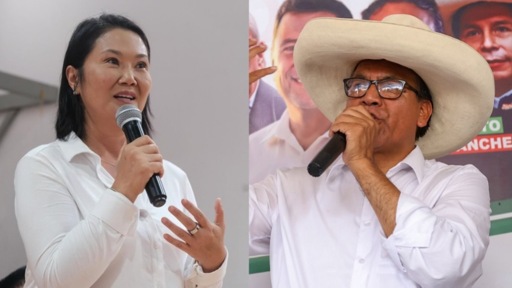
After the slow vote count in Peru was completed, the National Office of Electoral Processes (ONPE) announced on May 15, the two winners of the April 12 elections, who will compete for the presidency of the Andean nation on June 7.
With 100% of the votes counted, right-wing candidate Keiko Fujimori of the Popular Force Party received 17.19% of the valid votes, or 2,877,678 votes. In second place, after a close race, is the leftist Roberto Sánchez with 12.03%, or 2,015,114 votes. In third place, and with no chance of advancing to the runoff, is the far-right Rafael López Aliaga, with 11.92%, or 1,993,905 votes. In fourth place is the center-right Jorge Nieto, with 10.97%.
With the vote highly fragmented among nearly thirty candidates, the vote count was fraught with controversy and disputes. At first, businessman López Aliaga, the former mayor of Lima, appeared poised to advance to the runoff, but as votes from rural areas began to come in, Sánchez began to climb in the rankings before the astonished eyes of Peru’s right wing, which watched as the party of former President Pedro Castillo (imprisoned for attempting to convene a constituent assembly) once again made it to the runoff in consecutive elections.
López Aliaga quickly declared that it was electoral fraud, although he presented no evidence to that effect. He promised a popular mobilization and money to anyone who could prove the fraud. The pressure reached a climax (and remains unresolved) when the Prosecutor’s Office sought Sánchez’s imprisonment for failing to report income to his party, a charge the candidate has categorically denied.
Two very different government agendas
While the controversy between Sánchez and López Aliaga was being resolved, Fujimori, the daughter of former Peruvian dictator Alberto Fujimori, took advantage of the situation to campaign. Now that she knows she will face a candidate from a party that defeated her in the last election, Fujimori is focusing on a message of national unity.
“Today I call on you to transform fear and disappointment into action and hope … It is a choice between continuing to live in chaos or restoring order,” said Fujimori, who has questioned the electoral process and described it as “irregular,” which, Fujimori claimed, “damages democracy and affects Peruvians.”
Fujimori has established herself as one of the most consistent Peruvian politicians of recent decades. This will be her fourth runoff election. She has lost all of them, though she has managed to remain among the political elite by championing her father’s controversial legacy, which combined a heavy-handed approach toward his opponents with the radical implementation of a neoliberal program known as “Fujishock.”
Keiko has promised to take a hard line against crime (one of Peruvians’ main concerns) and to further neoliberalize the Peruvian economy – an approach that, while it has allowed her to retain the support of Fujimori’s core base, has also sparked strong opposition against her, which explains her three presidential defeats.
On the other hand, the leftist Sánchez, who had known for several days that the polls would give him an insurmountable lead over López Aliaga, has so far based his campaign platform on continuing the project initiated by Pedro Castillo, which was abruptly halted by Dina Boluarte’s inauguration and the subsequent crackdown on protesters, which left at least 50 dead during the several months the protests lasted.
During Castillo’s administration, Sánchez served as minister of Foreign Trade and Tourism. He was subsequently elected to Congress in the 2021 elections to serve until 2026, a position he left to run for the presidency.
The 57-year-old candidate for Together for Peru has called himself the candidate of “Castillism” and has promised to free Pedro Castillo from what he considers a purely political conviction, as well as to convene a Constituent Assembly “for the people.”
“The time has come for a true rebirth of our nation: a sovereign, just nation built from the ground up by the Peruvian people,” declared Sánchez, a psychologist by profession, after learning of his lead of more than 20,000 votes over López Aliaga.
Thus, while Keiko Fujimori appears set to appeal to the unity of sectors opposed to former President Castillo, promoting a discourse of “alert” in the face of the return of the Peruvian left, Sánchez is focusing on campaigning in Peru’s poorest areas and declaring his intention to “rebuild the nation” with a firm foundation in “the rural left,” as he has stated at several rallies.
The national government agendas presented by both candidates appear to be worlds apart. Fujimori advocates for more aggressive privatization and the strengthening of neoliberal institutions in the face of the threat from the left. Sánchez, on the other hand, proposes a restructuring of the entire institutional framework and the nationalization of natural resources “that belong to the people,” he stated.
Ultimately, Peru will have to choose between two clearly distinct models, in which political ideology cannot be hidden, nor can the material interests that underpin them, whether those of large business groups or of a rural population that feels displaced from the history of one of the region’s largest countries.
The post Sánchez and Fujimori to face off for Peru’s presidency appeared first on Peoples Dispatch.
From Peoples Dispatch via This RSS Feed.