

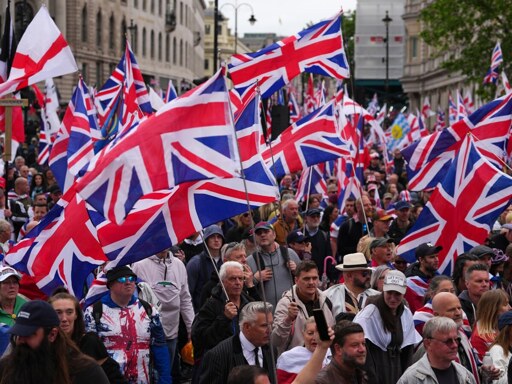

Populism has become the dominant political mode of the present moment, across the Western political spectrum. Contemporary Britain is a particularly clear example: Reform UK now polls consistently among the largest parties in the country after witnessing massive electoral success in the May 7 council elections; the parliamentary left has fragmented across multiple vehicles; the Starmer government is collapsing in real time under a sequence of scandals it cannot contain. Each of these phenomena is, at root, a response to the material conditions that have been deteriorating for over a decade.
As previous Canary coverage of Britain’s housing and cost-of-living crisis has set out, the conditions themselves are not in dispute. Everyone agrees, to some extent, that something has gone wrong. Wages have stagnated. Housing is unaffordable. The basic means for a dignified life have deteriorated to a point the political class can no longer credibly deny.
But what is increasingly in dispute across the left is whether populism, in either of its flavours, is structurally capable of addressing these crises.
The left-right axis as a smokescreen
Populism is not a solution, but rather relies on the existence of the problem. The function of populism is to translate and situate every political question into a left-right binary, and to abstract that binary from the class relations within which the underlying problem is actually located.
Housing becomes a question of generational unfairness (boomers versus zoomers) rather than of landlords and tenants. Immigration becomes a question of race and national identity rather than of labour markets and wage suppression. Inflation becomes a question of who is ‘out of touch’ rather than of monetary policy, supply chains or rent extraction. The result is a politics that produces enormous quantities of affect and almost no material adjustment at the level of the political.
What is most striking about this mode of politics is how symmetrically it operates across both flanks of the political spectrum. Right-populism and left-populism rely on the same operational logic: an identifiable enemy, a flattering self-image for the voter who bows his head, and a permanent state of grievance that justifies the next campaign. Neither is equipped to dissolve the conditions producing the grievance, because to dissolve them would be to dissolve the very conditions that enable populism to exist and thrive.
A Reform UK whose voters were no longer angry about immigration would cease to be Reform UK. A left-populism whose voters were no longer angry about billionaires would cease to be a left-populism. The grievance is the movement’s reason for existing.
What Blair gets right
The point has been made with some clarity by Tony Blair, whose 2024 book On Leadership devotes considerable space to the populist phenomenon. Populism, according to Blair, is the politics of activism mistaken for the politics of leadership. It identifies a problem, attaches an enemy to it, and substitutes the noise of grievance for the slower work of decision.
Its practitioners confuse the volume of feeling for the weight of analysis, and the certainty of being against something for the harder business of being for something concrete. The populist, Blair argues, is structurally dependent on the conditions he claims to oppose, because his political identity ceases to be the moment those conditions are resolved.
Blair’s diagnosis, as far as it goes, is correct. What it cannot account for is why populism has become as electorally dominant as it has. An answer is that the political project Blair himself led created the conditions for populism by steadily removing class from the vocabulary of British politics.
When New Labour declared, in various ways, that class was an outdated category and that we are all middle class now, it did not abolish the material language of class. Instead, it destroyed the political language through which those relations could be conceived and contested. The vacuum that cultural shift left was filled, predictably, by American-style ‘culture wars’ and moralism.
The Starmer government – which has styled itself as a kind of “New New Labour” and insists that the party has been transformed “from a party of protest to one that always puts the interests of the country first” – is now governing within the vacuum the original New Labour produced. The collapse in its standing is not principally a matter of management. It is the consequence of what happens when the tradition that emptied politics of class returns to administer the resulting conditions.
The case for a materialist politics
Deng Xiaoping is not a figure the British left has historically embraced. But the formulation attributed to him – that it does not matter whether a cat is black or white, provided it catches mice – captures the materialist principle populism elides. Namely, that politics, at its most useful, refers to the practical adjustment of material conditions. The question is not which identity coalition wins the argument, but whether housing becomes affordable, whether wages rise in real terms, whether the working day shortens, whether the basic conditions of a dignified life are restored to the people whose labour builds and sustains Britain.
A politics organised around questions of economic justice is necessarily a class politics. It is concerned with who owns what, who works for whom, who decides what is built and where, and who carries the cost when that arrangement falls. The left-right axis upon which populist discourse resides is, in relation to those questions, almost entirely beside the point. The populist surge of recent years has, in the aggregate, been a sustained vote against the present economic settlement. Whether it has produced any meaningful alternative is a question the British left will have to confront more directly than it has so far.
Featured image via Carl Court/Getty Images
From Canary via This RSS Feed.