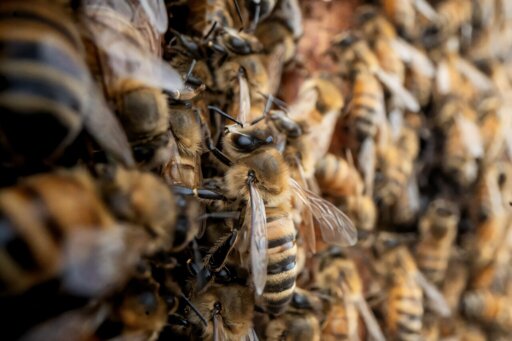
In a lot behind a disused West Virginia gas station at the foot of the Appalachian Mountains, Roy Funkhouser is surrounded by about a dozen beekeepers and countless buzzing bees.
From Biology News - Evolution, Cell theory, Gene theory, Microbiology, Biotechnology via This RSS Feed.
Years ago, some university cracked colony-collapse-disorder…
& … the world has ignored that, ever since…
I asked an LLM to find the research I’d remembered seeing announced…
The key link is at the bottom of this comment, after the LLM’s stuff…
The research study you are referring to was published in October 2010 in the peer-reviewed journal PLOS ONE (Bromenshenk et al., 2010).
The academic institution behind the lead author was the University of Montana (specifically led by entomologist Dr. Jerry Bromenshenk), who teamed up with researchers from the U.S. Army’s Edgewood Chemical Biological Center (Bromenshenk et al., 2010).
The study, titled “Iridovirus and Microsporidian Linked to Honey Bee Colony Decline,” investigated the mysterious sudden disappearances of worker bees known as Colony Collapse Disorder (CCD) (Bromenshenk et al., 2010).
The Two Pathogens Identified
Using mass spectrometry-based proteomics to analyze the proteins of healthy versus collapsing hives, the research team discovered a lethal “one-two punch” combination of a specific virus and a specific fungus (Bromenshenk et al., 2010):
- The Virus: Invertebrate Iridescent Virus (IIV) (specifically linked to Iridoviridae, a group of DNA viruses) (Bromenshenk et al., 2010).
- The Fungus: Nosema ceranae, a single-celled microsporidian fungus (or gut parasite) that destroys a bee’s digestive system (Bromenshenk et al., 2010).
The “Co-Infection” Theory
< snipped-out sycophancy nonsense > The researchers noted that while both the virus and the fungus could be found individually in healthy or mildly weakened colonies, the co-occurrence of both pathogens was a consistent marker of completely collapsed CCD hives (Bromenshenk et al., 2010).
In their controlled laboratory cage trials, the team found that a dual infection was significantly more lethal to the bees than either pathogen acting alone, suggesting a destructive synergistic relationship where the combination breaks down the honeybee’s system entirely (Bromenshenk et al., 2010).
Subsequent Scientific Context
While this study made major headlines in 2010 (with prominent features in The New York Times and PBS News), it is worth noting that follow-up studies by other global institutions struggled to replicate the exact results regarding the Iridescent Virus (McInnis et al., 2020). Today, the broader scientific consensus views CCD not as the result of a single definitive pairing, but as a complex phenomenon caused by multiple compounding stressors—including the Varroa destructor mite, nutritional deficits, habitat loss, and pesticide exposure (Taylor; US EPA, 2025).
References
Bromenshenk, J. J., Henderson, C. B., Wick, C. H., Stanford, M. F., Zulich, W. A., Jabbour, R. E., Deshpande, S. V., McCubbin, P. E., Seccomb, R. A., Welch, P. M., Williams, T., Firth, D. R., Skowronski, E., Lehmann, M. M., Bilimoria, S. L., Gress, J., Wanner, K. W., & Cramer, R. A. (2010). Iridovirus and microsporidian linked to honey bee colony decline. PLoS ONE, 5(10), e13181. https://doi.org/10.1371/journal.pone.0013181 Cited by: 344
McInnis, J. L., Williams, T., Chuang, Y.-C., & Gregg, D. A. (2020). Replication of invertebrate iridescent virus 6 (IIV-6) in European honey bees - potential involvement in colony collapse disorder? Southwestern Entomologist, 45(2). Cited by: 0
Taylor, A. (n.d.). Colony collapse disorder and how to mitigate losses. DigitalCommons@UNL. Cited by: 0
US EPA. (2025). Colony collapse disorder. United States Environmental Protection Agency. https://www.epa.gov/pollinator-protection/colony-collapse-disorder
Here’s the key link: https://journals.plos.org/plosone/article?id=10.1371%2Fjournal.pone.0013181
Do ANYTHING you have to, to prevent those 2 evils, & your hives hopefully will be able to survive…
_ /\ _