

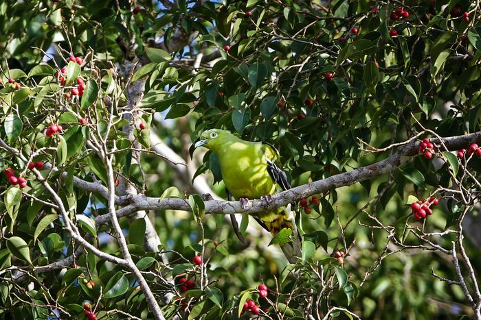
The extremely rare Timor green pigeon has fewer than 500 individuals left in the wild, according to a recent study. Researchers say its extinction risk must be revised from endangered to critically endangered. The fruit-eating Timor green pigeon (Treron psittaceus), known for its distinctive mango-green plumage, is “endemic to Timor, Rote and adjacent satellite islands” in eastern Indonesia and Timor-Leste. Once numbering in the tens of thousands, the bird’s population has suffered over recent decades. The species is currently classified as endangered on the IUCN Red List, with an estimated global population of 660-2,000 mature individuals. However, by compiling published observations and data from field surveys conducted from 2002-2025, researchers now conservatively estimate that only 100 to 500 individuals remain globally. The species is now considered nearly extinct in Indonesia, with no records in West Timor since 2005 and none in Rote since 2009. “While there has been loss of forest habitat on Timor and Rote islands over the past 100 years or so, hunting over recent decades is responsible for the catastrophic collapse of Timor green pigeon populations,” lead author Colin Trainor of Charles Darwin University, Australia, told Mongabay. The bird is particularly vulnerable due to its lack of a flight response. Hunters in Lautem district in eastern Timor-Leste call the bird tule (meaning deaf) because the flock often continues to feed even after rifles are fired, allowing several birds to be shot in a single session , the authors wrote. Jafet Potenzo Lopes, study co-author from Conservation International, told…This article was originally published on Mongabay
From Conservation news via This RSS Feed.