

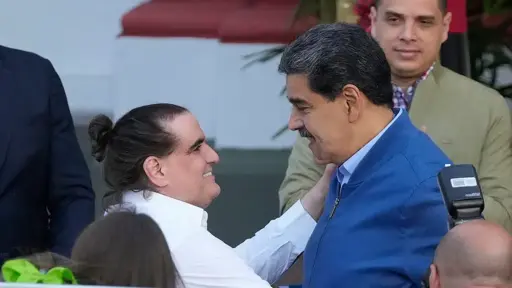
Caracas (OrinocoTribune.com)—On Monday, Venezuelan Acting President Delcy Rodríguez stated that “Alex Saab is a Colombian citizen, he held positions in Venezuela, and these are matters between the United States of America and Álex Saab,” after being asked about the deportation of the former Venezuelan minister for industry and ambassador to the African Union.
“We made an administrative deportation measure, justified in national interests,” she added.
“I want to tell Venezuela, all Venezuelans, that any decision the national government makes will be in the interest of Venezuela. Every decision from now on, and every decision we have made since we took office after January 3rd, has been in the interest of Venezuela, to defend Venezuela,” Rodríguez claimed.
She added, “We think of nothing other than the interests and rights of Venezuela, protecting our country, guaranteeing tranquility, peace, development, the future of our children, and ensuring the hope of our people.”
On Saturday, May 16, Venezuela announced the deportation of the former high-ranking official, making clear he is a Colombian citizen. The official statement added a controversial detail, indicating that Saab “is involved in various crimes in the United States, as is public, notorious, and widely reported.” This rationale contradicts the stance maintained by the Venezuelan government for over five years during and after the international #FreeAlexSaab campaign, which successfully sought his release from a US prison.
The campaign mobilized a majority of Venezuelan solidarity organizations around the world, eventually contributing to the Biden administration’s decision to pardon Saab as part of a high-level prisoner swap operation.
Diosdado Cabello’s statements
Also on Monday, the first vice president of the United Socialist Party of Venezuela (PSUV), Diosdado Cabello, stated that Saab’s deportation complies with the current legal framework and is based on the precepts of the Venezuelan Constitution. He insisted that Saab does not possess Venezuelan nationality and that civil identification records do not contain any file certifying his status as a native of the country.
Cabello explained that Saab entered and operated in Venezuela using a fraudulent identity document with an issuance date of 2004, which lacks legal support from the Administrative Service for Identification, Migration, and Foreigners (SAIME). This revelation surprised many Venezuelans, given that the government had previously appointed him as an ambassador and cabinet minister despite years of media reports of his foreign status, among other claims.
He added that when questioned by Venezuelan authorities, Saab could not provide basic information regarding how he obtained the document, nor could he recall its number. This triggered an investigation into various types of alleged fraud.
Minister Cabello invoked Article 271 of the Constitution to support the action, which expressly prohibits denying the extradition of foreign citizens accused of international crimes such as money laundering, drug trafficking, organized crime, and offenses against human rights or the public assets of other nations. However, hours later, Acting President Rodríguez categorized the measure as a deportation procedure rather than an extradition. On several occasions during his statements, Cabello also labeled the decision as a deportation.
Extremely controversial decision
Analysts claim that the decision to deport Saab to the US marks a breaking point between the Venezuelan government, international solidarity organizations that supported the Bolivarian Revolution, and Chavistas within Venezuela.
They argue that the actions taken against Saab contradict years of international solidarity work and jeopardize future efforts to launch a similar campaign to secure the release of Deputy Cilia Flores and President Nicolás Maduro. The couple are currently held captive in the US following their kidnapping during the US military invasion of Venezuela on January 3.
For these analysts, Monday’s statements by Cabello and Rodríguez worsen an already volatile situation. They argue that claiming Saab is not a Venezuelan national sends a message of institutional inefficiency that is difficult to believe. Furthermore, the contradictory labeling of the action as both a deportation and an extradition creates a legal mismatch that highlights a rapid deterioration in the Venezuelan government’s communication strategy following the events of January 3.
Most experts agree that since January 3, the Venezuelan government has lost significant sovereign decision-making capacity, viewing the decision to deport Saab as clear evidence of this shift.
In recent months, some analysts characterized the situation faced by the Chavista government led by Delcy Rodríguez as a strategic retreat under US military threats. However, several observers have abandoned that framing, bluntly labeling the current status of the Venezuelan people and their government as a new form of colonial protectorate.
Despite this, many Chavistas still hope that the Venezuelan government will address the situation more effectively by presenting the country’s reality without euphemisms. They call for an intelligent communication strategy to explain why these controversial decisions are being made and to clarify the administration’s long-term plans.
Special for Orinoco Tribune by staff
OT/JRE/SF
From Orinoco Tribune via This RSS Feed.