

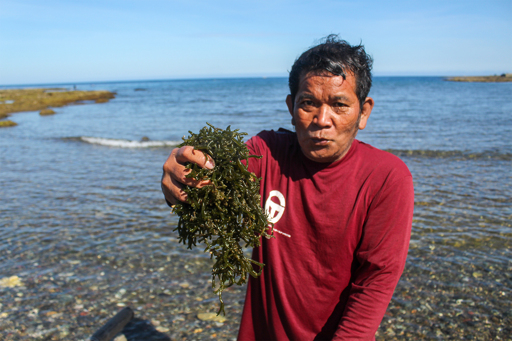
PASUQUIN, Philippines — Crouched on the beach under the hot noon sun, a fisherman flattens a black sheet of seaweed on a bamboo mat rolled out on the sand. Wearing a straw hat wide enough to shade his entire body, he tucks his legs in to avoid getting burned. Gamet, a rare and coveted variety of seaweed local to the coasts of the Philippines’ Ilocos Norte province, is both a staple to fishing communities and a popular souvenir for travelers. But harvesting the highly sought-after seaweed can be a dangerous task. Like the better-known nori, it belongs to the Bangiaceae family of red algae and grows exclusively on the sharp, pointed rocks along the cooler waters of the northern Philippine coast. At the other end of the beach, Ed Singson, leader of the local fishing association, has just come ashore with a bucket of fresh gamet. Taking a handful of seaweed from his bucket, he says, “We will protest on the seas for this if we have to.” Singson, 55, and his fellow fisherfolk have learned from local authorities about plans by a foreign company to build a vast stretch of offshore wind turbines on traditional fishing grounds. They say they fear the construction, vibrations and, eventually, the completed structures could disrupt their fishing routes and local marine life. A fisher in Burgos, Ilocos Norte, flattens a sheet of Gamet to dry on the beach. Image by Michael Beltran for Mongabay. ‘Renewable energy capital’ Ilocos Norte, the northwestern tip of…This article was originally published on Mongabay
From Conservation news via This RSS Feed.
It’s funny that they actually use windmill farms here to farm seaweed.
