

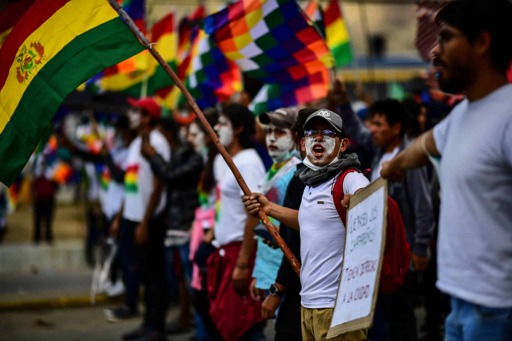
In the six months since Rodrigo Paz was elected president, his administration and the business elite have demonstrated their true agenda: to dispossess peasant and Indigenous lands, plunder natural resources, privatize public companies, and throw the country into debt, all while cutting taxes for big business. It’s no wonder that protesters are crying “Out with Paz!” during recent marches and blockades.
Workers, farmers, teachers, and neighborhood associations have taken to the streets, organizing against cuts to healthcare and education, land dispossession, and wages that do not keep pace with inflation. Protesters have faced a violent response from military and police, which which left four dead on May 16. Just as the working people resisted the de facto regime of Jeanine Áñez in Senkata and Sacaba, today we resist at every roadblock.
In the initial battles against Paz’s neoliberal austerity policies, such as the fight against Decree 55031One of the main decrees that ignited the current uprising in Bolivia, Decree 5503 doubled fuel prices overnight by eliminating state subsidies, imposing unaffordable costs on the country’s workers and peasants. and Law 17202Law 1720 is a land privatization effort, enabling small agricultural landowners to convert their holdings into larger commercial properties., some labor leaderships have betrayed the mobilized rank and file, colluding on decrees and bonuses and attempting to demobilize them.
We demand: No more backroom deals! We need open assemblies in every union, federation, and from the Bolivian Workers’ Center3The largest trade union federation in Bolivia (COB) as the centralizing bodies for the struggle of all sectors in movement and for the control of the grassroots. Every agreement must be approved by the rank and file in an open assembly.
We must strengthen the mobilization by incorporating into the COB’s unified platform the demands of various sectors in conflict, such as the demands for job security and against layoffs for workers at the Saca Churo and La Paz Limpia landfills in La Paz, the Trebol plant in El Alto, cable car workers, La Francesa and Incerpaz factory workers, SABSA (NAABOL) airport workers, and other isolated struggles.
Only by uniting and coordinating our struggles can we successfully impose our demands on employers and the government. In every workplace, in every mine, in every factory, we must engage in a general strike. We call for the organization of Action and Defense Committees to coordinate the struggles for the COB’s list of demands with the demands of peasants, Indigenous peoples, and students.
Business Owners Must Pay for the Crisis
We fight against austerity measures, the gas price hike, Law 1720, the defunding of education and healthcare, and tax cuts for the wealthy. We also fight to address the underlying problem which is the capitalist crisis. And those who must pay for it are the business owners, not the working people.
In this sense, we not only defend the collective gains that are currently under threat, but also assert that there is another way out: a state monopoly on foreign trade, nationalization of the banks under collective workers’ control, and nationalization of private mining under workers’ and community management. We propose the reversal of large landholdings and the nationalization of agribusiness, so that the land is managed collectively by Indigenous and peasant communities. We also demand full respect for the right to self-determination of all Indigenous and native peoples and nations.
The struggle we propose from the revolutionary Left is to expropriate the big businessmen who benefit from thousands of hectares of land — like Branko Marinkovic who, as a minister in the Áñez government, facilitated the titling of 33,000 hectares in favor of his family company, Laguna Corazón. These businessmen also flee capital to tax havens (between 2009 and 2024, the private sector registered a negative balance of $32 billion) and benefit from the bankruptcy of banks like Banco Fassil.
It is also crucial to consider how we transform experiences of self-organization into a democracy based on the power of workers, in the management of factories, mines, agribusiness, banks, and the country. There is no way to generate profound transformations from a sham democracy that prohibits the electoral participation of some political forces.
This is about opening up political participation. All elected officials must be subject to recall, public servants must earn the same salary as a teacher, and there must be full freedom of organization and political participation for workers’, peasants’, Indigenous, and popular organizations.
It is urgent to advance the self-organization of all sectors in struggle, resisting repression and promoting the self-defense of mobilizations and our families against repression and the criminalization of protests .
For a Provisional Government of Workers’ and Peasants’ Organization
As long as big business, bankers, and agribusiness remain in control, they will continue to place the burden of the crisis on the shoulders of the working people. After all, what electoral solution can we discuss with an electoral body tailored to the wealthy, which outlaws peasant, Indigenous, and workers’ organizations while proclaiming the governor of La Paz without a runoff? The Plurinational Legislative Assembly (ALP) acts in defense of the interests of agribusinessmen like Marinkovic and big businessmen like Doria Medina.
We, the workers, must begin to discuss a fundamental solution, so that the crisis is not paid for by the workers and the people, but rather by the rich and the capitalists. This must come from a struggle for a government of the workers and the people, based on our own forms of democratic self-organization.
The solution won’t come from above but from below, from the organizations of workers, peasants, Indigenous people, urban working-class sectors, youth, and women who are fighting against austerity and plunder. History itself teaches us that when the MAS leadership4The original version of this statement referred to the country’s center-left party (which governed throughout the 2000s and 2010s) as the MAS-IPSP, but the translator changed this as the party is mainly known in the United States simply as MAS. negotiated an electoral solution with Áñez in 2020, the consequence was the Arce government. In 2003, the negotiation put Carlos Mesa in the presidency, who refused to enact the Hydrocarbons Law. Neither the vice president nor the senators nor the representatives are going to break with the interests of big business and the International Monetary Fund.
The most important precedent for this possible solution lies in the Cochabamba Water Coordinating Committee of April 2000, or even earlier, in the experience of the People’s Assembly5In 1971, in response to a military coup, the Bolivian people formed an assembly consisting of various sectors of society and led by workers and left-wing organizations to organize their struggle against the military regime. It was one of the most advanced expressions of a self-organization in a Latin American country and holds relevance to the country’s revolutionary tradition. We must demand that the COB, the Confederation of Peasant Workers of Bolivia, and all labor and social organizations begin preparing to convene and organize this People’s Assembly, thus providing the struggle plan with a fundamental solution to the capitalist crisis.
This is not about transitioning between one government serving the business sector and another serving the same sector. For the rich to pay for the crisis, and in the face of Paz’s potential fall, we must establish a provisional government of organizations that have emerged and been built on the foundation of worker, peasant, and popular struggle and self-organization.
For this, the struggle for the political independence of the working class is fundamental — independence not only from the government but from all political expressions of the ruling classes. This independence is central not only so that workers can fight freely for their own rights and interests but also so that they can fight for the collective interests of oppressed sectors.
The struggle for the political independence of workers is fundamental to advancing the construction of a socialist and revolutionary hegemony, capable of dismantling all the mechanisms and safeguards of capitalist society.
This article was first published in Spanish on May 18 in La Izquierda Diario
Notes[+]
Notes
| ↑1 | One of the main decrees that ignited the current uprising in Bolivia, Decree 5503 doubled fuel prices overnight by eliminating state subsidies, imposing unaffordable costs on the country’s workers and peasants. |
| ↑2 | Law 1720 is a land privatization effort, enabling small agricultural landowners to convert their holdings into larger commercial properties. |
| ↑3 | The largest trade union federation in Bolivia |
| ↑4 | The original version of this statement referred to the country’s center-left party (which governed throughout the 2000s and 2010s) as the MAS-IPSP, but the translator changed this as the party is mainly known in the United States simply as MAS. |
| ↑5 | In 1971, in response to a military coup, the Bolivian people formed an assembly consisting of various sectors of society and led by workers and left-wing organizations to organize their struggle against the military regime. It was one of the most advanced expressions of a self-organization in a Latin American country and holds relevance to the country’s revolutionary tradition |
The post Declaration: For a General Strike in Bolivia Until the Paz Government Falls appeared first on Left Voice.
From Left Voice via This RSS Feed.