

By William Serafino – May 14, 2026
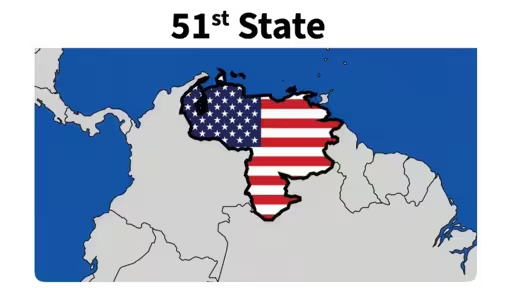
Although it is not the first time US President Donald Trump has expressed his interest, thus far only rhetorical, in annexing Venezuela to the US, the events of May 12 were undoubtedly a turning point. The official White House account posted an image of the Venezuelan map filled with the colors of the US flag, accompanied by the caption: “51st State.”
The escalation of this provocative narrative triggered an avalanche of divergent interpretations within and outside Venezuela. The responses attempted to decipher whether it was the US president’s typical trolling or the visual manifesto of a formal annexation plan underway.
Most likely, the closest answer to what Trump is really after lies somewhere between the more extreme interpretations. The post is not so innocuous as to be dismissed as mere geopolitical bullying, but it is far from being an unequivocal indication of a 19th-century-style conquest. It is in the gray areas where we should focus our attention.
First of all, is it possible?
It is unlikely. Within the US, the theoretical path to annexation is fraught with obstacles and profound political and institutional tensions. According to comments by international relations expert Roberto Stekman, when faced with such a proposal, “the first to oppose it would be the US public. Based on its population, Venezuela would gain two senators and at least 35 representatives, taking electoral representation away from other states and becoming the third-most powerful. No one in Congress would vote to relinquish their power.”
Stekman delves deeper into the legislative issue and asserts that “the House of Representatives has a limit of 435 seats. If Venezuela enters with 30 million inhabitants, 35 seats would have to be taken from other states. What congressman would vote to lose their own seat? Tell me.”
On the other hand, there is the contradiction between the idea and Trump’s own exclusionary view on migration. Regarding this, Venezuelan opposition-leaning analyst Alejandro Armas Díaz states that “when you consider that making Venezuela a state would mean that any Venezuelan could move to Illinois or Arkansas—which is exactly what Trump has sought to prevent at all costs—you have to realize that all the annexationist rhetoric is not actually serious.”
Although Trump is certainly an unpredictable politician, the idea of turning Venezuela into the “51st State” of the US is neither politically nor legally feasible in the short term, due to structural reasons in internal electoral and legislative equations.
Therefore, there is more to it than a simple act of media trolling, given that the nature of what was stated implies a challenge to Venezuelan sovereignty.
The selection of the moment: it’s geopolitics, stupid
The post was made while Trump was traveling to China on Air Force One. A few minutes later, the same White House account posted a short video of Secretary of State Marco Rubio speaking in January of this year, followed by an image of Nicolás Maduro being held hostage on Iwo Jima, and finally, a shot of the high-ranking US official wearing the Nike tracksuit that the Venezuelan president wore at the time of his abduction.
The two pieces are part of the same performance, intended for the People’s Republic of China. With the map of Venezuela depicted as the “51st State,” Washington flexes its geopolitical muscles before Beijing and symbolically reaffirms that the Caribbean nation is under US influence. This comes in a context where a recently issued OFAC license has opened the door to restructuring Venezuela’s enormous external debt. This potential operation that will require negotiations with China, a major creditor of Venezuela.
Consequently, the “symbolic annexation” also represents a geopolitical statement by the Trump administration, expressing its willingness to marginalize China’s energy and financial interests in Venezuela to an extreme degree.
Trump arrives in Beijing burdened by the strategic failure in Iran, weakened on the trade war front, and widely internationally criticized for his diplomatic missteps. It is there, faced with the impossibility of arriving with a victorious image, that the controversial map serves as a compensatory mechanism, implying to China that it has lost its former strategic ally in the heart of Latin America.
Lab B: Costs and benefits
In addition to the geopolitical implications regarding China, the symbolic aggression contained in the map reveals something important about the complex internal dynamics of the Caracas-Washington relationship, normalized after the January 3 military invasion.
First, Trump has used continuous praise of Venezuela’s acting president as a tool to defend what he considers the only international success of his second term: kidnapping Maduro and ensuring the plundering of Venezuelan oil under conditions of agreed stability.
While this tactic strengthens Trump’s foreign policy position, it weakens him politically. Republican sectors see Trump’s political endorsement of Rodríguez as having a dangerous electoral cost in the lead-up to the November midterms. This fear is particularly palpable in the neoconservative strongholds of Florida, where the eradication of socialism and the fall of the “regimes” in Venezuela, Cuba, and Nicaragua are textbook rhetorical magnets for attracting the Latino vote.
These sectors are demanding that Trump take a hard line with Caracas and replace friendly language with one of pressure and confrontation, forcing him to seek a balance that satisfies both his interests and those of his party.
In this context, the “51st State” narrative appears to offer the Republican president a middle ground within a framework of controlled tension. By resorting to symbolic provocation, Trump creates a climate of diplomatic impasse with Rodríguez, balancing praise with differing opinions without jeopardizing the signed energy agreements. Furthermore, he gains the added benefit of removing the issue of María Corina Machado’s intense lobbying effort to thwart the promised oil investments from the media spotlight.
Thus, he would hypothetically kill two birds with one stone. He engages in a low-cost discursive duel with Rodríguez and simultaneously presents Venezuela as an extension of the US. This way, investments in crude oil, gas, and minerals in the country would be as safe and reliable as those made in Texas or New Mexico.
Using measured language, Venezuelan Acting President Rodríguez responded to Trump, saying annexation would never be considered “because if there is one thing we Venezuelans have, it is that we love our independence process.” Following the map published by the White House, Rodríguez responded on social media with a map of “All of Venezuela,” with explicit sovereignist connotations.
The Venezuelan acting president has had a unique opportunity to polarize the US and reconnect with Chavista and independent sectors concerned that the country is being handed over to Washington. Yet, she took care not to reach a point of maximum tension near the rupture of diplomatic and energy relations.
Until proven otherwise, Trump and Rodríguez appear to have reached a kind of political Pareto optimum where neither sacrifices what is considered strategic. Trump gains political and symbolic ammunition with both external and internal utility. Meanwhile, Rodríguez finds an opening to revive the concept of sovereignty within her administration, dispelling the shadows of an ongoing energy pact in which the US controls Venezuela’s crude oil sales behind the Bolivarian Republic’s back.
Beyond the immediate objectives, it is crucial to recognize that the establishment of the general framework for US policy of domination over Venezuela lies behind the challenging narrative of the “51st State.” This framework positions the “relationship with the US,” mediated by elements of dependence and subordination, as the central component of Venezuela’s internal political struggle. Within this framework, all actors across the political and ideological spectrum are compelled to offer forms of association and integration with Washington to achieve electoral viability.
Delcy Rodríguez: Venezuela Will Not Become 51st State of the US
In that sense, the “51st State” would not be presented as a formal outcome but rather as a way of organizing Venezuelan politics within the parameters of strategic alignment with the northern power.
We could be facing a truly dangerous trial balloon that seeks to capitalize on, in Washington’s favor, the lack of representation cruelly exposed on January 3.
Translation: Orinoco Tribune
OT/JRE/SF
From Orinoco Tribune via This RSS Feed.
Trump wants Venezuelans to have the right to vote, open travel to the mainland, and ability to hold arbitrary jobs without immigration papers?