

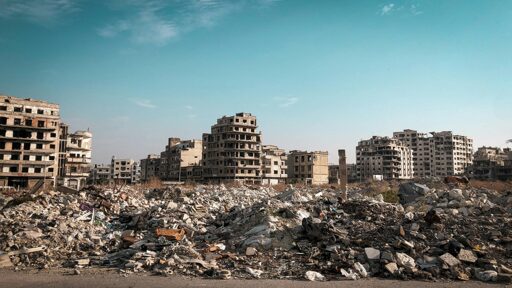
The following theses sketch the contours of what might be called the colonial Real: not only the dimension of violence and antagonism that colonial discourse cannot fully symbolize, but the point at which reality itself for the colonized begins to fracture under the pressure of that violence, even as colonial discourse continually attempts to domesticate it.
Colonial regimes do not merely administer territory or populations; they organize perception, narrative, and historical time in ways that stabilize domination while concealing their traumatic foundations. In doing so, they produce a seemingly coherent reality that depends on the repression of its own constitutive violence. The Real appears precisely where this symbolic order falters—where violence exceeds the discursive frameworks meant to render it intelligible, and where reality itself ceases to function as a stable, narratable horizon.
The ideas that follow emerged from my recent work on the Palestinian writer Adania Shibli’s novella Minor Detail, which I read as staging a literary encounter with what I call the colonial Real—not simply the point at which violence exceeds representation and narrative begins to break down, but the point at which the subject’s relation to reality itself becomes unstable, fragmented, and irreducible to meaning. In the broader project from which these theses are drawn, this encounter is situated within the political and psychic structures of Zionist settler colonialism and its necro-imperial logic. The analysis examines how colonial domination produces an asymmetrical relation to the Real for colonizer and colonized subjects, shaping both the ideological management of violence and the perceptual field through which it is encountered, including the very conditions under which reality can appear as coherent or intelligible at all.
The theses that follow do not offer a systematic theory. Instead, they propose a set of conceptual coordinates for thinking about the relation between colonial violence, ideology, and temporality, as well as the conditions under which reality itself is sustained or destabilized. Their aphoristic form is inspired in part by Walter Benjamin’s “Theses on the Philosophy of History,” where conceptual propositions function less as a linear argument than as a set of critical orientations for grasping historical rupture.
In this spirit, the propositions move across several registers: the perceptual encounter with violence, the spatial organization of colonial domination, the asymmetrical experiences of colonizer and colonized, the ideological mechanisms that stabilize colonial order, and the temporal logic through which settler colonialism attempts to narrate its founding violence as already completed, alongside the moments in which these structures fail and reality itself appears as rupture, disturbance, and excess.
A central claim running through these propositions is that colonial domination depends on a fiction of finality. The land is imagined as empty, the founding crime dissolved into landscape, and the conflict relegated to the past. Yet the colonial Real persists precisely as the impossibility of this closure. It returns in displaced forms—in fragments of perception, narrative repetition, and the minor details through which suppressed antagonisms reappear, destabilizing not only historical narrative but the coherence of the present itself.
In this sense, the colonial Real is not simply the traumatic remainder of colonial violence. It is also the point at which the colonial order’s attempt to seal the present encounters its limit. What emerges at this limit is not only the return of violence but the breakdown of reality as a stable symbolic field. What returns is not only the memory of violence but the persistence of a futurity that colonial power seeks, but ultimately fails, to extinguish, alongside a mode of experience in which reality itself can no longer be apprehended as a unified or meaningful whole.
I
The colonial Real emerges where representation fails, but not only as a breakdown of meaning—as the point at which reality itself ceases to cohere as a stable symbolic field.
Violence becomes Real not because it is extreme, but because it exceeds the symbolic frameworks meant to render it intelligible, thereby destabilizing the very conditions through which reality is apprehended. It appears precisely where language, law, and narrative cease to stabilize meaning, and where the world can no longer be experienced as ordered, continuous, or intelligible.
II
The Real appears first in perception rather than narration.
Before narrative breaks down, the body registers disturbance: sounds without source, lingering smells, objects suddenly charged with menace. Narrative collapse is only the belated inscription of a rupture already registered by the body, a rupture that signals not simply trauma but the disintegration of reality as a coherent perceptual field.
III
Colonial space organizes proximity to the Real.
Certain places appear to embody it—checkpoints, borders, genocide sites, extermination camps, besieged territories—but function as limit-zones where subjects approach the Real without symbolically integrating it or politically traversing its antagonism, and where reality itself appears fractured, suspended, or inaccessible as a unified experience.
IV
Colonial domination depends on narrating its founding violence as already completed.
The land is empty, the past resolved, the struggle finished, and reality itself is presented as stable, continuous, and already reconciled.
V
Colonial violence strives to erase its own traces.
Burials without record, destroyed archives, and silenced testimony attempt to restore symbolic coherence by eliminating evidence of the founding crime, thereby sustaining the illusion of a coherent reality that depends on the disappearance of its own constitutive rupture.
VI
Colonial domination produces an asymmetry of the Real.
The colonized and the colonizer encounter the Real through a structural asymmetry of recognition and jouissance: what appears as trauma for one may appear as mastery or denial for the other, and what for the colonized registers as the breakdown of reality may, for the colonizer, be sustained as a coherent world through ideological disavowal.
VII
The colonized subject encounters the Real through the foreclosure of the Symbolic.
Where the colonial order blocks symbolic integration, subjectivity reorganizes around fragments of perception rather than coherent narrative.
The world appears not as a field of meaning but as a constellation of sensory intensities—numbers, sounds, distances, surfaces—through which the Real insists, such that reality is no longer experienced as a unified or continuous world but as discontinuous, unstable, and resistant to symbolic organization.
VIII
Colonial trauma returns through displacement rather than declaration.
What cannot be spoken directly reappears through detours—minor details, repetitions, substitutions, scenes that both reveal and conceal the traumatic kernel, registering not only the limits of articulation but the impossibility of fully inhabiting reality as a coherent narrative field.
IX
Screen memories may structure colonial narration.
Events that appear central—atrocities, testimonies, historical episodes—may simultaneously reveal and conceal deeper antagonisms unspeakable within the colonial symbolic order, functioning as stabilizing fictions that allow reality to appear coherent while masking the rupture that sustains it.
X
Repetition signals the subject’s orbit around the Real.
Narrative loops, compulsive returns to places or events, and structural detours mark a subject circling a traumatic kernel that cannot be reached or integrated, where repetition becomes not only a sign of trauma but a failed attempt to stabilize a reality that can no longer be symbolically secured.
XI
The colonizer encounters the Real only as an ideological disturbance—through fantasy, denial, and destructive repetition, such that the breakdown of reality is not experienced as such but reabsorbed into narratives that preserve the coherence of the world.
XII
Colonial ideology functions through semblants.
Discourses of civilization, progress, humanism, and universal equality operate as symbolic surfaces that stabilize colonial reality while masking the antagonism on which that reality depends, thereby sustaining the appearance of a coherent and continuous world that disavows its constitutive rupture.
XIII
The Real exposes the structural link between universalism and elimination.
Universalism reveals its truth at the moment it fails, when the reality it sustains can no longer be symbolically secured.
When colonial semblants collapse, the violence required to sustain them becomes visible as exclusion, expulsion, and extermination, revealing that the coherence of colonial reality is grounded in the management of this violence…
XIV
The Real persists not only as trauma but as the impossibility of colonial finality.
Colonial violence attempts to seal the present by erasing the traces of its founding crime and producing a retroactive fiction of completion, thereby presenting reality as already resolved and historically closed.
In doing so, it seeks to foreclose futurity itself: the possibility that the colonized might return or transform the historical field.
The Real returns as the persistence of a futurity that the colonial order cannot extinguish, and as the disruption of any reality that claims to be complete.
XV
The colonized reopen the temporal field that the colonizer attempts to seal.
They refuse to allow the colonial symbolic order to determine the horizon of the future, thereby unsettling the reality that colonial domination presents as fixed and finished.
A vision of the future that cannot yet be symbolically articulated nevertheless persists, not as a coherent projection but as a pressure that exceeds the limits of the present.
XVI
Literature approaches the Real where history falters.
Where archives fragment, testimony collapses, and juridical language fails, literary form can register disturbances that official discourse cannot contain, including the breakdown of reality as a stable and intelligible field of experience.
XVII
The task of critique is not to reveal the Real but to prevent its ideological domestication, and to sustain the rupture through which reality can no longer appear as complete.
The colonial order survives not because the Real is absent, but because it is systematically misrecognized and symbolically domesticated, allowing the fractures of reality to be reabsorbed into narratives of coherence, progress, and completion.
Final Note
If the colonial Real marks the point at which colonial ideology encounters its limit, then the task of critique is not to reveal a hidden truth concealed beneath appearances, nor simply to expose what cannot be represented, but to attend to the points at which reality itself can no longer be sustained as coherent. Colonial violence is rarely secret; it is more often systematically misrecognized, reframed through narratives of security, civilization, progress, or humanitarian necessity. The problem is not simply that violence is hidden but that it is rendered intelligible within discourses that neutralize its antagonistic structure, thereby stabilizing a reality that depends on the disavowal of its own constitutive rupture.
The colonial Real, therefore, appears not only as trauma but as a disturbance in the very fabric of reality—a reminder that the historical field remains open despite the colonial order’s attempts to narrate it as closed. It signals not only the return of violence but the failure of any reality that claims to have resolved it. Against the fiction of completed disappearance, the Real returns as the persistence of an unresolved future, and as the destabilization of the present that seeks to contain it. In this return lies the possibility that what colonial power seeks to render unthinkable—the transformation of the historical field by those it seeks to erase—remains, however faintly, on the horizon, not as a fully articulated vision but as a pressure that exceeds the limits of the existing order.
The post Seventeen Theses on the Colonial Real appeared first on The Philosophical Salon.
From The Philosophical Salon via This RSS Feed.