



This is the transcript of a talk I gave yesterday at a conference at NYU. And SPEAKING OF HOW I’M IN NEW YORK RIGHT NOW, if you live there or thereabouts, consider coming out to see me and Sohrab Ahmari in dialogue about populism tonight in Queens.
What I want to explore in this presentation, and in the paper, is what I think of as the “new skepticism” about objective material interests from academic Marxists. To try to be as clear as possible about what I’m talking about, an “objective material interest” is an interest that someone has purely by virtue of their material position. In other words, as soon as you know what someone’s material position is, that’s enough to know that they have these interests. A particularly interesting and important category of objective material interests would be objective interests people have by virtue of their class location. Workers have an interest in being exploited at a lower rate, and ultimately abolishing exploitation. Capitalists have an interest in being able to squeeze more hours of labor out of their workforce for less money. Etc. Of course, it would be extremely foolish to deny that people also have various material interests that don’t stem from their class location. But the core Marxist claim would be that, once you know someone’s class location, you know at least some interesting and important things about what their material interests are. The kind of materialism that’s typically taken to be central to Marxism is, I have to say, pretty hard to make sense of if we don’t assume at least that much.
OK. So I said I was going to be talking about a “new” skepticism about all of this. And in some ways this might just a recent expression of ideas that have been kicking around left academia for a long time. But one thing that makes this particular iteration of this kind of skepticism interesting is a combination of a couple of elements. First, the conclusion that we should be skeptical about objective material interests tends to be presented as if it were so obvious it barely requires explanation, never mind argument. Second, the skeptics about objective material interests I want to discuss tend to present themselves as firmly within the Marxist tradition, rather than coming from a self-consciously heterodox position with the Marxist tradition or just calling themselves post-Marxists or anything like that. Which is surprising, because, again, maybe I’m just suffering from a lack of imagination, but I have trouble understanding how the core of Marxist analysis is supposed to work without belief in objective material interests and in particular objective material interests stemming from class locations—belief, for example, that workers and capitalists have innately antagonistic interests regardless of the subjective consciousness anyone might or might not have about it.
And I want to be clear that I’m not resting anything here on a Marxist appeal to tradition. Heterodox doesn’t mean wrong. Revisionist doesn’t mean wrong. Sometimes Marxist orthodoxy is wrong, and it should be revised or some aspect of it should be rejected entirely. That’s all fine. But I do think that breezy skepticism about the very idea of objective material interests expressed from a position that presents itself as firmly Marxist is an odd combination.
One of the two main authors I’m thinking of here is William Clare Roberts, best known for a book on Marx’s Capital. If you read that book, which by the way has some real insights, there are real things I learned from it, but if you read it, Roberts never presents himself there as a critic of Marx, always as a defender. And the other is Dylan Riley of the New Left Review. Again, often a sharp and insightful thinker, and one clearly thinking within Marxist categories.
OK. Let’s start with him.
In a widely shared note last fall in NLR, Riley takes aim at what he describes as a “new Marxist culture that emerged in the United States from about 2010.” He says that a particularly important feature of this new strain of Marxism is a “worldview” where “there are classes whose members have material interests deriving from their position in a system of property relations.”
And again, you might wonder how what he’s describing here isn’t just a general feature of Marxism, not some specific kind of Marxism that arose around 2010. Surely, to be a “materialist” in the Marxist sense is among other things to believe that people have material interests by virtue of their position in a system of property relations. Without that, what would a Marxist analysis of capitalism even be?
But Riley objects, saying that the idea that interests can be derived from property relations has a peculiarly “timeless and metaphysical quality.”
Why is that? Well, he says that people “live toward the future as they perceive and imagine it.” Fair enough. But when we’re asking what someone’s interests are, the question is surely which of various possible futures would be better for them. If some futures would be better for them, independent of their attitudes, it makes sense to describe those as objective interests. And the traditional Marxist claim would be that when we know a person’s position within a class structure, we at least know quite a bit about which outcomes would be good and bad for them.
To bring all this down to earth a little, it’s worth noting that even most non-Marxists would probably find the claim that people’s position in a system of property relations tells us something about what’s good or bad for them pretty intuitive at least for some positions within some systems of property relations. I suspect that most people would agree, for example, that if someone is a slave—so, their position within a system of property relations is that someone else owns them—we don’t need to know anything else about them to have a very strong reason to believe they’d be better off if slavery were abolished, or failing that if they could escape to a different polity where they could live a decent life and not be returned to bondage. Would Riley agree with that?
Hold that thought while we take a look at Roberts. Writing in Crisis & Critique, Roberts takes Jeremy Gong and Eric Blanc to task for claiming that, “Wage exploitation means that the interests of the whole working class and the capitalist class are diametrically opposed.”
Roberts calls this a “soothing fiction” and objects that different fractions of the working class and of the capitalist class often have wildly divergent interests. For example:
“Capitalist employer A does not have an interest in capitalist employer B extracting more surplus labor from B’s workforce. Capitalist employer B extracting more surplus labor may well be a threat to capitalist employer A.”
Individual capitalist firms, Roberts grants, are “hierarchically arranged and organized for the pursuit of a particular interest,” and the workers at a given firm can have a straightforward common interest in workplace-level organizing against their particular boss. But he thinks it’s a conceptual confusion to think whole capitalist economies work in an analogous way, and that this confusion obscures the complexities and contingencies of real-world socialist strategy.
To help us keep track, let’s call this Reason #1 to Be Skeptical That People Have Interests by Virtue of Their Class Locations. And that’s that membership in a class defined by general relationship to the means of production is too abstracted from specific concrete details about anyone’s economic life to tell you much about their interests.
And it’s probably worth taking a moment to differentiate this from a slightly different concern that wouldn’t really activate the same kind of skepticism. I’m going to call this Reason 1.5 because it’s a little sideways to what we’re talking about here. And that’s that membership in a class based on general relationship of production is too coarse-grained to provide us with a lot of the information we want about people’s interests. Nick French has a great essay in Left Notes from a couple weeks ago where he addresses this, and as he points out there, Reason #1.5 doesn’t give us any reason at all to reject the idea that people have interests based on their class location. It just gives us a reason to complement our coarse-grained theory of class structure with a more fine-grained theory of specific locations within that structure. And of course as Nick quite rightly points out, that’s not intellectual work that would need to be done from scratch in the 2020s. We already have just such a theory in Erik Olin Wright’s work on contradictory class locations, which is a theory he develops different versions of in his very rich discussions in these books:

The key point is that, if you accept any version of the account of contradictory class locations, you can absolutely continue to believe that people have objective interests that can be derived from nothing but their position in a system of property relations. It’s just that for certain analytical purposes you want to zoom in and look not just at whether they own the means of production or have to work for people who do but also at questions like whether they have managerial authority or whether they’re a credentialed expert with more individual bargaining power than other workers and so on. The core of what Riley and Roberts seem to be objecting to is left untouched there. But what makes Reason #1 different from Reason #1.5 is that according to Reason #1, you don’t know what someone’s interests are based on their abstract class location—even when we provide a higher level of resolution by looking at sub-class categories differentiated by things like workplace autonomy and specialized skills and managerial authority—because interests tend to reside in concrete fragments of classes. We need to know things like which specific company you work for if you’re a worker, or which one you own if you’re a capitalist. That’s what the Capitalist A and Capitalist B business was supposed to establish.
But, let’s think a little harder about this example about Roberts’s discussion Capitalist A and Capitalist B. Specifically, the passage I had highlighted earlier:
“Capitalist employer A does not have an interest in capitalist employer B extracting more surplus labor from B’s workforce. Capitalist employer B extracting more surplus labor may well be a threat to capitalist employer A.”
Based on that, you might suspect that Capitalist A would be incentivized to fund a union organizing drive at Capitalist B’s workplace so that B will extract less surplus and do worse in competition against A. It’s interesting, then, that this is the kind of thing that doesn’t happen all the time. In fact, as far as I know, if it happens, it’s very rare. Why is that?
Well, my guess would be that it doesn’t happen much for about the same reason that, if I’m having a conflict with my next-door neighbor, even if the conflict turns violent, even if we get into a fistfight or I try to shoot him, one strategy I probably won’t consider is setting fire to the dry grass on his front lawn. It wouldn’t be in my interests to do that. And that suggests a sense in which the basic truth of Blanc and Gong’s observation about all workers sharing interests and all capitalists sharing interests is consistent with the obvious interest individual capitalists have in out-competing each other. Marx described capitalists as a “band of warring brothers,” and the basic point, I think, is that the warring takes place within well-defined class parameters. And those parameters are what bands them together as brothers.
If I’m hunting for deer in the woods of northern Michigan, my interests are counterposed in some straightforward ways to the interests of other hunters who frequent the same forest. If there’s a particularly desirable eight-point buck that’s been sighted in the woods where I’m hunting, I hope I’ll bring him down before some rival does. But if the state government in Lansing tries to shorten deer season, or if local authorities try to close the forest to hunting entirely, me and my rival will be on the same side by virtue of our common position as hunters. Similarly, social democratic reforms that reduce the sting of unemployment, for example, tend to be bad for the whole band of warring brothers, and a transition to a fully socialist economy would be really bad for the whole band, and vice versa holds for the working class, all that stuff is in their interests. Workers of course have individual interests that can point in the opposite direction. That’s why you get scabs during strikes! More generally, it’s why organizing is hard. Collective action problems are big problems. But this is all compatible with saying that at least one big part of the matrix of relevant interests is the interest workers have in achieving social democracy or socialism.
Or so it seems to me, anyway. But perhaps there are deeper reasons than the ones I’ve considered so far why we can’t derive interests from class locations in this way. Perhaps the view that membership in either a class or a fraction of one is sufficient all by itself to produce interests is misguided. Both of these guys have suggested as much. In the Riley note in New Left Review, he says that material interests “are ‘material’ to the extent that they emerge from those objective circumstances; they are ‘interests’ to the degree that they are oriented toward a horizon.” The first part is clear enough. But what does “oriented toward a horizon” mean?
At the end of the paragraph, Riley says that Marxism, if it’s going to be plausible, can’t be a “philosophy of the stomach.” So, even if someone’s objective location in a class structure tells us what they have to do to fill their stomach, something other than that provides the “horizon.” OK. So, what’s the missing, non-stomach component?
Here I think Roberts is usefully clearer than Riley. In another essay, this one published in Radical Philosophy, Roberts that “the crucial point to understand about any discussion of interests” is that “to say that x is in your interest is to say that you have a good reason to want x, or that x is what you should rationally want, given your aims.”
And that phrase “given your aims,” I have to say, really triggered my inner analytic philosopher. It was an a-ha moment. Like, oh, right, that’s what’s going on here. That’s what Riley is getting at with all of this talk about how someone’s position in a system of property relations doesn’t tell you what their material interests are because first you need to know which horizon they’re aiming it. Riley assumes that the relevant horizons are provided by the consciousness people form as a result of political struggles, which seems a bit arbitrary—certainly, that’s one way people can come to care about goals, but it’s far from the only way—but putting that aside, the basic philosophical point is this:
Roberts and Riley both just sort of take it for granted that the only sense in which anything is good or bad for anyone is a purely instrumental one—in other words, a sense that arises from nothing but means/ends rationality. I have this goal and that strategy is the one that would best advance it, and so I rationally “should” do it, and this is the only sense in which any course of action can be more rational than any other. So, again, to make sure everyone’s tracking all of this, they accept that there can be objective interests in the sense that a certain course of action is objectively the best way to achieve someone’s goals, but they deny that people can have “objective” interests in the sense that they deny that some goals are more rational to aim at regardless of how they fit with the goals you happen to have.
Hence, in the next line, Roberts writes that “you can’t say what people’s interests are unless and until you figure out what they are trying or otherwise aiming to do or be.”
OK, so this is the last of the big reasons to be skeptical of the idea that people have interests by virtue of their class locations that I want to talk about today. Reason #2 would apply not just to membership in classes defined by general relation to the means of production but also to zoomed-in Wrightean class locations or even to membership in concrete fractions of classes. And that even if there are objective facts about people’s class locations, those don’t give rise to objective facts about people’s interests because interests can only be defined relative to subjective aims.
And once again I want you to notice that in both the Roberts essay in Radical Philosophy and the Riley note in New Left Review, they take this point to be so basic, so obvious, that they don’t really need to argue for it. They just kind of announce it and move on. Roberts at least pauses to explain the general philosophical position, but he doesn’t feel the need to tell us why he thinks it’s correct. They just treat it as a settled issue. But they really shouldn’t.
David Hume, historically the most famous advocate of this view of practical rationality, at least understood that he was saying something extremely provocative. In fact, he reveled in that. In his Treatise of Human Nature, he says that it is “not contrary to reason to prefer the destruction of the whole world to the scratching of my finger.”
The fundamental philosophical debate here, which is very much an open one, is whether there’s such a thing as objective well-being. That’s the thing Riley thinks is “timeless and immaterial”—thinking that there are things that are good or bad for people for reasons more fundamental than that a particular person happens to have a particular goal. That, in other words, there are things we know are good or bad for people simply by virtue of knowing that they are people. Which is a premise that, in combination with the premise that people occupy certain positions in class structures, gets you objective—in other words, remember, attitude-independent—class interests.
And on that note, I want to go back to the thought I asked you to hold earlier about the slave. In presenting that example, I didn’t tell you a single specific concrete thing about that person. I didn’t tell you who he or she was, what specific experiences he or she had, what kind of personality he or she had, what his or her hopes or dreams were, any of that. I haven’t even told you what his or her general beliefs about the justice or injustice of slavery were. I just said that the character in the example was (a) a person who (b) was held as property by another person, and I took it as a given that © this gives us a very strong reason to believe that he or she would be better off being freed. That, in other words, it would be in his or her interests to be freed.
One view you might have about this, on the opposite end of the spectrum from the Riley/Roberts position, would be a belief in classical hedonic utilitarianism. What’s best for people is whatever makes them happiest and that’s that. Or if you think (like I do) that that’s a little too simplistic to be plausible, another possibility that’s also on the opposite end from Riley/Roberts is that you believe in something like an Aristotelian conception of human flourishing. That the same way we can look at various kinds of plants or non-human animals and see which ones have succeeded in fulfilling their functions, we can look at some very basic facts about human nature and see that there’s a development of our intellectual and moral and creative capacities that can make some humans successful humans, and conversely there are various ways that human lives can go wrong that make us fail to flourish. Aristotle himself was in some important ways a prisoner of the stage of historical development that produced him, and he took it for granted that there were different kinds of humans—that women didn’t have the same rational capacities as men, for example, and even that some people were natural slaves. But obviously there have also been lots of robustly universalist versions of the same line of thought. And since we’re talking here about Marxism, it’s surely worth pointing out that Marx himself fell into that tradition—there are recent books by Vanessa Wills and Sam Badger dedicated to rediscovering the dimension of Marx’s thought that assumed something at least generally along the lines of a neo-Aristotelian theory of human flourishing.
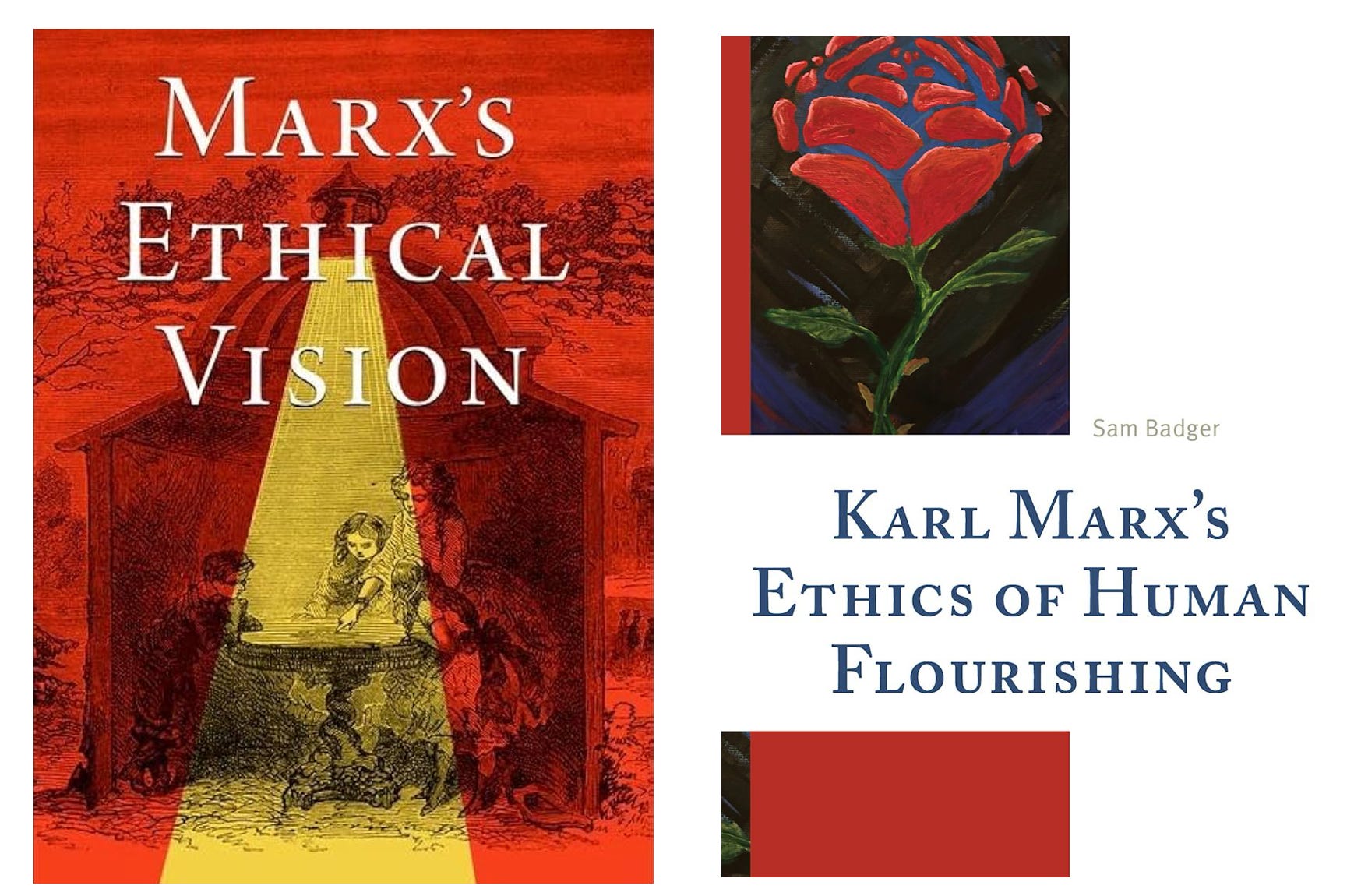
That’s often been neglected. Many Marxists have the idea that being a Marxist requires denying that there are any transhistorical facts about human nature, but I’ve never really understood why they think that. Positing that all humans have a robust interest in developing various important capacities and flourishing as people fits pretty naturally with the thought that we should be horrified by class societies where slaves and serfs and proletarians are constantly and predictably blocked from flourishing in these ways.
Now, I’m pretty sympathetic to this line of thought. If you read some of what Erik Olin Wright says about flourishing in Envisioning Real Utopias, for example, that sounds about right to me.1 But I’d be engaged in dereliction of philosophical duty here if I didn’t at least briefly gesture at the existence of all sorts of views that are somewhere in between the Marx/Aristotle/Wright end of the spectrum and the Riley/Roberts/Hume end. My graduate school friend Benjamin Yelle, for example, wrote his dissertation on this, it’s called “Realizing What Matters” if you want to look it up online, where he tries to reconcile two commonly-held intuitions about this, which are that, first, different lives are good for different people, and second, that it’s possible not just for people to pursue bad or irrational strategies relative to whatever ends they happen to have, but also for people to pursue ends that go against their interests. As I understand it, his view is that an objectively good life is one that’s lived in accordance with whatever values a particular person happens to most deeply hold, which might come apart from what you’re “aiming to do or be” if you’ve adopted irrational aims or you hold bad beliefs about what’s good for you—so, there can be levels of subjectivity, and we can at least critique the shallower ones in the name of the deper ones, and it can function a little bit like objective interests.2
Now, I certainly won’t pretend to be able to settle a philosophical debate of this magnitude in a short talk. But I do want to insist that this is a live debate, and that important things are at stake here. To see how the pieces fit together, let’s end by going back to our example about the slave. Instead of just thinking about any slave, let’s think about a particular slave and psychologically describe her.
Let’s say that the slave in question has been effectively brainwashed to believe that God decided at the dawn of time which souls would be born into slavery and which ones into freedom and that it would be sinful for her to participate in a slave revolt or even to individually try to escape. Is it still the case that it’s not in her interests to do those things?
On an extreme subjectivism about well-being, we might actually say that right now, the slave’s interests are served by remaining in bondage. If we convinced her that the cultural story she was brainwashed into accepting was incorrect, and thus she was convinced to start aiming at freedom, have we made her aware of the interests she always had? Or have we actually served her poorly by bringing her interests and her circumstances out of alignment?
The classic description of the state of affairs where she piously refrains from trying to escape is that she has false consciousness. And my sense is that, whether or not this applies to either Roberts or Riley, at least some otherwise Marxist-influenced people who are drawn to the Riley/Roberts kind of position are motivated at least in part by a discomfort with attributing false consciousness to anyone, for the basically honorable reason that they worry that it’s ridiculous and condescending to go around telling people that they don’t know what their real interests are. The reason I say that’s a basically honorable instinct is that, if you’ve convinced yourself that the great mass of the population are total dupes who don’t know what’s good for them and only you and your intellectual friends know what’s what, I really do think it’s a healthy instinct to wonder if you might be the one who’s missing something.
But let’s slow down and notice that, to reject the hypothesis of widespread false consciousness, you don’t actually have to reject the premise of objective material interests (and hence the very possibility of disconnects between material interests and subjective aims). In fact, if your worry about postulating rampant false consciousness is that it’s condescending, simply defining the problem out of existence may be the most condescending way of going about things. Compare: You think it would be bad to accuse people of being stupid, but you also think most people aren’t smart enough to know how to tie their own shoes, so you redefine “stupid” so that you don’t have to be smart enough to know how to tie your own shoes in order to be “not stupid.” Serious rejection of rampant false consciousness shouldn’t proceed by conceptual fiddling to stop the issue from arising, but from actual empirical belief that it’s not a widespread phenomenon.
And that’s the correct position! It turns out that most people have a pretty good idea of what their interests are, at least as those interests most clearly arise in their day-to-day lives, is a relatively rare one. Yes, brainwashing exists, cults exist, drug abuse and addiction exist, there are certainly some situations in which people deeply mistaken about what’s good for them. But generally speaking, and all of this totally tracks on something like a neo-Aristotelian flourishing account, by the way, generally speaking people have a pretty good idea. Most people who see someone with a good job and a high income and a loving family and enriching projects that they have lots of free time to pursue and a community they’re nourished by and that they give back to in a deeply satisfying way aren’t confused about whether that person is doing well in life. Conversely, most people who pass by someone shooting up on a park bench have a pretty good idea that they’re not looking at a life well-lived. And the same is true even with vastly less extreme examples on either end. This is why good union organizers are trained to listen more than they talk, When you start listening to people talk about their lives, they know perfectly well what their problems are, what their needs are. Your job is to show them that collective action is the way to get those goods.
And this, it seems to me, gets us to the most basic premise of materialism. Marxism is “materialist” in at least two senses. The narrow sense is historical materialism—what Marx is talking about in the 1859 preface, what Cohen is defending in Karl Marx’s Theory of History. At least in its classic form, that’s a series of linked premises about the development of the forces of production over the course of history and how that enables the reorganization of the relations of production within a society and how that in turn leads to the formation of a legal and political superstructure that serves to perpetuate those relations of production. And it seems to me that, whether you ultimately accept that story or not, an absolutely vital premise without which it wouldn’t make any sense is materialism in a looser, simpler sense, which is just the view that enough people will be motivated by their objective material interests enough of the time that we can use that assumption to build explanatory models and make interesting and important predictions about the world around us. That looser sense is what we’re typically thinking of when we talk about giving a “materialist” account of this or that contemporary event or phenomenon. Without even materialism in this loose sense, you just can’t cobble together anything that looks much like Marxism.
Or so, at any rate, it seems to me. But now I want to know what all of you think.
Thanks for reading Philosophy for the People w/Ben Burgis! This post is public so feel free to share it.
I didn’t have time to get into this in the talk but for the record here’s at least enough of that discussion to give you a general idea:
Human flourishing” is a broad, multidimensional umbrella concept, covering a variety of aspects o f human well-being.’ It is like the idea of “health,” which has both a restrictive meaning as the absence o f diseases that interfere with ordinary bodily functioning, and an expansive meaning as robust physical vitality. The restrictive meaning o f human flourishing concerns the absence of deficits that undermine ordinary human functioning. This includes things like hunger and other material deprivations, ill health, social isolation, and the psychological harms of social stigma. This is a heterogeneous list-some elements refer to bodily impairments, others to social and cultural impairments. But they all, through different mechanisms, undermine basic human functioning. A just society is one in which all people have unconditional access to the necessary means to flourish in this restrictive sense of the satisfaction of needs for basic human functioning.
The expansive idea of flourishing refers to the various ways in which people are able to develop and exercise their talents and capacities, or, to use another expression, to realize their individual potentials. This does not imply that within each person there is some unique, latent, natural “essence” that will grow and become fully realized if only it is not blocked. The expansive idea of individual flourishing is not the equivalent of saying that within every acorn lies a mighty oak: that with proper soil, sun and rain the oak will flourish and the potential within the acorn will be realized a s the mature tree. Human talents and capacities are multidimensional; there are many possible lines of development, many different flourishing mature humans that can develop from the raw material of the infant. These capacities may be intellectual, artistic, physical, social, moral o r spiritual. They involve creativity as well as mastery. A flourishing human life i s one in which these talents and capacities develop.
You could also be a pure subjectivist about interests and say that members of each class will so overwhelmingly and predictably cluster around subjective interests that are served by having more income/leisure/etc. that in practice they function like “objective” interests in my sense. The challenge there, though, is to explain why people overwhelmingly and predictably cluster around these preferences in a way that doesn’t get into human-nature considerations in a way that would start to look an awful lot like the view that people have these preferences because they know that’s what’s in their objective interests.
From Philosophy for the People w/Ben Burgis via This RSS Feed.