

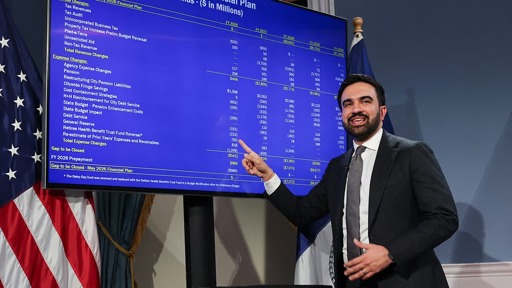
After months of wrangling with Albany in order to close a massive $12 billion deficit, Zohran Mamdani — the first so-called “socialist” mayor in nearly a century — has proposed his first city budget.
The Mayor’s supporters are, rather tepidly it seems, hailing it as a “step in the right direction,” claiming that it “makes progress on his affordability agenda.” But, while the budget does provide some funding for expanded Pre-K and other services, it largely resembles the first budgets of previous Democratic mayors such as Bill de Blasio. In fact, the clever accounting tactics and compromises necessary to balance the budget, and the lack of any meaningful challenges to the politics of the status quo, are a telling sign of how we can expect Mamdani to govern for the rest of his term.
Rather than build the forces and the kind of politics needed to confront the ruling class directly and challenge the very logic of the budget process, Mamdani has chosen instead to play along to get along, making back-room deals and passing painful cuts onto future budgets. By focusing on a limited program of minor reforms — paid for largely by postponing required payments and “cost saving” schemes — this budget shows well that Mamdani plans to govern not as an advocate for working people, but as a “responsible” mediator of class conflict and a useful tool of the ruling class, which has found in the young mayor a way to channel popular anger back into the Democratic Party.
What’s in the Budget, What’s Not, and Who’s Paying for It
The good news is that Mamdani’s budget includes more than $2 billion to expand the popular Pre-K program — a vital service for many parents who are increasingly unable to afford private childcare in the city. This includes $100 million to expand the “3-K” program, and $73 million to launch a pilot program to provide free childcare for more than 2,000 two-year-olds across the city. But whether or not future budgets will include the hundreds of millions more needed to maintain and further expand these programs remains to be seen.
The budget also slightly increases baseline allocation for public libraries, a positive but inadequate development. While this means libraries will no longer have to beg for re-allocation of resources in each new budget cycle, the funding is still $97 million less than the 0.5 percent of the total budget that Mamdani promised on the campaign trail. Importantly, and to Mamdani’s credit, the budget includes no direct cuts to public services (but keep reading, because the devil is in the details).
The bad news is that many parts of Mamdani’s key affordability agenda are not in this new budget, including funds needed to create free city buses; to put $100 billion toward new public housing construction over the next ten years; and to expand access to vital housing assistance programs for families who are under threat of eviction — a demand that Mamdani said was “an essential lifeline for thousands of New Yorkers.” In fact, Mamdani’s budget intentionally ignored a legal mandate to increase the housing voucher program, bringing him into direct conflict with the City Council, which passed laws that required the program be expanded in 2023.
The really bad news, however, is that only a small portion of the new funding in the budget, and none of the money allocated to close the budget gap, comes from revenue increases. With the exception of an expected $500 million from the “pied à terre tax,” which still needs to be passed by the state legislature, all of the new spending is being funded directly by the state. This may sound great for New Yorkers who live in the city, but those funds will have to come from somewhere, meaning that we can likely expect further austerity in future state budgets (especially in the likely event that Governor Kathy Hochul is reelected). This could directly affect future funding to city services, including the Department of Education and the City University of New York, both of which receive a good portion of their budgets from the state.
Indeed, this sleight of hand — robbing Peter to pay Paul — is at the heart of Mamdani’s “balanced” budget. The $500 million expected from the tax on luxury second apartments in the city is the only revenue increase in the entire budget and is only a tiny fraction of the total $216 billion proposal. So where did all of the extra money come from to balance the $12 billion deficit that Mamdani inherited?
In addition to the more than $2 billion in funds from the state (Hochul’s gift for Mamdani’s endorsement), the budget includes several unsavory savings mechanisms. First, and perhaps worst of all, it saves an additional $500 million by ignoring a state-mandated requirement to decrease class sizes in New York City public schools. Mamdani is basically paying for increased access to pre-K by increasing class sizes on those same kids when they get to the public schools.
In addition to this, the budget saves several billion more by postponing mandated payments to city worker pension funds, a move that will only increase future costs at a rate even higher than municipal bond payments. In other words, Mamdani, like so many first term mayors before him, is increasing future debt in order to balance this year’s budget.
More nefarious perhaps and less discussed is the so-called “savings” that are built into the budget. The budget argues that the city can “save” billions more by the appointment of new Chief Savings Officers to several city agencies, who will be tasked with finding and implementing measures to make those savings a reality. This is really just a recipe for future austerity with extra steps.
Winning Our Demands, with Working-Class Methods
As I’ve argued elsewhere, Mamdani had a unique opportunity when he came to office. Riding a wave of incredible enthusiasm and excitement, not to mention the support of more than 100,000 volunteers, Mamdani, were he an actual socialist, could have become a lightning rod for class struggle. He had the chance to use the bullhorn of his office to challenge the logic of the budget process by calling massive assemblies and encouraging working people and unions to demonstrate and strike in support of a truly transformative program for New York City.
Instead of endorsing weak-tea Democrats and making back-room deals with Hochul, he could have refused to balance the budget on the backs of working people and demanded that City Council and the state legislature actually tax the rich as he said he would. There are more than 150 billionaires in the city. Even just a tenth of the $759 billion held by these people would produce enough revenue to close the budget gap six times over.
And there is no reason why corporate landlords should be allowed to own such a huge share (or any) of the city’s housing stock, building expensive luxury housing that only drives up the rent for the rest of us. If Mamdani were serious about making the city affordable he would do more than promise to build more public housing; he would be leading efforts to appropriate corporate landlords, like in Berlin, to create truly affordable and quality social housing for all.
Instead, Mamdani chose to play the good Democrat, agreeing to perform the role of the executive, which inevitably demands the defense of the very system that is dedicated to the reproduction of the rule of capital. This includes the use of the police to repress working-class organization and resistance. This is why the DSA and the working class and oppressed throughout the city must reject the limited demands and reformist strategy of Mamdani and take up a truly ambitious and uncompromising program for the city grounded in methods of working class struggle, including assemblies, mass demonstrations, and strikes.
At a time when far-right authoritarianism is on the offensive, when ICE is rounding up hundreds of thousands of imigrants, when our tax dollars are funding genocide and war, when millions can barely afford the rent, when the next pandemic is possibly around the corner, and when the near term effects of climate change threaten the very livability of our city, we cannot pretend that everything is normal. Faced with so many interlocking crises, Mamdani’s lack of urgency and his willingness to carry on with business as usual is the clearest demonstration that he has nothing to offer the working people that run our city.
We need to impose, with class-struggle methods and self organization, progressive taxes on large fortunes and corporations, wage increases in line with inflation, price controls, and democratic bodies of the working class, the oppressed, and middle class New Yorkers to discuss a common platform and a budget that seriously confronts the outrageous inequalities of one of the most expensive cities in the world.
The post Mamdani’s First Budget Is a Masterclass in Class Collaboration appeared first on Left Voice.
From Left Voice via This RSS Feed.
When the task ahead of you requires massive change, people will criticize you no matter what.
If your first step is too modest, they say “How will you ever reach the necessary level of change?”
If your first step is too ambitious, they say “How will you ever get anyone on board?”
It’s just an excuse to say they know better, without risking anything in the process.
Did you read the article? The criticism is very valid and the writer even lays out an alternative course Mamdani could have taken. By not making use of the popular support he enjoyed during his campaign, he’s killing this powerful movement. Instead he basically functions as a less corrupt democrat who does not challenge the corrupted system at all.
Not sure I agree with this negative take but is good to see some substantiative criticism of Zohran on his policies instead of neoliberal thinly veiled Islamophobia.
Yeah, right?
The dude was handed a colossal clusterfuck, doesn’t have the support of the state for increasing the taxes he wants, and still managed to balance things.
I do think there is call for caution, but I don’t see this as a walk-back or anything similar.
I find myself watching this guy’s near daily news conferences and I don’t even live in the same country. Guy is such a breath of fresh air.
