


Bullets:
China has monopolies on supply chains and manufacturing of industrial drones.
Drones are suddenly and widely in use by non-NATO countries across the world, and wreak havoc on weapons platforms and fixed targets worth hundreds of millions of dollars.
The War Department is scrambling to close the gap with China, and is looking for suppliers for thousands of suicide drones.
To clear the way for US companies, Washington has banned new imports of Chinese drones, which are popular in American small businesses, heavy industry, and in fire and police departments.
But even if the Pentagon can eventually buy and deploy drones at low cost, drones cannot be defended against at low cost.
Inside China / Business is a reader-supported publication. To receive new posts and support my work, consider becoming a free or paid subscriber.
Report:
Good morning.
China has monopolies on the manufacturing of drones, and on the supply chains for drones. That’s because China, before anyone else, was building drones for industrial and commercial markets. That’s where the demand is. There will always be a lot more people who use drones for peaceful means and ends, compared to the population of people who want them for war. The civilian market is also where cost and quality matter. The Pentagon is indifferent to cost; money is no object. That point of view is not prevalent in businesses.
And here we are taking just a handful of examples, how small businesses are using drones in industry, and even to create new industries. Here operators are using drones to feed fish in offshore farms. In South Florida alone, there are a dozen companies that use drones to power-wash roofs and buildings 40 stories high. Those drones cost $6,000 - $15,000 each to buy from Chinese factories—so they’re not cheap—but they replace a whole crew of guys dangling from cables, off the sides of buildings. Cleanings can be done more often, and obviously more safely. Empower Field is where the Denver Broncos play, and they’re not hurting for money, and they use drones there to clean the stadium.
That’s a new industry. It didn’t exist even just five years ago. Drones are heavily used now in construction, and in mining. Mining companies are using drones to do surveying work, in blast management, and in search and rescue of trapped miners.
We know that drones are already in heavy use by hobbyists and videographers, but when affordable tools become available, industry and business people are clever in asking how they can be used in their own trades, to do their jobs better, and less expensively, and safer.

Chinese companies are way ahead of everyone else on drones, because those are the markets that Chinese companies build for: civilian users. Militaries across the world have learned the hard way that drones are also ruthlessly effective in warfare, at low cost. The Pentagon and other Western militaries are trying to catch up, and to dominate with drones in the same way they did in the past, with other transformative technologies. But the Chinese are already there in drones, and getting away from China won’t happen fast, and won’t happen cheap.
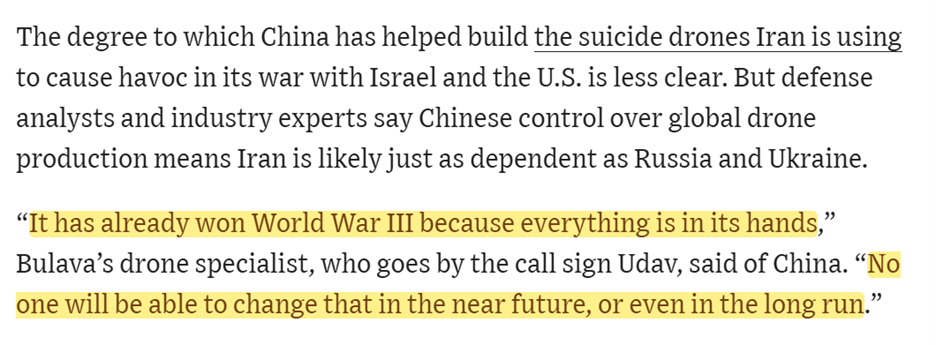
China has a strong hold on everything in this industry, from end-to-end. This Ukrainian unit was taking apart a Russian FPV quadcopter. The batteries, the motors, and the brain came from China, and it “could not have been built without” Chinese parts. Here’s a money quote: “(China) has already won World War III because everything is in its hands”. That won’t change soon, and it won’t change later:
Our group has done several reports on Chinese drones, and the problems they are posing for other countries, and ironically even for China itself. The Chinese have strict export bans on these technologies, which restrict their intended use as weapons. And in the case of Russia and Ukraine, both sides are dependent on getting Chinese parts for their drones.
The Pentagon has a $1 billion plan to break China’s grip on the industry, called “Drone Dominance. “Unleashing American Drone Dominance” was an executive order from last June, and the idea is to build drones that are completely domestic, and not reliant on parts from foreign countries. A week later the Secretary of War shared this on X, which became one of the worst-ratioed videos in the history of the internet:
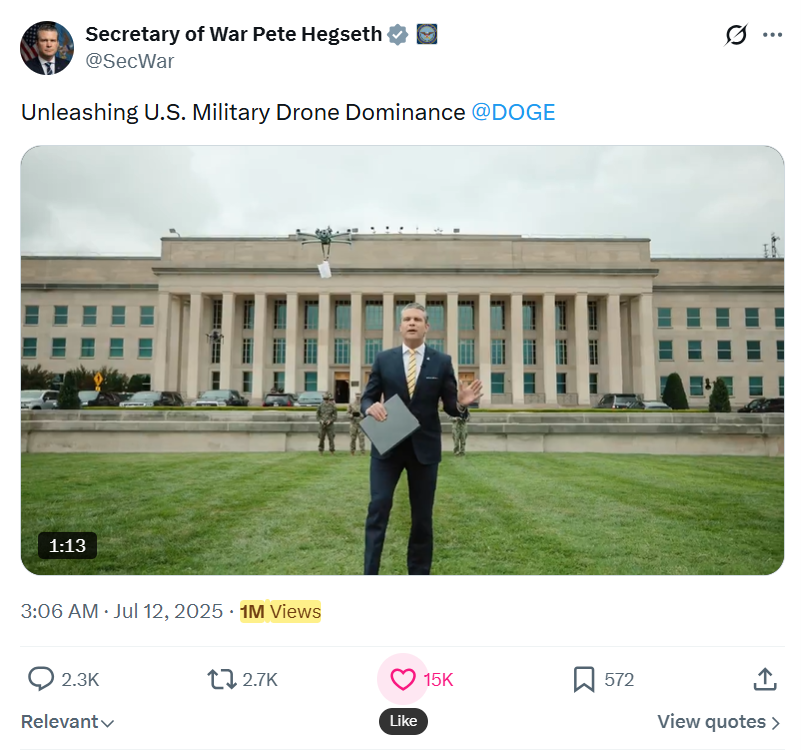
And this program is another example of political rhetoric, which just falls apart in the face of objective reality. There is no “American drone dominance” to unleash. It doesn’t exist. China dominates the drone industry. Chinese companies build 90% of the world’s drones, and even drone makers outside China source their parts from here, for assembly elsewhere.
For each and every component, there is no getting away from China:
Brushless motors—China controls at least 90% of the motors used in drones. Antennas—there are companies outside China who build them, but they cost a lot more, and Chinese-made antennas work smoothly with other Chinese components.
Next is the camera. There are Japanese and American companies of sensory equipment, but assembly of the whole camera is a Chinese industry. Precision lenses – those are also all China.
Batteries for drones is the same as every other battery—China owns the entire supply chain.
Flight Stacks illustrate the problem, even where non-Chinese alternatives are available. The technical barriers to entry are low, but US suppliers cannot compete on price, because there is no demand, and thus no reason to mass-produce them.
Drones are not complex; they’re simple. Technically anyone can build them. The China problem is the economies of scale on the manufacturing side, and the supply chains that feed the factories. China’s cost advantages are total, may as well say: The Chinese build quadcopters for civilian users across the world; an American company using non-Chinese components cannot build one for under $15,000, over three times as much. There is, again, a Chinese monopoly on batteries and motors. The batteries come from minerals on the critical supply lists, and Chinese companies monopolize the supply chains for most of them.
Getting new mines opened, and then the infrastructure scaled up for mass production would take at least ten years. That’s the supply chain problem. Then there’s the demand side: DJI is the largest producer in the world for commercial drones, and DJI and a handful of other Chinese companies have 80% market share in the United States. Their drones are high quality, high performance, and don’t cost much.
Nature photographers, YouTubers, and other content producers are the ones most people think of first, when we imagine who the buyers for drones are. But they’re big in real estate, civil engineering and surveying, inspection, and search and rescue operations by first responders. And there we see, again, that there is a far bigger market for people using drones to save people, instead of blowing them up.
American drone companies cannot compete against DJI and Autel on price or quality, so the Pentagon is a godsend for US companies. Now they finally have a customer who doesn’t care about cost, and is probably indifferent as to the quality too. That’s not true of municipal governments, usually anyway, and certainly not in industry. The military is the only client.
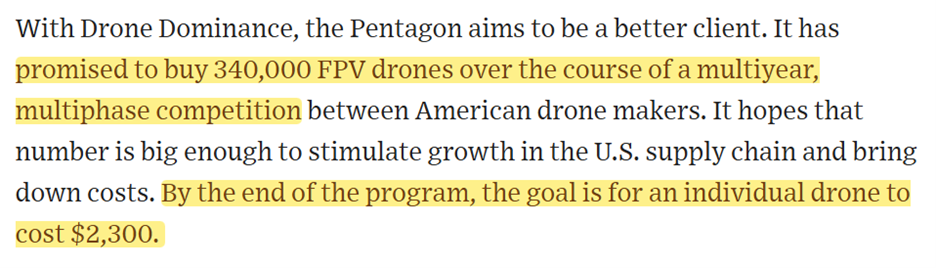
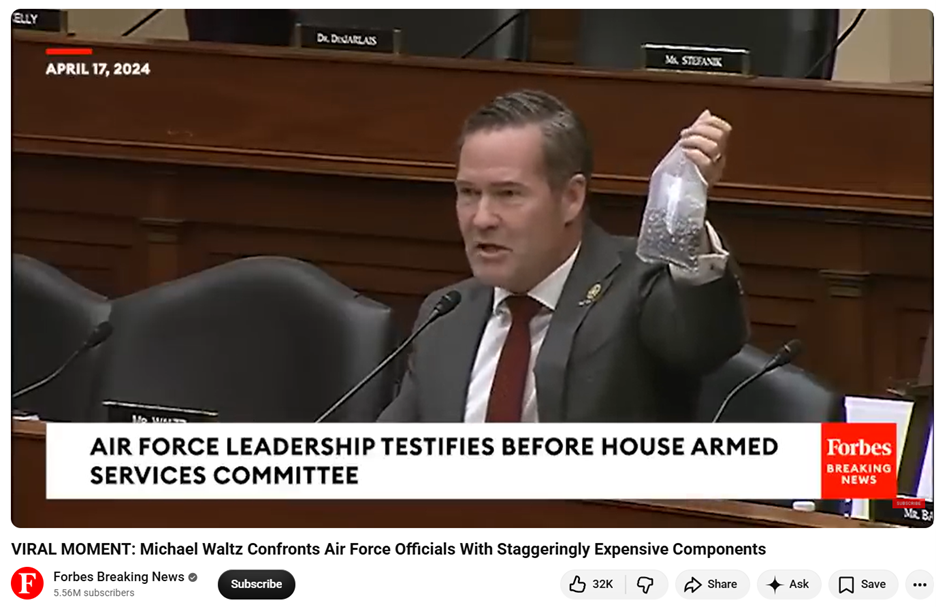
The Pentagon promised to buy 340,000 first-person- view drones over the course of several years. It hopes that order size is sufficiently large that the US supply chain will grow, competitors will come in, and the cost will fall. If that does happen, it will be the first time, in the history of the universe, that Pentagon contractors’ prices fall over time. $2,300 is the cost for a high-quality right now, from DJI. So the intended audience for that paragraph is someone who doesn’t know, for example, that the Pentagon pays $90,000 for bolts and screws and fasteners that cost a hundred bucks at Home Depot:
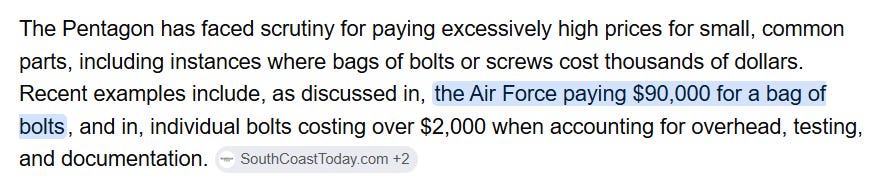
Then there’s a simple problem of politics. It will take years for American companies to learn how to produce the raw materials for these parts at all, let alone manufacture them at scale, and every presidential administration has an end date. There will be a new war secretary in January of 2029, at the latest, and the drone program itself is only funded through next year, 2027. The War Department is trying to build an industry that already exists—the current industry is already high quality and low cost.
So, the only way forward is to get DJI and Autel and the other Chinese drone makers completely out of the way, so US companies can compete. That was a relief to Skydio, and to a handful of others. This is Blake Resnick, age 25, whose company builds drones for police departments. BRINC knows they would have a lot more sales as soon as DJI drones are banned. He can sell a lot more drones to police departments who are happy with the DJI drones they’re using now.
And when the FCC did announce the ban, drone operators across the United States were furious. Immediately they began stocking up on DJI drones and parts. These are American small business owners who will be put out of business, because American drones cannot compete. They cost more, they don’t work as well, and now that they’re building for the Pentagon there’s no reason to make their products attractive to industrial or small-business users. Companies are buying drones, batteries and parts to push out the day they’ll be out of business. 43% of pilots – these are Americans – say the effect of the ban will be extremely negative and threatens their survival. 85% said their business would last for just two years or less.
There are simply no alternatives for these thousands of small companies across the United States. Now Chinese companies are banned from selling new models in the American market, and the Pentagon is buying up drones for military and weapons testing. Thousands of those higher-cost American drones are being bought for the US military, by the Department of Government Efficiency:
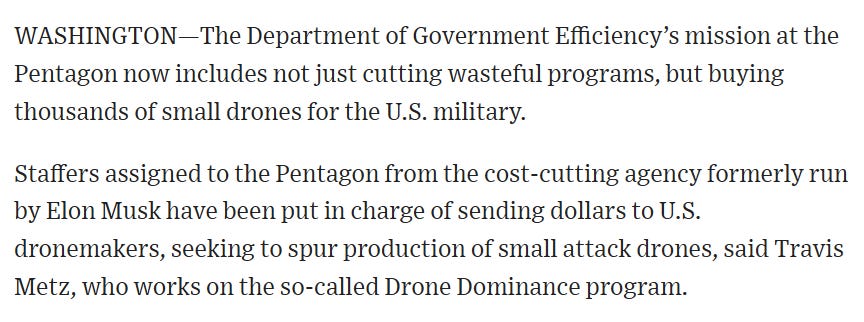
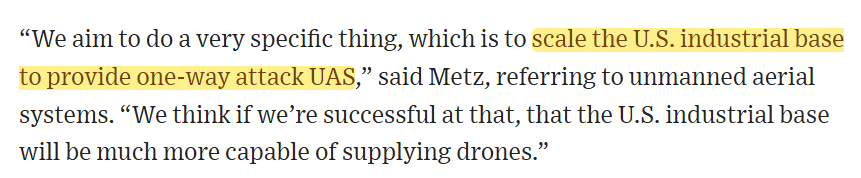
The jokes write themselves sometimes. The strategy there is to spur production of small attack drones, and scale the US industrial base to build suicide drones. Again—there is no industrial market for that. There is no business case for a one-way drone, where a good day is launching a drone that costs thousands of dollars, that doesn’t come back.
War Secretary: It’s a “new era of cheap and disposable drones.” But the only buyers in the world for “disposable” drones are militaries. And if it’s the American military, they won’t be cheap.
The Pentagon announced an event fair, where up to a dozen companies will be picked to supply 1,000 drones each, for delivery in a few months. The risk to that, of course, is that drone models from different companies will function differently, and users need to be trained to do that safely every time. They will be outfitted with explosives, after all. And another risk is that the Pentagon will buy thousands of units that are obsolete by the time they get delivered to the field.
The War Department has a lot of problems, then, when it comes to going into the drone business. The only way they can get a dozen American companies competing for contracts to build suicide drones, it to deliberately bankrupt thousands of companies across the United States who use drones in their business. And to tell hundreds of local governments and police and fire departments across the country that they cannot buy affordable drones to catch bad guys, or put out fires. That is the cost, American population-wide; that is the cost to society.
But the Pentagon has got another problem, even if they do manage to build a domestic drone industry, where they are again the only client. And that is that they will not, ever, have a monopoly on that industry outside the United States. It’s already too late for that–the idea that the United States can be the first to get this technology figured out and deployed to the battlefield. This is a mature industry, right now, and drones are in wide use, right now, by military units in the fight, right now.
That poses yet another problem: even if the Pentagon can eventually buy drones at a low cost, drones cannot be defended against at low cost.
That was a real failure of imagination, by Washington. We watched Russia and Ukraine use tens of thousands of low-cost drones to attack each other, and destroy armored vehicles and equipment that are a hundred times more costly than the drone itself. But for some reason nobody thought that Iran might be watching too.
Iran used low-cost drones to blow up American naval bases, and radars that cost hundreds of millions of dollars each. Aircraft totaling a billion or so more. And when Iran says that no ships are going through the Hormuz without their green light first, it’s with the implication that one of their drones costing a few thousand dollars could be sent toward a ship costing a few hundred million dollars, with another few hundred million dollars’ worth of crude oil in the tanks.
Nobody is even close to solving that problem yet. In the first four days of the War on Iran, the Pentagon sent up $5.7 billion worth of interceptors to shoot down very-low-cost Iranian ballistics and drones. Just in the first four days. One Patriot missile costs millions of dollars each and takes years to build, while drones are mass-produced and cost a thousand times less.
The good news, such as it is, is that some companies are hoping to build interceptor missiles that only cost tens of thousands of dollars each, instead of hundreds of thousands. The so-called Department of Government Efficiency might see that as a win these days, but we’ve just moved the decimal point over one spot. An Iranian drone costs a few thousand dollars, and these new interceptors—which haven’t been built yet—will hopefully cost just ten to twenty times that, plus remember that usually two or more interceptors are fired against a single inbound.
So we’re back to the same problem as before. Iran, in the case today, wins these engagements no matter what happens. If their drone is intercepted, it is at the cost of twenty times what Iran paid to launch their drone. If the drone is not intercepted, it may go on to blow up a headquarters building, or a radar system, or a supertanker.
That’s the real lesson, and that’s the real problem posed by drones overall. They cannot be stopped. Iran proved it. The Pentagon’s budget is a trillion dollars. Iran’s military spending for the past year was just one fiftieth of that–$23 billion. Iran doesn’t have nuclear weapons, or aircraft carriers, or stealth bombers. Those things aren’t important.
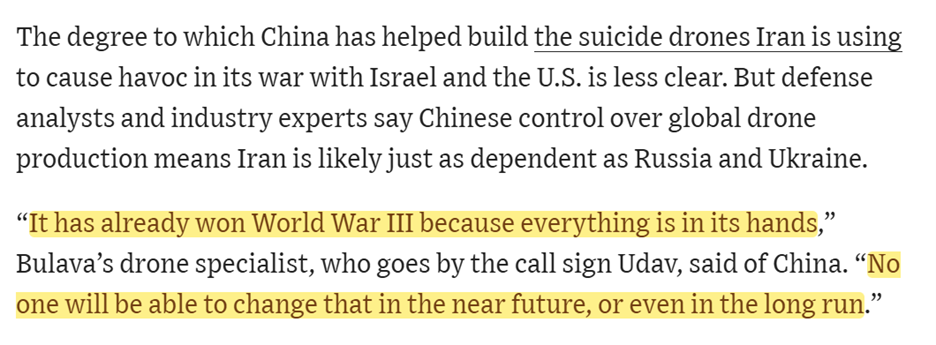
That’s the quote from the very beginning. Iran is friendly with China, Iran builds a lot of drones. And that is all that matters. In end, this could be very good news. Instead of merely transforming modern warfare, drones may just end modern warfare completely.
Be good.
Resources and links:
How are Drones Revolutionizing the Mining and Surveillance Industry
https://karkhana.io/how-are-drones-revolutionizing-the-mining-and-surveillance-industry/
Drones and laser scanning revolutionize blast monitoring with enhanced safety and precision
https://www.miningdoc.tech/2025/09/25/drones-and-laser-scanning-revolutionize-blast-monitoring-with-enhanced-safety-and-precision/
DJI still dominates the 2025 drone market — and new data proves it
https://www.thedronegirl.com/2025/11/06/2025-drone-market-dji/
Drones Can Help Mining Companies Rescue Their Workers After a Mine Collapse
https://dronearticles.com/drones-can-help-mining-companies-rescue-their-workers-after-a-mine-collapse/
The U.S. Wants to Break China’s Drone Dominance. Here’s Where It Will Struggle.
https://www.wsj.com/politics/national-security/the-u-s-wants-to-break-chinas-drone-dominance-heres-where-it-will-struggle-39e69e18
America Downs Cheap Drones With Million-Dollar Missiles. A Fix Is In the Works.
https://www.wsj.com/world/america-downs-cheap-drones-with-million-dollar-missiles-a-fix-is-in-the-works-2afff48a
At the Pentagon, DOGE Mission to Cut Costs Includes Buying Drones
https://www.wsj.com/politics/national-security/at-the-pentagon-doge-shifts-from-cutting-programs-to-buying-drones-9efc1861
Drone Makers Looking to Steer Clear of China Fear Beijing’s Wrath
https://www.wsj.com/world/asia/drone-makers-looking-to-steer-clear-of-china-fear-beijings-wrath-8fea8508
U.S. Bans New China-Made Drones, Sparking Outrage Among Pilots
https://www.wsj.com/politics/national-security/u-s-bans-new-china-made-drones-sparking-outrage-among-pilots-1624e32a
China is restricting export of drones that can be used for military purposes and some drone features
https://apnews.com/article/china-drones-export-restrictions-eb7acb88b84d97cf5fc1cbafdb650d43
China optimizes export control measures for drones, bans export intended for military purposes
https://www.globaltimes.cn/page/202407/1317107.shtml
America’s farmers and first responders love Chinese drones. And that’s about to be a big problem.
DJI drones used to feed fish
https://www.facebook.com/reel/1116979861490174
VIRAL MOMENT: Michael Waltz Confronts Air Force Officials With Staggeringly Expensive Components
DJI still dominates the 2025 drone market — and new data proves it
https://www.thedronegirl.com/2025/11/06/2025-drone-market-dji/
Drones Can Help Mining Companies Rescue Their Workers After a Mine Collapse
https://dronearticles.com/drones-can-help-mining-companies-rescue-their-workers-after-a-mine-collapse/
The Pentagon wants to build millions of drones without Chinese parts. It’s off to a bad start.
Iranian strikes on bases used by US caused $800m in damage, new analysis shows
https://www.bbc.com/news/articles/cddq7j48p35o
Iranian Strikes Have Destroyed $2.7 Billion Worth of High Value U.S. Anti-Missile Radars
https://militarywatchmagazine.com/article/iranian-strikes-destroyed-antimissile-radars
Attack On US Navy Fifth Fleet Headquarters In Bahrain
https://www.military.com/feature/2026/02/28/attack-us-navy-fifth-fleet-headquarters-bahrain.html
Footage Confirms Iranian Drone Strike Took Out U.S. Army’s Most High Value Air Defence Radar From THAAD System
https://militarywatchmagazine.com/article/iranian-drone-destroy-radar-thaad
Attack on US radar plane at Saudi base raises concern over Iran’s capabilities
https://www.theguardian.com/world/2026/mar/31/destruction-us-radar-plane-saudi-base-raises-surveillance-concerns
UNLEASHING AMERICAN DRONE DOMINANCE
https://www.whitehouse.gov/presidential-actions/2025/06/unleashing-american-drone-dominance/
Unleashing U.S. Military Drone Dominance
This 25-Year-Old Founder Wants To Kick Chinese Drones Out Of American Skies
Inside China / Business is a reader-supported publication. To receive new posts and support my work, consider becoming a free or paid subscriber.
From Inside China / Business via This RSS Feed.