


By JOHN LESLIE
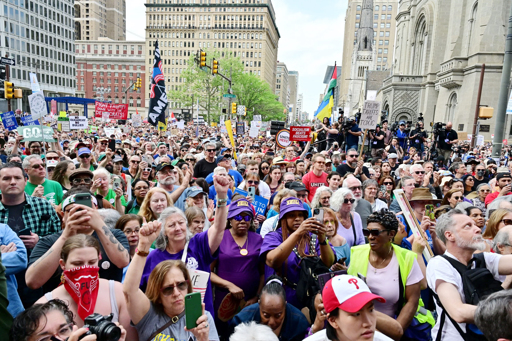
May Day Strong initiated a coalition of hundreds of trade unions and social justice groups to organize this year’s May 1 walk-outs and protests. The nationwide actions centered on antiwar, pro-democracy, pro-labor, and immigrant rights demands.
A couple of months earlier, May Day Strong, together with sympathetic legislators from the Democratic Party and other allies, issued a programmatic document, “The Real Affordability Agenda,” which tries to address the growing economic and social polarization between the rich and the working class.
For working-class people, the crisis of affordability has become more dire. Prices have been rising, rents are out of control, and many people work more than one job just to run in place. Many young workers are saddled with high debt from student loans. It’s not lost on them that the government, which is quick to bail out banks and corporations, has done nothing to help them.
The Affordability Agenda highlights the basic bread and butter questions that form the affordability crisis, calling for affordable housing, good well-paying jobs and an end to wage stagnation, affordable universal needs such as “child care with fair provider wages, free school meals and expanded food assistance alongside anti-gouging measures.” The Agenda also calls for free higher education, comprehensive health care for all, free public transit, and publicly controlled utilities.
While the planks in this program are both correct and supportable, there are limitations. If there is one lesson of the recent gutting of the Voting Rights Act, it is that no reform, no matter how hard won it might be, is permanent as long as capitalism continues to exist.
The growth of wealth inequality and the affordability crisis are the result of ruling-class attacks on working-class living standards. Capitalism delivers austerity for us and tax cuts for the ruling rich. U.S. workers, and workers around the world, have been subjected to more than 50 years of one-sided class war, with both capitalist parties complicit in these attacks. These attacks have accelerated during Trump’s second term.
The limits of reformism
The response of the Democratic Party establishment has been tentative and inadequate. Failing to come to grips with their 2024 defeat by Donald Trump, the Democrats have decided that they have to move rightward and deemphasize social issues that could be seen as “woke.”
While the base of the Democrats has increasingly rejected U.S. support for apartheid Israel, the party leadership has at best issued some mild criticisms of Israeli policy. Meanwhile, pro-Palestine progressives running in Democratic primaries have faced a massive funding onslaught by pro-Israel donors.
Formerly loyal Democratic constituencies—including many LGBTQ people, women, and Black people—should be prepared to be thrown under the bus if they haven’t been already. The Democratic Party’s social democratic wing has put forward alternatives similar to the Affordability Agenda, but these reforms will find little support inside a party that is fundamentally in service of capitalism.
Past gains made by African Americans, women, and LGBTQ people are under increasing attack. Key social safety net reforms like Medicare, Medicaid, and Social Security itself are in peril. Much of the pushback against these attacks has been expressed in opposition to Trump. While Trump is an odious figure, attacks on Trump fail to understand the systemic problem that underlies this ruling-class offensive. To be clear, Trump could not achieve his horrific goals without the support of at least a section of the capitalist class. It’s capitalism that’s the problem, not the politicians who serve our rulers.
Does this mean that socialists oppose reforms and merely want to “wait for the revolution” to achieve change? No, socialists understand that it is necessary to fight for gains for the oppressed and working class now. In fact, the fight for these reforms will radicalize many of the activists leading these fights. As revolutionaries, we want to work side by side with all steadfast fighters for economic and social justice while explaining that reforms alone won’t make fundamental change.
One essential ingredient of a strategy for fundamental change is the political independence of workers and the oppressed from ruling-class parties. Time and again, the Democrats have proven themselves to be a brake on social movements. The same is true of Democratic Party aligned NGOs, which serve to divert movements into the safe waters of electoralism and reform. Many movement leaders, from labor bureaucrats to the abortion rights movement and the Black freedom struggle, have subordinated themselves to the Democrats.
Emergency action program for the class struggle
The capitalist system is in a crisis that is environmental, political, and economic. Our ruling class wages wars overseas, has financed and supported a genocide in Palestine, and is waging war against working-class people here at home. Democratic rights are quickly eroding and the gains of the Civil Rights Movement are in danger of reversal.
The emergency we face, caused by the acceleration of the ruling-class offensive, must be combated with working-class methods of struggle and a program that goes beyond reforms and points towards revolutionary change. Workers and the oppressed have the social and economic power to bring the system to halt. During the resistance to ICE thugs in Minneapolis, the movement demonstrated this by organizing the Jan. 23 walkouts, combined with a mass action of tens of thousands marching in the streets.
While Jan. 23 was not a true general strike, it did illustrate the potential of such a strike and helped a layer of workers to visualize their potential social power.
A Workers’ Action Program to meet the current crisis must harness the power of workers, students, and the oppressed in a united fightback. Such a movement should be based on local, regional and national assemblies of trade unionists, community organizations, and organizations of the oppressed working to hammer out a program and course of action.
Protesters gather during the Workers Stand Up to Billionaires rally on May 01, 2025, in Philadelphia. (Lisa Lake / Getty Images for May Day Strong)
The post Workers need a program of action that is independent of the Democrats first appeared on Workers’ Voice/La Voz de los Trabajadores.
From Workers’ Voice/La Voz de los Trabajadores via This RSS Feed.