

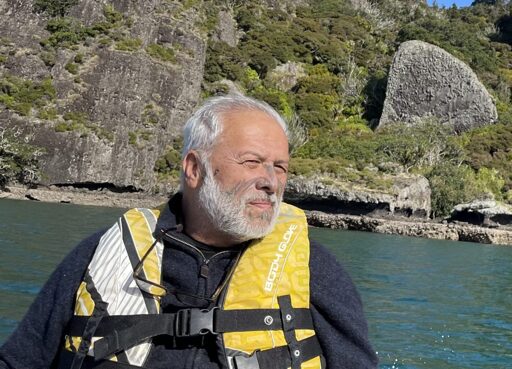

“Once again, we’re seeing the machinery of government being used to protect entrenched interests from legal scrutiny.” Mike Smith, climate change activist, whose right to sue the country’s largest emitters will be removed by the coalition government. (Photo supplied)
The government plans to overrule the Supreme Court and put an end to climate activist Mike Smith’s right to take the country’s largest emitters to court.
In 2024, the Supreme Court granted Mike permission to sue Fonterra and other major dairy and fossil fuel companies, which collectively contribute about a third of New Zealand’s emissions.
The hearing in the High Court was due to start in April next year. But now justice minister Paul Goldsmith says the law will be changed to prevent companies from being sued for damage caused by greenhouse emissions. It will apply to all current and future cases.
Here’s Mike explaining why that’s a direct hit to democracy.
I’ve spent most of my adult life involved in struggles for justice. Some of these struggles are about defending Māori rights and Te Tiriti o Waitangi. Others are about climate change, corporate accountability, and the responsibilities we owe to our tamariki mokopuna.
But at the heart of all these issues has been the same basic question: Who holds power in this country, and who is forced to live with the consequences of decisions made by that power?
That question is now coming into sharp focus with the government’s announcement that it intends to change the law to prevent climate cases like mine, Smith v Fonterra, from proceeding through the courts.
This decision is far more serious than a disagreement over environmental policy. It strikes at the constitutional foundations of our democracy. It raises profound questions about the rule of law, the separation of powers, and whether ordinary citizens can still seek justice when their interests clash with those of politically influential industries.
For seven years, I’ve pursued this case through lawful and democratic processes. I took my concerns to the courts because climate change is no longer some distant future threat discussed only in scientific reports and international conferences. It’s here now. We’re living through it.
Over the past six months alone, communities across Aotearoa have been hammered by severe weather events, including flooding, slips, cyclones, and storms of increasing intensity. Cyclone Vaianu caused widespread flooding and destruction across the North Island. Northland communities were cut off by torrential rain and slips. Waikato, Bay of Plenty, Tairāwhiti and Hawke’s Bay all experienced severe flooding, prompting state of emergency declarations. Mount Maunganui suffered catastrophic landslides after record rainfall. Wellington and Canterbury communities faced flooding damage to homes and infrastructure. Insurance claims from storms have surged as extreme weather becomes more frequent and more destructive.
These incidents are becoming part of the new reality of life in this country.
Entire communities, particularly coastal populations and vulnerable communities, are already paying the price.
The core argument behind my case has always been straightforward. If corporations knowingly contribute to dangerous climate harm, then surely there must be some legal mechanism through which accountability can be tested.
This isn’t a radical proposition. Courts exist precisely to examine difficult questions where public harm and private power intersect.
Importantly, the courts themselves recognised that these issues deserved to be heard. My case survived attempts to have it thrown out. The judiciary acknowledged that the law may need to evolve in response to the realities of climate change. That alone was a significant moment, not just for New Zealand but internationally.
Now the government proposes to intervene by changing the law while the matter is still before the courts. The proposed amendment will prevent findings of liability in torts — a type of civil case where people can seek damages for harm caused by the wrongful actions of others.
To many New Zealanders, this may sound technical or procedural. It’s not. In practice, it means that parliament may use its power to extinguish legal claims that challenge powerful corporate interests. It means that when ordinary people finally manage to get their concerns before a judge, the government can simply change the rules midstream to ensure the case never reaches a conclusion.
Māori have seen this all-too-familiar pattern before.
The clearest example was the foreshore and seabed issue. When Māori sought to test our customary rights before the courts, the government of the day responded not by allowing the legal process to run its course, but by legislating to remove those rights before they could be properly determined.
That experience left a deep scar on the relationship between Māori and the Crown. Many Māori saw it as a fundamental breach of justice and an abuse of parliamentary power. Regardless of where people stood politically at the time, the constitutional implications were profound. The government intervened specifically to prevent rights from being tested independently in the courts.
That’s why the current situation alarms me so deeply.
Once again, we’re seeing the machinery of government being used to protect entrenched interests from legal scrutiny. Once again, the public is being told that the democratic process is being respected, while the practical effect is to remove the ability of citizens to pursue justice through the courts.
I struggle to see this as anything other than a dangerous precedent.
I’ve been involved in the pursuit of justice and defending our lands, oceans and peoples long enough to recognise how power operates. During the campaigns against deep-sea oil drilling, I stood alongside iwi leaders, environmental groups, community organisers, fishermen, and young activists who understood that opening new fossil fuel frontiers was reckless. We stood up to be counted because we believed governments were failing to confront the scale of the climate crisis honestly.
At the time, we were often dismissed as unrealistic or extreme. Yet today, even conservative institutions acknowledge that the continued expansion of fossil fuel extraction is incompatible with preventing the catastrophic warming of our planet. What we were saying years ago is now accepted scientific fact.
My work has also taken me deeply into conversations about constitutional reform in Aotearoa. Under the patronage of Sir Hepi Te Heuheu and Ngāti Tūwharetoa, I helped convene working parties for a series of national constitutional hui examining the future of Te Tiriti o Waitangi and the protection of Māori rights within our political system. Later, I helped organise the National Summit on Constitutional Change at Waitangi.
Those discussions were grounded in concerns about how vulnerable rights become in a system where parliamentary majorities hold enormous, unchecked power. New Zealand has no fully entrenched written constitution. Protections for the rights of ordinary citizens are comparatively fragile. Governments can, if they choose, legislate quickly and decisively in ways that override long-standing expectations of fairness and due process.
What’s happening now with climate litigation demonstrates exactly why those concerns matter.
This isn’t simply about me — and it’s not about whether people agree or disagree with every legal argument in my case. The larger issue is whether citizens retain the right to challenge powerful interests through independent courts without political interference designed to predetermine the outcome.
If governments can change laws specifically to shut down inconvenient litigation, then public confidence in democratic institutions will inevitably erode. People will rightly conclude that there is one set of rules for ordinary citizens and another for those with wealth, influence, and privileged access to political power.
This is corrosive to democracy.
I also believe there’s a deeper moral failure at work here. Young people today are inheriting a world of increasing instability while political leaders continue to prioritise short-term economic interests over long-term survival. Future generations will live with the consequences of decisions being made right now.
As a Māori, concepts such as utu and whakapapa shape how I understand these responsibilities. We are connected to te taiao not as owners but as part of the beautiful and delicate web of life. We hold obligations to those who came before us and to those who will come after us. That worldview stands in direct conflict with political systems that treat the environment as expendable whenever profit margins or electoral calculations are at stake.
It goes without saying that the coming election will be enormously important.
All of us who seek to call this place home face a choice about the kind of country we want to live in. Do we want a system where powerful industries can rely on governments to shield them from accountability? Do we want environmental protections and access to justice treated as obstacles to economic growth? Do we accept the weakening of constitutional norms whenever they become inconvenient to those in office?
Or do we insist on something better?
I believe people across the political spectrum should be deeply concerned by what’s unfolding. Even those who disagree with my case should recognise the danger in governments intervening to prevent courts from hearing matters of major public importance. Once that precedent is normalised, it won’t stop with climate change.
We need to pay attention. Don’t treat this as somebody else’s issue. Democracy isn’t self-sustaining — rights survive only when people are willing to defend them.
The climate crisis is accelerating. Public trust in institutions is fraying. Economic inequality is widening. Māori rights remain contested. These interconnected symptoms reflect a political system struggling to balance concentrated power with the public good.
The response can’t be silence or resignation. People need to organise, speak out, challenge misinformation, support independent journalism, engage in public debate, stand with communities already suffering the impacts of climate change, and vote with a clear understanding of what’s at stake. Real change has always come from ordinary people deciding that the direction of their country matters enough to fight for.
That’s the challenge before us now.
I intend to continue that fight, both inside and outside the courtroom, because the issues at stake are bigger than any one case and any one generation.
E tū e tū! Tutū te puehu! (Rise up! Kick up the dust!)
Mike Smith (Ngāpuhi, Ngāti Kahu) is a climate change activist, a father, grandfather, and an uncle to many as a kaumātua from Te Tai Tokerau. He has more than 30 years’ experience in climate education and strategic organisation and action in Aotearoa and internationally.
For more background on Mike’s case, see Michael and the Goliaths.
The post Mike Smith: This is corrosive to democracy appeared first on E-Tangata.
From E-Tangata via This RSS Feed.