


“I stand beside Indian New Zealanders who recognise Te Tiriti o Waitangi, in the same way as I stand beside anyone who recognises our nation’s foundational arrangement.” — Denis O’Reilly. (Photo supplied)
It’s time to stand alongside Indian communities in Aotearoa, writes Denis O’Reilly.
I know what I stand for. I also know when it’s time to stand up for those beliefs. I do so now — I stand beside Indian New Zealanders as I do with all New Zealanders.
Even more closely, I stand beside Indian New Zealanders who recognise Te Tiriti o Waitangi, in the same way as I stand beside anyone who recognises our nation’s foundational arrangement.
I’m a Pākehā from Timaru. My mum, Patricia Hooper, was a highly intelligent woman, educated by French-speaking Sacre Coeur nuns, and compared to her peers, something of an intellectual. On the other hand, Dad — Dinny O’Reilly — was not highly educated, although in post-World War Two New Zealand, he was renowned as a brilliant mechanic who could adapt the engine parts of one car-maker to fit and work in a vehicle made by another.
Dad wasn’t given to reciting poetry, but he had a complimentary phrase that he used when encountering someone with an unusual or unexpected capacity. It was a line taken from Rudyard Kipling: “You’re a better man than I am, Gunga Din!”
Kipling was the voice of Victorian English imperialism. But he positioned Gunga Din, a poor and much derided Indian water carrier for the imperial army, as a heroic figure who showed greater bravery and humility than the English troops who belittled him.
And it is this phrase that springs to mind as I watch a political and cultural attack on Indian New Zealanders, fellow tangata Tiriti, play out.
This includes the political rhetoric of self-styled ”matua of the provinces”, Shane Jones, with his “butter chicken tsunami” metaphor for unfettered immigration. It also includes the “purari karikari” cultural jibes ostensibly aimed at Parmjeet Parmar, but encompassing all Indians, during the haka led by Che Wilson at the recent Tainui Regional Kapa Haka competition
Last cab first. Haka is a powerful cultural device for composers and performers to “vent their spleen”, as Tīmoti Kāretu once put it. In this instance, the venting was occasioned by Parmar’s objection, as ACT’s education spokesperson, to the University of Auckland designating safe spaces for Māori and Pasifika students, and the university’s compulsory Waipapa Taumata Rau first-year course, which focuses on Māori culture and the Treaty of Waitangi.
Parmar is a smart woman. She is a distinguished academic and someone who appreciates symbolism, as evidenced by her championing a campaign to erect a statue of Gandhi in Auckland. She has previously jumped waka (as a former member of National, now with ACT), so is clearly capable of making the cynical calculations needed in MMP politics.
It’s hard to tell if Parmar has had to swallow a dead rat to regurgitate it as ACT party policy, or if she truly believes in the sort of cultural blancmange she promotes.
I don’t agree with the cultural insults expressed by the haka. However, I understand the sentiment, and I defend the right of a Māori person to express deep feelings within the cultural context of kapa haka. This is theatre, and theatre is a global human channel to express contentious views.
In the same way, Shane Jones justifies his frequent use in English of hyperbole, bathos, pathos, ethos, and logos as devices to achieve what he calls “cut-through” in the political attention economy. When Matua Shane fulminates, it’s hard to take it seriously. After all, he’s simply bottom-trawling for crucial votes.
Kia tūpato. Let’s be vigilant. Recognising and calling out jingoistic rhetoric helps maintain a healthy balance between national pride and the need for co-operation and critical self-reflection.
These theatrics don’t reflect the ways we stand by each other.
After Cyclone Gabrielle hit our region, I sat, exhausted, outside our ruined whānau whare at Waiohiki. People I didn’t know came up the driveway with shovels and wheelbarrows. I was suddenly overcome with emotion.
A man said: “Mate, you look shattered. Go over to the marae and get yourself a feed and a drink.” I did so. An Indian family arrived at the marae with a huge pot of curry and another of rice. An Indian lady said to me, firmly: “Sit, please. Eat, please.” I thought: “This is Aotearoa.”
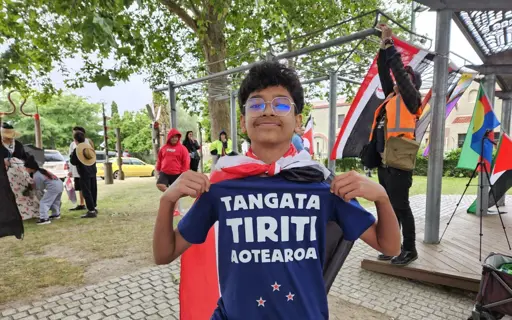
When the Toitū Te Tiriti hikoi gathered for speeches in central Hastings, Misbah, an Indian teenager, gave a most uplifting kōrero about how he felt to be a New Zealander, to be tangata Tiriti, and how he supported this constitutional arrangement we call Te Tiriti, the Treaty of Waitangi.
I was near tears, arising from hope brought by the insight of this next generation, born elsewhere but firmly located in Aotearoa.
When I presented to the justice select committee on the Treaty principles bill, on behalf of Tangata Tiriti Aotearoa, my co-presenter was an Indian New Zealander, Rizwaana Latiff. The work done by Rizwaana is a beacon for cross-cultural collaboration in the context of Te Tiriti.
This week, my son Tareha sent me a 2026 Race Unity speech, “The Courtroom of Life”, made by Hastings High School head boy Amanjot Singh, a young Sikh New Zealander. Amanjot spoke of his own dad’s encouragement to deploy the weapon of love to meet the challenge of diversity in Aotearoa, and his urging not to confuse assimilation with belonging.
As he spoke, my dad’s image arose before me again — a straightforward, plain-speaking, fair-dealing New Zealander of Irish stock. He knew little about Te Tiriti, but he knew that good people are good people wherever they come from, and whoever they are.
And in my mind, the poet’s words and my father’s voice echo still:
Though I’ve belted you and flayed you,
By the livin’ Gawd that made you,
You’re a better man than I am, Gunga Din.
Denis O’Reilly lives at Waiohiki in Hawke’s Bay, where he chairs the Waiohiki Community Charitable Trust. He is a writer, social activist and consultant.
The post The ways we stand by each other appeared first on E-Tangata.
From E-Tangata via This RSS Feed.