

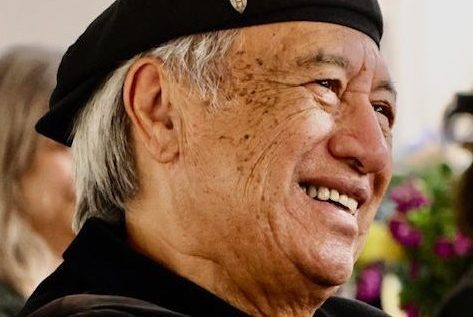

Witi Ihimaera Smiler (Photo Hary Culy)
Witi Ihimaera Smiler’s new book, Te Kaikaukau / The Swimmer, is both a memoir and an account of the year he spent in the world of te reo, as the oldest ākonga or student (aged 80) in a total immersion reo course at Te Wānanga Takiura.
In this extract from the book, he recounts his introduction to Takiura and explains the addition of “Smiler” to his name.
My first challenge was, of course, to face down the surprise and shock of all the ākonga of Takiura.
“Oh my god, that can’t be who we think it is,” they said as I walked by. “What’s he doing here?”
It’s never been entirely my fault that people assume that I am a certain kind of person — when I know I’m not. At Takiura, same old, same old. My fellow students thought I was that person, the Ihimaera, when I was really this person, Witi Smiler. Witi Ihimaera was really a construct, somebody I had created to do the mahi he does.
Try and explain that to people. They would think you’re nuts, like one of you was Dr Frankenstein and the other was the monster. Here’s how the dual identities began.
Call me Ishmael
In 1956, when I was 12, my parents shifted my sisters, brother and me from Gisborne to a farm at Te Karaka that my father Tom had purchased from a Mr Beer; across the river was leasehold land that Dad had secured on part of a 99-year Māori lease. It was quite a change from my townie life, but I loved the challenge of being a farm boy. Dad didn’t have much equity to put in except our own sweat. Even so, today I still miss that physical life and say that I would be a farmer if I wasn’t doing this.
During the evenings, in those days before electricity came to the farm, I would scribble stories on the walls of my bedroom before the lamp sputtered out, and in the mornings when I woke up half asleep from my dreams. Perhaps moemoeā were the last refuge of my lost reo, waiting there for me to reclaim as modern pūrākau when I eventually became a writer.
My sister Polly has told people that my dream-scribblings were like a chaotic spider’s web of sentences that started in one place and tangled with others across all the walls and floor. It delighted her that sometimes she would start reading a story that would peter out halfway across one wall, reappear in the knotted snarl of words on another wall, and end up in faded words underneath the bed.
I began secondary school at Te Karaka District High School the next year.
My sisters Kararaina, Polly and Viki and brother Derek went to Te Karaka Primary School. The high school and primary school shared the same grounds. You might have expected that with my whakahīhī ways I would be bullied by the Māori boys at my new school, but I never was. I have no idea why not as, if I had been one of them, I would have given myself a darn good thrashing! Instead, they gave me a koha: they took me onto their side where I watched, with them, what was happening to us.
Bear with me as I gather some important threads together that convey that my becoming a writer arose out of small but important insights — awareness — of how racist the school system was.
For instance, even though the school served an almost exclusively Māori student catchment — Te Karaka, Kanakanaia, Ormond, Puha, Mātāwai — the only Māori member of staff was the janitor-groundsman.
I am taking the following statistic from a count of heads in the school photograph for 1959, but the high-school student body comprised, give or take, 55 students, say, 40 Māori. At fifth form level, there were seven of us, but only two Māori (the other was my mate Barney Tautau).
I had opted for the “A” or Academic stream when I arrived. I didn’t ask, I took this for granted, not knowing any better. So I was disturbed when I discovered that my newfound Māori friends and whānau had been placed — whether they wanted it or not — into the “B” stream: the boys did woodwork, the girls did something called home sciences. Decisions had already been made about their political, economic and cultural worth in New Zealand.
No Māori culture took place during or after school, certainly no reo classes and, by now, the language had already been beaten out of those who had been the last left standing.
An English comprehension text we were taught in the “A” stream, Plain Sailing, had no Māori writers in it. That erasure made my blood boil, and I made a vow to write a book that would tell stories about Māori culture, compulsory for Pākehā students whether they liked it or not; that book was Pounamu, Pounamu.
Later, in my final year at District High, I was taught from another book, The Oxford Anthology of New Zealand Stories. A story written by a Pākehā author described Māori in such a demonised way that I threw it out the library window; I got caned for it.
The caning didn’t stop me from wanting to sit School Certificate at the end of 1959. I was becoming accustomed to being punished whenever I expressed an opposite view. And here’s where things got surprising.
I had to provide a birth certificate for the application to sit. When the certificate arrived by rural delivery, my name was printed as:
Witi Tame Ihimaera (Smiler).
Yes, with Smiler in brackets.
I am asking you to believe me that I was not, until then, aware of our Māori surname, Ihimaera. I spoke to Dad about it, and he told me the story of Grandad Pera’s father, Ihimaera Te Hānene (Ihimaera the Honey Gatherer or, these days, Ihimaera the Gentle Breeze). He had been a lieutenant for Te Kooti Arikirangi during Te Kooti’s War.
Adding more potency was that Ihimaera was the transliteration for Ishmael, the progenitor of the Arab nation from the Old Testament. No guessing what side I’m on in the Israeli–Palestine war. Our family story of how we acquired the surname “Smiler” was that Mormon missionaries, who converted my grandfather Pera from Te Hāhi Ringatū, couldn’t pronounce “Ihimaera” easily; they called him Smiler because that’s what the reo sounded like.
All these stories of loss of Māori identity and personal history buzzed violently in my brain. I was a boy looking for a future that would have symbolic meaning, one that would be to speak up against the theft. I advised school authorities my name would be Ihimaera for my School C registration. I didn’t tell Mum and Dad — or Grandad.
I passed School Certificate, but when the results were published, everybody thought I had failed because no Witi Smiler was listed in The Gisborne Herald. Mum and Dad were cross; even Pera turned up to ask me what I intended to do now.
“Witi passed,” Dad told him. “He registered as Ihimaera.”
I hope Pera was pleased that I had resurrected the name; he didn’t say. Ever since, Witi Smiler has remained my personal self. Witi Ihimaera is the eidolon, the construct, the person who goes out and does the mahi, the political self.
In reflection, I suspect that the person I became Ihimaera for was my grandmother Teria. Both Witi’s were always answerable to her.
Indeed, before she died in 1955, my grandmother used to say to me, “When you grow up, do good work for your people.” I always found her voice so beautiful, softly accented, and, until now, had always remembered this as if she was talking to me in English.
But I now think she spoke to me in Māori, “Kia pakeke koe e Witsh, kia ū ngā mahi rangatshira mō te iwi.” And I must have converted everything she said to me, unconsciously, into English. Why do I think this? Because English could never have replicated Teria’s singular way of speaking, our mita with its softened ‘t’s, as in Witsh or rangatshira.
What does this mean? I suspect that, while I had already lost the speaking ability, I had not yet lost the ability to understand the reo. I cannot prove it, but is it possible that during the attrition of one’s reo — during the backward slide of it into oblivion — you still keep hearing it, playing itself out in the language that is replacing it? Until the stem cells of it become so irreparably damaged that, finally, the echo effect of it fades away from your memory?
And so I recall a day, my first at Patutahi School, when Nani Teria was waiting for my return on the school bus to Waituhi.
“E Witsh, he aha rā tshe mātauranga hōhonu e i akona mai i tshe Pākehā i tshēnei rā?”
“I learnt a nursery rhyme, Nani, about a boy named Jack and a girl called Jill.”
“E hika mā! He aha rawa kē, aua ingoa! Ā, he aha hoki tā rāua i piki ai i te puke ki tshe tiki wai? He wāhi pōrangi kē tshēnā mō tshētahi puna.”
I didn’t know at the time that Teria was cautioning me about what was waiting for me in the world outside the village: a place of strangers who built wells on tops of hills and where boys wore crowns but girls didn’t. Alas, on my second day, my news for my Nani wasn’t any better.
“Auē taukuri e tshaku mokopuna pōhara! Kōrerotshia mai, e kare, ngā mātauranga hōhonu o tshe Pākehā i akona mai ki a koe i tshēnei rā, hā?”
“Another nursery rhyme, Nani,” I answered. “About a girl named Miss Muffet.”
“Āe, mārika e hoa mā!” Teria said crossly. “Ko wai rawa atu tshēnei wahine nei a Miss Muffet? He aha hoki he tuffet? Ā, he aha hoki aua curds and whey, e kai ana ia? Ā, kātahi tshe tamaiti Pākehā hoki ki te ngārara!”
“I don’t know who Miss Muffet is,” I answered. “But I think a tuffet is a chair. Curds and whey are a Pākehā porridge. And I don’t know why Pākehā are scared of spiders and don’t say hullo to them instead.”
Nani kissed me and cuddled me. “Kī atu ki a rātou kia kī atu rātou ‘Kia ora’ ki tshe pūngāwerewere, ā, me whakatakoto rātou i a rātou ki tshētahi wāhi haumaru.”
This time, Nani Teria was giving me wise advice that the world outside lived in a different way with different kai and had different values to ours. It didn’t live as close to the natural world as we did and was afraid of spiders. In many ways, all I have been doing ever since is affirming the story of the spider and making the world safe — kia ora — for them as well as us.
And what of the spider-web walls of my bedroom?
Some years after I had left the farm to go to school in Gisborne, my mother, Julia, painted all my bedroom walls with yellow paint and scrubbed the kupu off the floor.
I was numb with shock when I saw what she had done. “Why, Mum?”
“All those scribblings, son,” she shivered. “All that other world . . .”

Te Kaikaukau / The Swimmer, by Witi Ihimaera Smiler, published by Auckland University Press.
Back to Takiura.
I wasn’t the only well-known student enrolled. Others included television presenter Miriama Kamo as well as Courtney Tairi, former New Zealand netball international. Te Aomihia, daughter of Oriini Kaipara, who was at the time a television news presenter, sometimes assisted the teaching staff.
But I was certainly the oldest. I felt my capacity for learning was as good as everybody else’s, but my memory was not as quicksilver. Why would my new young school friends think I was their superior? Their memory and retention abilities would act as flotation devices in the wide sargassum sea of the year’s ocean gyre. Their brains were more attuned to the learning process, and they had managed to counteract the sheer force of white colonialism, race, history and assimilation better than I had; it was less present by the time they had been born.
So, it was kind of gloomy for me to walk to the first pōwhiri on the marae and see the waves parting before me like the Red Sea. Not as if I was Moses but somebody carrying a plague or something.
Maybe I had reached my use-by date after all.
However, some of the other younger 60- and 70-year-olds took pity on me and invited me to join them. I think my turning up gave them some relief.
A koroua had arrived who was older than they were.
The consternation continued when I arrived at my assigned class. In rumaki reo, there were five akomanga, 33 to 40 ākonga per class.
“Please tell us you’re not in the same class with us?” my new friends asked.
I took a seat way at the back along with a few of the boys — why do boys gravitate to the back! — and tried, like them, to make myself invisible. And then our pouako, Whaea Sharmain Hancy, arrived and settled the class down.
I credit this vigorous young woman with my Māori-language reset. Slim, vivacious, stylish in the Māori way with her greenstone earrings and Māori-styled clothing or hoodies, her body often swayed gracefully as she taught us — as if she were singing or chanting her lessons.
She was a clever combination of carrot and stick, pushing us from behind as well as pulling us from the front through the seas of the rumaki reo. Although the opinions and observations in Te Kaikaukau are mine, the mātauranga I write about is hers and Takiura’s. And while I’m about it, I acknowledge Sean Woon, too, a graduand who sometimes subbed for Whaea Shar. His reo was as muscular as was his physique; it had great biceps to lift the kupu.
Okay: “Whaea” was normally a title for a mother or aunt — certainly an older woman — so I had to adjust. But Whaea Shar provided the best normalisation process available to a Māori kaiako. She asked all us newbies to form a circle.
“Let’s introduce ourselves,” she said brightly.
It was pepeha time. By the time it was over, I had an akomanga of beautiful grandmothers, mothers and strong young men and women — not to mention babies chuckling and crying among us — to belong to.
They formed the heart of my whare reo.
An extract from Te Kaikaukau | The Swimmer, by Witi Ihimaera Smiler, published by Auckland University Press (RRP: $45)
For more of Witi, check out Witi Ihimaera: A writer’s memoir and Witi Ihimaera: Back at the beginning.
The post Witi Ihimaera Smiler: ‘Call me Ishmael’ appeared first on E-Tangata.
From E-Tangata via This RSS Feed.