

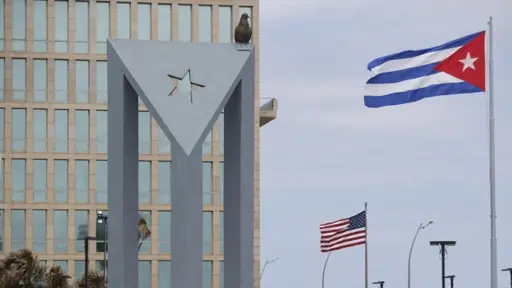
The Cuban government reported that a delegation from the United States Central Intelligence Agency (CIA), led by Director John Ratcliffe, met with the leadership of the Cuban Interior Ministry in Havana on Thursday, May 14.
In a statement, the Cuban government said that “based on the US government’s request for a delegation headed by Ratcliffe to be received in Havana, the revolutionary leadership approved the visit and the meeting with its counterpart from the Interior Ministry.”
The meeting took place “in a context characterized by the complexity of bilateral relations, with the aim of contributing to the political dialogue between the two countries as part of the efforts to address the current situation.”
The statement added that the information provided by the Cuban representatives and their exchanges with the US delegation “categorically demonstrated that Cuba does not constitute a threat to US national security, nor are there legitimate reasons to include it in the list of countries that supposedly sponsor terrorism.”
During the meeting, the US delegation could verify “the consistency and coherence in the historical position of our country [Cuba] with the actions of the Cuban government and its competent authorities in confronting and unequivocally condemning terrorism in all its forms and manifestations.”
The statement added that “once again, it has been demonstrated that the island does not harbor, support, finance, or allow terrorist or extremist organizations, nor are there foreign military or intelligence bases on its territory. It has never supported any hostile activity against the US, nor will it allow actions against another nation from Cuba.”
The Cuban government reported that the meeting served to gauge both parties’ interest in developing bilateral cooperation between law enforcement agencies, “for the security of both nations, regionally and internationally.”
Ratcliffe’s visit to Havana occurs in a context of heightened US hostility toward Cuba. The White House has imposed an oil blockade that has caused a severe energy crisis, with serious economic and social consequences for Cuba. These new sanctions reinforce the 67-year blockade and its extraterritoriality.
Alongside the reinforcement of the blockade and the unilateral coercive measures, US President Donald Trump is increasingly issuing threats of military intervention. Reports of surveillance flights by US planes and drones near Cuba have also increased, which analysts classify as a pressure campaign.
Cuba: US Formally Announces Humanitarian Aid Offer for First Time
Cuba, meanwhile, faces a severe fuel deficit and serious electricity problems, with recurring, prolonged blackouts that have affected production, services, and the population.
The situation has led the Cuban government itself, as well as several countries and organizations, including the UN, to warn of the danger of a humanitarian crisis in Cuba, which has received only one oil tanker since December 2025. Critical services such as health, education, water supply, transportation, and food are being severely affected.
On Thursday, Cuban Foreign Minister Bruno Rodríguez Parrilla reported that, for the first time, the United States government publicly formalized an offer of humanitarian aid to the island. Minister Rodríguez expressed Havana’s positive stance regarding the offer.
He also expressed hope that the aid will be free from political schemes “and attempts to take advantage of the shortages and pain of a besieged people.”
He further emphasized that the greatest benefit to the Cuban people would be the lifting of the economic, commercial, and financial blockade.
(Telesur)
Translation: Orinoco Tribune
OT/SC/SF
From Orinoco Tribune via This RSS Feed.