

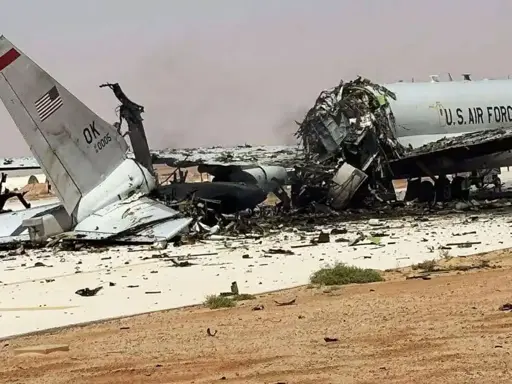

A US lawmaker has said the US has lost 39 aircraft in the failing Iran war. The number is considerably higher than previously suspected. The details emerged in a Senate hearing in the US.
The Express Tribune reported an exchange between Democratic Congressman Ed Case and Pentagon financial officer Jay Hurst “about the extent of damage suffered during the conflict”:
“We’ve lost about 39 aircraft, according to a report in The War Zone, and that’s an old one that’s almost one month old,” Case said, asking Hurst whether the Pentagon had calculated “a retention cost on all those aircraft.”
Hurst replied:
There are costs there, sir, but I want to get back to you in writing and what they specifically are, because, as you can imagine, repair of aircraft is something that’s very hard to calculate.
We want to do a full diagnosis of the aircraft before we estimate that cost.
Sounds like the Pentagon was playing for time. But Hurst did not deny the 39 figure outright.
The outlet added that according to Case:
39 aircraft were destroyed and another 10 sustained varying levels of damage.
The report also claimed that an F-35A Lightning II fighter jet was hit inside Iranian airspace and that a Boeing E-3 Sentry aircraft was destroyed.
The claims could not be independently verified, and Pentagon officials did not publicly confirm the alleged losses during the hearing.
The US has been extremely guarded about losses in the failing war — including casualties. The Intercept’s Nick Turse reported on 1 April:
Almost 750 U.S. troops have been wounded or killed in the Middle East since October 2023, an analysis by The Intercept has found. But the Pentagon won’t acknowledge it.
U.S. Central Command, or CENTCOM, which oversees military operations in the Middle East, appears to be engaged in what a defense official called a “casualty cover-up,” offering The Intercept low-ball and outdated figures and failing to provide clarifications on military deaths and injuries.
US-Israel attacked Iran first on 28 February without provocation. Iran was offeringunprecedented concessions in negotiations at the time. The Pentagon has sincestated there was no imminent threat from Iran. And the UN’s atomic watchdog, the IAEA, has said there isno evidence Iran was developing a nuclear weapon.
The US has achieved none of its original war aims. Iran predictably closed the Straits of Hormuz, a vital oil channel, once attacked — creating a global energy crisis. Far from being defeated, Iran has said the war will continue until:
the enemy’s inevitable and permanent humiliation, disgrace, regret, and surrender.
Trump came to power on an anti-war ‘America First’ ticket. He now faces worldwide humiliation. The US president is currently scrambling for an off-ramp from the war he started.
Featured image via NBC
By Joe Glenton
From Canary via This RSS Feed.