

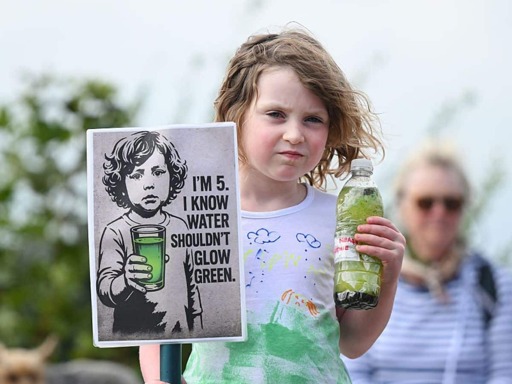

Campaign group Save Lough Neagh are set to hold a major march on Sunday, May 17 to highlight the water body’s plight from years of profiteering abuse. It will fall on the anniversary of a landmark 1986 rally against lignite mining.
Marchers will follow the same route as the 3000 who attended 40 years ago, going from The Battery Bar on the lough’s shore, to Ardboe High Cross around two miles to the south. In 1986, campaigners fought back successfully against lignite strip mining in the area, which would have had a devastating impact on the environment.
Farmers and fishers would have potentially had their livelihoods destroyed through damage to the water table, loss of farmland and water pollution. Lignite is also the filthiest form of coal, an already highly pollutive fossil fuel, so the wider implications for mining were also severe.
Energy companies such as BP Coal were ultimately forced to relent in their plans to open the area for exploitation in 1988.
Rent-seeking Earl a symbol of long environmental exploitation
The activists didn’t stop Lough Neagh ultimately entering its current dire state, however, caused again by greed. Save Lough Neagh said ahead of Sunday’s march:
Stormont has failed our Lough, putting private interests, profit and growth above our natural environment and rights to clean drinking water. Meanwhile the Earl of Shaftesbury continues to earn money on sand dredging, disturbing the fragile ecosystem, while holding the Lough back with demands.
It’s a sign of the depth of environmental exploitation in Ireland when an English Earl is still hoovering up rents from the wreckage caused. The Shaftesburys inherited Lough Neagh in the 1800s. The English aristocracy has a history of this sort of thing, having essentially wiped out Ireland’s rainforests for the sake of farming and timber. The timber was then used for Britain’s navy that helped to conquer and terrorise much of the world.
Sand dredging of the kind the Earl profits from was found to have potentially “profound negative ecological consequences“. Researchers from Queen’s University Belfast said:
We have used sonar to map the bed of Lough Neagh and we have found that where sand is extracted, it can be lowered by 10 to 20 metres and is heavily scarred.
This process of sedimentation — churning of sand and silt — could also “reduce the water clarity and quality”, and “harm wildlife throughout the ecosystem”.
More recent damage has been caused by massive local farms that were allowed to get away with pumping shit into the lough for years in the 2010s, with Save Lough Neagh blaming:
…the 5 main parties of Stormont who backed disastrous Going For Growth agri-policy, [and] give rates relief and subsidies to massive polluters.
This is likely in reference to the Democratic Unionist Party, the Ulster Unionist Party, Alliance, the Social Democratic and Labour Party, and Sinn Féin. People Before Profit can be regarded as not carrying similar blame, and backed Sunday’s march.
Packham backs campaign to Save Lough Neagh
Also backing it is celebrity environmentalist Chris Packham, who said:
The destruction of Lough Neagh is a national scandal unfolding in plain sight. One of these islands’ most important freshwater ecosystems is being sacrificed because governments and regulators have failed to act with the urgency this crisis demands.
Toxic algae, collapsing biodiversity and sewage pollution are not inevitable, they are the consequences of political choices. People marching on May 17 are standing up not only for Lough Neagh, but for every community’s right to clean water and a healthy environment.
Neoliberal policies around the world are leading to this kind of de-development, where something like clean water — once taken for granted — can no longer be guaranteed. The only way to change it is to fight back with people power, as those in 1986 did.
Declan Coney, one of the veterans from that campaign said:
I was here at the very first lignite rally in 1986 where 3000 people marched this. Fishing families, local families, farming community. They all come [sic] here to say “No, enough was enough” to the lignite and to any exploitation of the lough at all.
He continued:
Our government has let us down constantly with soundbites. Talk is cheap. Time for action now.
Featured image via Charles McQuillan/Getty Images
From Canary via This RSS Feed.