

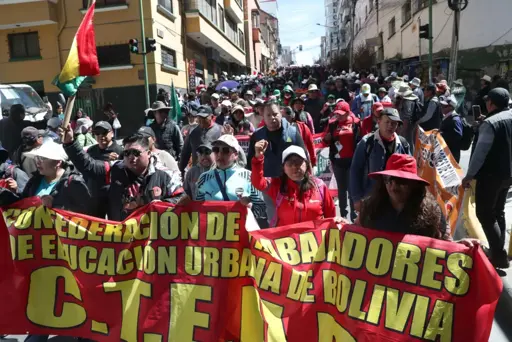
Friday, May 15, marked the 12th day of the indefinite general strike called by the Bolivian Workers’ Central. The strikers are demanding the resignation of President Rodrigo Paz.
Amid daily marches that fill the center of La Paz and a roadblock that shows no signs of easing, the workers’ union and peasant organizations have reaffirmed their decision not to abandon their pressure tactics until the government addresses their demands.
Cooperativas Mineras marchan en La Paz en protesta contra el gobierno. Tienen su propio pliego de demandas. @teleSURtv pic.twitter.com/u0rmDkdhng
— Freddy Morales (@FreddyteleSUR) May 14, 2026
The situation has escalated following failed negotiations over a proposal with more than 100 demands from 70 affiliated unions. The unions are now on strike against Paz’s administration, marked by corruption and rising costs of basic services.
Sixty roadblocks throughout the country
The department of La Paz has 47 of the 60 roadblocks reported nationwide. The disruption to traffic has heavily impacted three of the country’s nine departments.
The peasant sectors have warned that they will not back down and are prepared to resist any attempt to evict them from the blockades.
The causes of the discontent
Among the issues that have ignited workers’ indignation is the doubling of the price of low-quality fuel, which has caused mechanical damage to thousands of vehicles and increased transportation costs.
In addition, there is the questionable case of 32 suitcases that the authorities brought to Bolivia from the United States four months ago. The contents of the suitcases remain a state secret.
Government threatens with police and military action
In response to the prolonged strike, the chief of the Bolivian police, Mirco Socol, announced that operations to unblock roads will begin soon.
However, the police will not act alone. Socol confirmed that the police will have the support of the armed forces to ensure the roadblocks are evicted.
Similarly, the Attorney General’s Office declared that it is ready to initiate immediate legal proceedings against those who lead pressure tactics or use violence during the operations. It called the blockades an attempt to destabilize democracy.
With security forces ready to intervene and unions entrenched on the routes, the country is entering the most critical phase of the indefinite strike.
(Telesur)
Translation: Orinoco Tribune
OT/SC/SF
From Orinoco Tribune via This RSS Feed.