

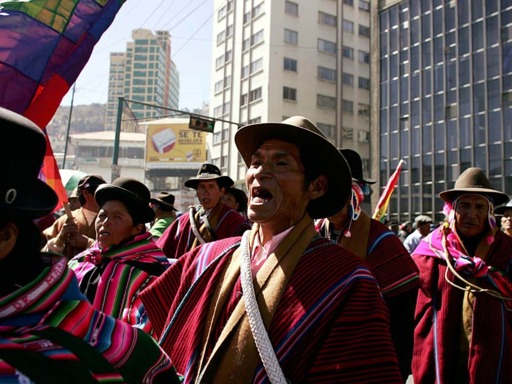

Trade unions and workers across Bolivia are marching on another general strike against the neoliberal administration led by Trump ally President Rodrigo Paz.
Thousands of miners clashed with police in La Paz on Thursday, demanding the resignation of the neoliberal Bolivian President Rodrigo Paz over the country’s economic crisis.
The government says Paz, in power six months, will not step down. pic.twitter.com/aVQ7GgvRvg
— comra (@comrawire) May 15, 2026
Bolivia — general strike
Workers decided to strike indefinitely following the Paz administration’s refusal to negotiate on laws that undermine the rights of peasants and indigenous territories.
The people are marching upon the administrative capital, La Paz, from all corners of the Andean country. The strikes are being coordinated by the largest miners’ union (FSTMB) and the confederation of peasant workers (CSUTCB).
One spokesman for the unionised workers condemned the “neoliberal” government and stated online that the long march comes
… in repudiation of this government that only wants to turn us into another US colony. … We are sovereign. Here, we govern ourselves.
We are firmly in this fight until the very end.
CSUTCB and COB, the Bolivian Workers’ Central union, call for Paz’s resignation.
A general strike is now underway in Bolivia, this time calling for the resignation of the neoliberal President Rodrigo Paz.
Causes:
– Fuel crisis
– Inflation
– Govt proposals to privatize natural resourcesThe neoliberal experiement is already a failure. pic.twitter.com/e0qYkkBlHg
— Ollie Vargas (@Ollie_Vargas_) May 12, 2026
What sparked the strikes?
Bolivia’s plurinational, largely indigenous and generally low-income population has been beset by recurring fuel crises. These were caused in part by fuel subsidies, which massively benefitted the poorest but led to black market trade and state losses.
Back in January, Paz’s economy Minister Gabriel Espinoza said that cutting subsidies on gasoline and diesel would save public finances $10m per day.
Union leaders accused the government of ‘buying off’ specific sectors to undermine the strike’s legitimacy, after Paz rescinded a meeting in the presidential palace with the COB executive and miners’ federation (FSTMB) leader Andrés Paye.
The collapse of natural gas industrialism in Bolivia met with dwindling supplies of foreign currency. The result was soaring inflation, supply shortages and higher prices. Bolivians often queue for hours for fuel and US dollars trade at twice the official rate.
Relatedly, the country — alongside neighbouring states currently undergoing neoliberal restructuring, notably Argentina — has suffered crippling inflationary pressures. This only intensified since the fuel shocks generated by the criminal US-Zionist war on Iran.
Another trigger for the strikes was the introduction of Law 1720, which threatens to overturn the country’s historically progressive laws recognising indigenous land rights. These were won by Evo Morales’ indigenous-led Movement Towards Socialism (MAS), but Law 1720 sought to privatise the land for foreign extractive corporations.
Yet, at a public meeting in La Paz this week, representative of the strikers and peasant union leader Oscar Cardozo declared:
Our life is collective, not individual. The land must be respected; it’s not for sale.
Democracy Now! reports that the Paz administration already repealed Law 1720 on 13 May, but the strikes continue anyway in disgust at the US-aligned regime.
Only six months into its rule, Bolivia’s neoliberal government is failing.
Indigenous movements and trade unionists launched a general strike yesterday, demanding President Paz resign in response to his land privatization efforts and economic crises. pic.twitter.com/zIxljiF26W
— Jacobin (@jacobin) May 13, 2026
The recolonisation of Bolivia
When Paz was elected in late 2025 and took office that November, he did so on a platform of “capitalism for all.” This signalled a hard break from two decades of MAS.
While he is often described as “centre-right,” Paz wasted no time aligning himself with the far-right, imperialist Trump administration. Colonial war-hawk Marco Rubio quickly congratulated Paz following his surprise election win.
Elected on a neoliberal policy platform, Paz is the (white) Spanish-born relative of two ex-presidents. As mayor of Tarija, Paz built commercial malls and plazas which offered the city’s predominantly working-class population very little.
Paz swiftly legalised Elon Musk’s Starlink—overruling considerable privacy and data security concerns—and reestablished ties with genocidal and apartheid-ruled Israel.
Paz arrested ex-president Luis Arce over corruption allegations. He promised to ‘reopen’ Bolivia’s critical mineralresources to international markets (read: sellout vital national assets), warmly welcomed by hemispheric hawk Marco Rubio.
Paz eviscerated universal fuel subsidies, sending gas, diesel, bus, and food prices soaring—sometimes 160%—and crippling many households across the low-income plurinational state.
Day 2 of Bolivia’s general strike, demanding the resignation of neoliberal President Rodrigo Paz.
Rural communities are marching on the capital, will arrive by end of the week. They say the long march is “in repudiation of the government that wants to turn us into a US colony”. pic.twitter.com/2D9rNe3iy8
— Ollie Vargas (@Ollie_Vargas_) May 13, 2026
Movement away from socialism?
Paz’s presidency constitutes the reassertion of a traditionally white-dominated ruling class (~5%) over a majority indigenous (~20%) and mixed-race (~68%) population. It’s also self-evident backlash against the wildy popular and progressive MAS.
Evo Morales’ popular Movimiento al Socialismo (MAS) party dominated Bolivian politics for two decades. MAS saw sweeping recognitions of indigenous rights, side-lined by the prior constitutional arrangement. It advanced sectors like public healthcare, education, and infrastructure. Evismo became a grassroots power-symbol for global leftism.
But socialism is difficult to administer in the world’s largest informal economy. Eventually, MAS became mired in political infighting and — via corruption — abandoned many populist promises. After two decades and Morales’ blocking, MAS lost power.
But though Bolivians grew wary of MAS, many still demand economic dignity. In response to various ensuing neoliberal reforms, COB, the largest trade union congress, initiated an indefinite general strike at the start of 2026.
Throughout early 2026, COB-affiliated workers led demonstrations and roadblocks, leaders refusing to negotiate with a president intent on dividing social movements and reversing progress. The workers then went on strike again in March 2026.
Now Bolivians march again, defying the state’s movement away from socialism. One unionised indigenous food-seller, Vilma Paredes, told the Canary:
Who knows, maybe we’ll discover that we don’t need political leaders — we just need to organise ourselves for the common good. That’s my opinion.
Featured image by Spencer Platt/Getty Images
From Canary via This RSS Feed.