

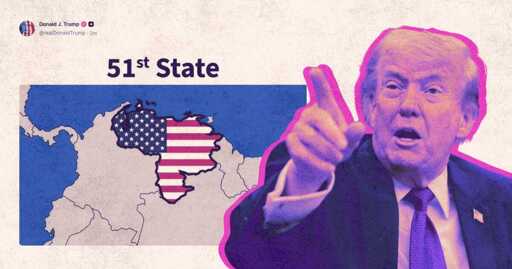
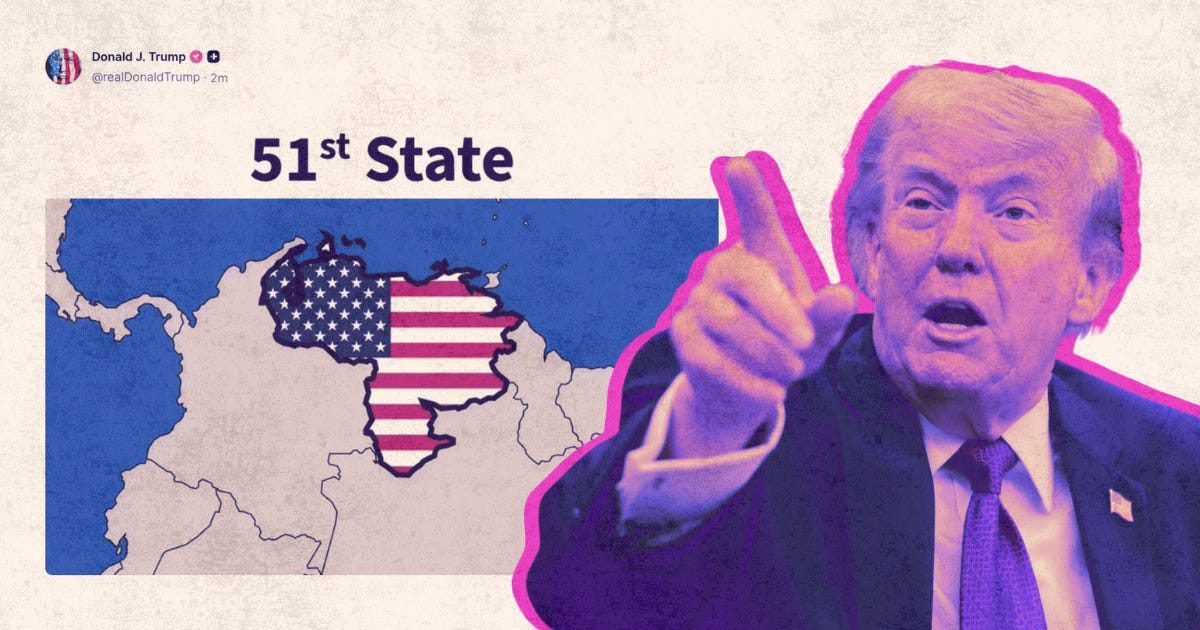
Historical vertigo. That is what I felt when the official White House account posted an image of Venezuela covered by the U.S. flag and labeled it the “51st State.” Not because I believed annexation was literally imminent, but because of what the image symbolized: a strange sensation of watching two centuries collapse into a meme.
CODEPINK Substack is a reader-supported publication. To receive new posts and support our work, consider becoming a free or paid subscriber.
In one crude graphic, the deeper logic that has shaped Washington’s relationship with Latin America for over two centuries was revealed: the idea that the hemisphere ultimately exists within the orbit of U.S. power.
And perhaps nowhere does that contradiction become more historically charged than in Venezuela.
Venezuela was born out of one of the foundational anti-colonial struggles of the modern world. Independence leader Simón Bolívar did not simply lead a war of independence against Spain. He envisioned the liberation of Latin America as a civilizational project: a sovereign bloc capable of resisting domination from any empire, European or otherwise. Bolívar led campaigns that liberated what are now Venezuela, Colombia, Ecuador, Peru, Panama, and Bolivia.
Bolívar understood very early on that the newly rising power in the north could become as dangerous to Latin America as the old European empires. In 1829, he warned that the United States seemed “destined by Providence to plague America with misery in the name of liberty.”
Bolívar was identifying an underlying contradiction: that a powerful republic–the United States–could use the language of freedom while pursuing domination. Two centuries later, that contradiction remains central to hemispheric politics.
Historically, mature great powers have often preferred informal empire to formal annexation. After achieving domination, they often prefer indirect control: favorable trade arrangements, military alliances, debt structures, sanctions regimes, intelligence partnerships, elite cooptation, and cultural influence. Formal annexation is expensive, politically risky, and often unnecessary.
Trump’s “51st state” discourse is less a realistic policy proposal than a symptom of anxiety inside a declining unipolar order.
To understand why, one must first understand how U.S. hegemony in the Western Hemisphere historically functioned.
The Monroe Doctrine, announced in 1823, was initially framed as a warning to European powers against further colonization in the Americas. Latin American independence leaders had just defeated the Spanish Empire across much of the continent. On paper, the doctrine appeared anti-colonial.
In practice, however, the doctrine gradually transformed into something else entirely: a declaration that Latin America belonged inside an exclusive U.S. sphere of influence.
Throughout the twentieth century, Washington rarely needed formal territorial annexation to achieve regional dominance. It developed far more efficient instruments.
In Central America and the Caribbean, the United States deployed military occupations and direct interventions, but left U.S. puppets to govern. In South America, especially after World War II, the preferred mechanisms evolved into financial leverage, intelligence operations, elite alliances, and NGOs at the service of Washington.
The goal was not necessarily to govern countries directly - and even less to promote democracy - but rather to ensure that governments remained compatible with U.S. strategic and economic interests.
When governments moved too far outside those boundaries, intervention followed. Guatemala in 1954 after land reforms threatened United Fruit interests. Brazil in 1964. Chile in 1973. Nicaragua throughout the Contra war. Panama in 1989. The methods differed, but the logic remained remarkably consistent: political sovereignty was tolerated only insofar as it did not disrupt hemispheric order under U.S. leadership.
For decades, this system functioned because the United States occupied an overwhelmingly dominant position within global capitalism. But that world is changing.
The emergence of China as a major economic actor transformed Latin America’s geopolitical environment. For the first time in generations, countries historically dependent on Washington acquired alternative partnerships. China finances infrastructure, transportation systems, energy projects, telecommunications networks, and commodity integration across the Global South. Russia provides military and energy cooperation. Iran creates alternative trade channels under sanctions. BRICS institutions increasingly position themselves as mechanisms outside traditional Western financial control.
None of these actors are altruistic. But together they create something historically significant: options.
And hegemons become anxious when monopolies disappear.
That matters enormously for Venezuela because Venezuela is not only an ideological problem for Washington. It is a geoeconomic one. Venezuela possesses the largest proven oil reserves in the world. For most of the twentieth century, Venezuelan oil flowed comfortably inside a U.S.-dominated hemispheric order. When Hugo Chávez came to power in 1999, he disrupted the assumption that strategic resources in the hemisphere would remain aligned with Washington indefinitely.
The Chávez project attempted to transform oil sovereignty into geopolitical autonomy. That was the real threat.
Sanctions became Washington’s primary instrument after regime change efforts failed. But sanctions reveal an important contradiction of modern U.S. power: they function best when no viable alternatives exist. The more fragmented the global economy becomes, the harder it is to permanently isolate states through economic coercion alone.
The recent annexation rhetoric reveals a symptom of anxiety inside a declining unipolar order. The fear that coercive measures may no longer guarantee long-term geopolitical alignment in a multipolar world.
Under Nicolás Maduro, Venezuela became one of the clearest examples of a state subjected to relentless external pressure aimed at forcing political and economic realignment: sanctions, asset seizures, recognition of a parallel government and repeated regime change operations. Yet, despite years of maximum pressure, Washington still failed to reassert uncontested control over Venezuela, revealing the limits of U.S. dominance in an increasingly multipolar world.
That contradiction helps explain the escalation that followed: the 2026 kidnapping of President Maduro and First Lady Cilia Flores, growing pressure on Interim President Delcy Rodriguez and renewed efforts to restructure Venezuela’s political and economic order more directly around U.S. strategic interests.
For many Latin Americans, the “51st state” image activated a painful historical memory: occupations, coups, sanctions, protectorates, debt dependency, military interventions, and repeated attempts to subordinate regional sovereignty to external power.
The discomfort many Venezuelans felt was not merely ideological. It was historical. Because regardless of one’s position on the Venezuelan government, there is something profoundly unsettling about watching the homeland of Bolívar, a nation born from an anti-colonial war for sovereignty and self-determination, casually imagined by the White House as territory to absorb under another empire’s flag.
Add your name to the international solidarity letter to let Maduro, Cilia Flores and the Venezuelan people know they are not alone. Send a message of solidarity to Nicolás Maduro and Cilia Flores
Michelle Ellner is the Latin America campaign coordinator of CODEPINK.
From CODEPINK Substack via This RSS Feed.
You must log in or # to comment.
deleted by creator
