

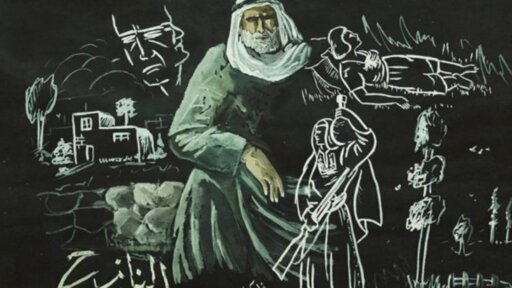
Since 1948, May 15 has been a day of suffering and remembrance. On this day we honor the memory of the victims of the ethnic cleansing of Palestine, the 700,000 Palestinians forcibly expelled, dispossessed of their lands and property, and forced onto the roads of exile. These commemorations represent a victory of memory against Israeli historiography, which has attempted to erase the bloody origins of the colonial state.
But on this day, we will not only reflect on the memory of the massacres and ethnic cleansing of 1948. While Israel has been carrying out genocide for two and a half years, while Trump aspires to implement his ultra-colonial plan for Gaza, and while the U.S. and Israel have launched a new imperialist war of aggression against Iran, the commemoration of May 15 takes on a much broader significance. In this context we are reminded that the first Nakba was but a prelude to a larger struggle against imperialism and the ongoing genocide of the Palestinian people in Gaza.
The Ethnic Cleansing of Palestine and the Origins of the State of Israel
As in any colonial situation, the conqueror writes its own memoirs, relegating the testimony of the vanquished to oblivion. For a long time, Israel tried to silence the memories of the Nakba: the Palestinians supposedly left of their own accord, at the behest of Arab leaders who, barely had Israel’s independence been proclaimed, went to war against the Jewish people. Since the opening of the Israeli archives in 1978, and thanks to Palestinian historians and Israeli “new historians,” we now know that the expulsions began the day after the Peel Commission’s partition plan for Palestine was adopted on November 29, 1947, and ratified by UN Resolution 181.
Between November 1947 and January 1948, the Palestinian bourgeoisie (approximately 70,000 people) voluntarily left the land they sensed they were about to be dispossessed of. In late December 1947, an attack by the Irgun (the paramilitary wing of Revisionist Zionism) in Haifa sparked an Arab uprising, which the Haganah (the early incarnation of the Israeli Defense Forces) violently suppressed. In January 1948, the Haganah devastated Sheikh Badr, while the Lehi (a fascist splinter group of the Irgun) carried out terrorist campaigns in Lifta and Romema. 1Jean-Pierre Filiu, How Palestine was lost and why Israel did not win: History of a conflict (19th-20th century) , Paris, Seuil, 2024, pp. 164-165. The “Daleth” plan was adopted on March 10, 1948. As Henry Laurens summarizes, it aimed to:
To mount operations against enemy population centers located within or near our defensive system in order to prevent their use as bases by an active armed force. These operations can be divided into the following categories: – destruction of villages (setting them on fire, blowing them up, laying mines in the debris), especially when dealing with population centers that are difficult to control continuously. – to mount sweep and control operations according to the following guidelines: encirclement of the village, search within. In case of resistance, the armed forces must be eliminated and the population must be expelled outside the state borders. The villages thus emptied must be included in the fixed defense system and must be fortified if necessary. 2Henry Laurens, The Return of the Exiles: The Struggle for Palestine from 1869 to 1997 , Paris, Robert Laffont, 1998, p. 653. Based on the work already cited by Jean-Pierre Filiu.
Making villages and urban centers prime targets, the Haganah and its terrorist branches, the Irgun and the Lehi, led by Avraham Stern who was close to Italian fascism, had carte blanche to carry out the systematic expulsion of Palestinians, as in Deir Yassin on April 9, 1948. These operations were prepared long in advance thanks to intelligence collected on Palestinian villages by the Yishuv military forces, trained by the British colonial forces, as shown by Ilan Pappé in The Ethnic Cleansing of Palestine.
In early May, Ben-Gurion welcomed the outcome of the operations, marveling at the empty neighborhoods of Haifa, describing it as a “terrifying and magnificent sight,” before adding: “What happened in Jerusalem and what happened in Haifa can happen in large parts of the country, if we hold firm.” 3Reported by Tom Seguev, A State at any Cost , New York, Farrar, Straus and Giroux, pp. 416-418. By the time the State of Israel was proclaimed, approximately 400,000 Palestinians had been expelled, representing more than half of the Nakba refugees. A report dated June 1, written by Israeli army intelligence, further refutes the theses of Israeli historiography: according to its author, of the 391,000 Palestinians expelled, 55% were expelled by Israeli military operations, 15% by attacks by the Lehi and the Irgun, 22% by the climate of “terror” imposed by the armed forces, 2% by expulsion orders and 5% by calls to flee the country. 4Benny Morris, “The Causes and Character of the Arab Exodus from Palestine”, Middle East Studies , 22-1, 1986, p. 6-11.
Two further waves of expulsions followed: during the summer of 1948 and then in the autumn, Eastern Galilee, Central Palestine, and then Central Galilee were meticulously emptied of their Arab, Muslim, and Christian populations. 5 Jean-Pierre Filiu, How Palestine Was Lost …, op.cit ., p. 168-169. While the Peel Commission had granted Israel 55% of the Palestinian territory in 1947, by the time of the ceasefire signed on January 7, 1949, Israel controlled 78%, whereas the settlement had possessed only 7% of the land at the end of the British Mandate. Nearly 700,000 Palestinians were expelled from their land.
The UN would again justify ethnic cleansing by adopting Resolution 273, which, by admitting Israel as a member state, retrospectively declared ethnic cleansing an act of self-defense. The Israeli Absentee Property Law then ratified the dispossession of the Palestinians and the mass theft of their lands and homes, the keys to which they retained as a relic of sorrow and hope. May 15, 1948, thus marks less the beginning of ethnic cleansing than it separates the first two waves of expulsion, from November 1947 to May 1948, from those of the summer and autumn of 1948.
May 15: An Anti-Imperialist Commemoration
The Nakba also cuts through the entire century. It is the concrete result of the implementation of a violent political ideology, but it also foreshadowed the endless succession of calamities that have since befallen the Palestinian people. The Nakba is a historical monad, an event that encapsulates its past and heralds its future. May 15 thus demands not only compassion for the victims but also condemnation of the perpetrators and their accomplices.
The “catastrophe” that we remember today is first and foremost the result of a deadly encounter between a hybrid ideology and the interests of imperialism. This hybrid ideology — Zionism — was indeed a minority doctrine among European Jewish communities, born at the crossroads of Slavic nationalism, European colonial ideology, and secular messianism. Instrumentalizing Judaism to “justify the return to the homeland and legitimize its reconquest,” one of the organic intellectuals of the Zionist movement, Aharon-David Gordon, advocated the construction of what he called an “integral nationalism.” The goal of this nationalist project was to revitalize the European Jewish diaspora by rooting it in a national soil where the Jewish people would be reborn through working the land.
Echoing the antisemitic clichés of his time, Gordon presented work as the means to halt what he called “Jewish degeneration.” Through it, the Zionist nation could, according to Gordon, both be reborn from exile and establish its colonial right to the land of Palestine. Adopting the rhetoric of European colonialism, Gordon considered work the principle legitimizing conquest: “One thing remains certain: the land will belong most to whichever of the two peoples is most capable of suffering for it, the one who knows how to work it most, will know how to suffer most over it. This is only logical, it is only just: such is the nature of things.” 6Aharon-David Gordon, “An Irrational Solution”, Writings I , op.cit ., p. 96. A spiritual father to Ben-Gurion, who had studied alongside him, Gordon thus blended the antisemitic propaganda of his time with the European colonial ideal, formulating his nationalist project in religious language. It was his ideas and writings that the first settlers brought with them during the initial waves of immigration. However, Ben-Gurion’s sect could not have gone very far without the support of British imperialism.
In an article published in 1920, Winston Churchill rejoiced at the progress of the Zionist movement in Palestine. 7Winston Churchill, “Zionism Vs Bolshevism; Struggle For The Soul Of The Jewish People,” The Illustrated Sunday Herald , February 8, 1920. Displaying a completely unabashed antisemitism, the future Prime Minister distinguished between three categories of Jews and separated the “good” from the “bad” Jews. After describing the assimilated “national Jew,” Churchill went on to talk about the “international Jews,” whom he associated with the communist movement: “From the time of Spartacus-Weishaupt to that of Karl Marx, by way of Trotsky (Russia), Béla Kun (Hungary), Rosa Luxemburg (Germany), and Emma Goldman (United States), this worldwide conspiracy to overthrow civilization and to reconstitute society on the basis of arrested development, envious malevolence, and impossible equality, has continued to grow.”
For Churchill, the “Zionist Jews,” who constituted the third category, would make it possible to contain the “Judeo-Bolshevik” threat while preventing “national Jews” from representing too large a portion of the European population. He even went so far as to lament that Palestine was “far too small” to accommodate the entire “Jewish race.” “Palestine is far too small to accommodate more than a fraction of the Jewish race, and the majority of national Jews do not wish to go there. But if a Jewish state were to be created in our lifetime on the banks of the Jordan, under the protection of the British Crown, and capable of uniting three or four million Jews, it would constitute an event in world history which, from every point of view, would be beneficial, and would be particularly in harmony with the most genuine interests of the British Empire.”
Assisting the colonial forces of repression during the Great Arab Strike of 1936–1939 and suppressing the insurrection, the Zionist colony gradually deepened its grip on the local economy, eventually freeing itself from British tutelage and transforming the “national home” mentioned in the Balfour Declaration into a supremacist state. 8Maxime Rodinson, Jewish People or Jewish Problem?, Paris, La Découverte, 1997, pp. 153-239. With the Nakba, the alliance between a nationalist, racialist, and colonial ideology and declining British imperialism sealed the birth of an imperialist outpost in the Middle East.
Initially used to protect the Suez Canal, which connected the British metropolis to its Asian empire, Israel would quickly become, under the sponsorship of the United States, the guardian of the imperialist order in the Middle East. From counter-revolutionary wars waged against Arab nationalist regimes, which Washington considered too close to the USSR, to the protection of the energy and oil production of the Gulf, whose petrodollars fuel the US financial markets and ensure the debt capacity of the United States, Israel has played a vital role in assisting U.S. imperialism.
The Time of Catastrophes
But the Nakba is also a pivotal event, the first act in a genocidal logic that could only deepen. While the settlement controlled 7% of Palestinian territory before the Peel Commission extended its sovereignty to more than half of historic Palestine, by 1949 it dominated 78% of the country. Taking advantage of the adventurist operation by France and the United Kingdom to regain control of the Suez Canal, Israel temporarily annexed the Sinai Peninsula in 1956. In the aftermath of the Six-Day War, the IDF quadrupled its territory and conquered Transjordan.
After the defeat of the Egyptian army, annihilated in a matter of hours by the Israeli air force, the colonial forces forcibly exiled 300,000 Palestinians. This second Nakba brought the number of displaced persons since 1947 to over one million. Unconditionally supported by the all-powerful United States, colonization relentlessly advanced while Israeli forces, with the complicity of the Palestinian Authority, brutally suppressed popular uprisings and imprisoned the Palestinian people in open-air prisons in Gaza and the West Bank. Today, the State of Israel controls 97% of historic Palestine.
For the past two and a half years, a new catastrophe has been unfolding. A “new Nakba” that surpasses in brutality the horrors of 1948 and 1967. The IDF’s genocidal operations in Gaza, compounded by an extremely violent pacification campaign in the West Bank, have displaced almost the entire population of the Gaza Strip and, as of May 3, 2026, have resulted in 75,881 deaths, according to the Gaza Ministry of Health. This figure is a significant underestimate, as the Max Planck Institute estimated in November, 2025 that the number of violent deaths due to Israeli offensives was more likely between 100,000 and 126,000. 9“Gaza: study reveals unprecedented losses of life and life expectancy,” Max-Planck-Gesellschaft, November 25, 2025. For its part, the medical journal The Lancet considered that the number of direct deaths had to be multiplied several times to estimate the total number of deaths, including indirect deaths due to epidemics, famine, or the after-effects of the war.10Less than a year after the start of the genocide, the journal put forward the figure of 186,000 deaths. See Rasha Khatib, Martin McKee and Salim Yusuf, “ Counting the dead in Gaza: difficult but essential ”, The Lancet , July 5, 2024.
While a fragile ceasefire was established by Trump in October, Washington wants to transform Gaza into a colonial protectorate, run by a puppet technocratic committee subservient to the Peace Council, promising to turn the Gaza Strip into a new paradise for billionaires. For now, negotiations are stalled while Israel occupies approximately 60% of the territory, shooting anyone who approaches a “yellow” demarcation line, and the genocide continues at a low intensity.
While Gaza remains starved, the imperialists and Israel have once again gone to war against Iran, projecting the genocidal methods developed in the hellscape of Gaza onto the entire region. With the offensive having failed and U.S. imperialism facing a profound strategic crisis, Israel aspires to occupy a portion of southern Lebanon, applying the “Rafah method” there.
Today, we will therefore commemorate not only the 78th anniversary of the 1948 massacres, but also all the catastrophes that have befallen the Palestinian people and the workers and youth of the region over the past two and a half years. While the failure of U.S. imperialism in Iran is creating significant openings and weakening the genocidal camp, it is of paramount importance to build a broad anti-imperialist movement that links solidarity with Palestine to the struggle against the imperialist war in Iran and Lebanon, and calls for the defeat of the United States and Israel throughout the region.
While imperialist states continue to morally, militarily, and financially arm the State of Israel and criminalize hundreds of activists fighting against genocide and figures of solidarity with Gaza, such as Anasse Kazib, spokesperson for Révolution Permanente or Rima Hassan, the international movement of solidarity with Palestine has a decisive role to play in weakening Israel’s imperialist backers and in helping to build the “other city,” which Hiba Abu Nada, killed by Israel in Khan Younis on October 20, 2023, spoke of in a poem written three days before her death:
*Up there, right now,**we are building another city.**With doctors without injuries or bleeding,**teachers without overcrowded classrooms or shouting at children,**families without suffering or pain,**journalists describing Eden,**poets writing of eternal love,**They are all from Gaza, all of them.**In paradise, there is a new Gaza, without a blockade,*taking shape right now.
Originally published in French on May 14 in Révolution Permanente
Notes[+]
Notes
| ↑1 | Jean-Pierre Filiu, How Palestine was lost and why Israel did not win: History of a conflict (19th-20th century) , Paris, Seuil, 2024, pp. 164-165. |
| ↑2 | Henry Laurens, The Return of the Exiles: The Struggle for Palestine from 1869 to 1997 , Paris, Robert Laffont, 1998, p. 653. Based on the work already cited by Jean-Pierre Filiu. |
| ↑3 | Reported by Tom Seguev, A State at any Cost , New York, Farrar, Straus and Giroux, pp. 416-418. |
| ↑4 | Benny Morris, “The Causes and Character of the Arab Exodus from Palestine”, Middle East Studies , 22-1, 1986, p. 6-11. |
| ↑5 | Jean-Pierre Filiu, How Palestine Was Lost …, op.cit ., p. 168-169. |
| ↑6 | Aharon-David Gordon, “An Irrational Solution”, Writings I , op.cit ., p. 96. |
| ↑7 | Winston Churchill, “Zionism Vs Bolshevism; Struggle For The Soul Of The Jewish People,” The Illustrated Sunday Herald , February 8, 1920. |
| ↑8 | Maxime Rodinson, Jewish People or Jewish Problem?, Paris, La Découverte, 1997, pp. 153-239. |
| ↑9 | “Gaza: study reveals unprecedented losses of life and life expectancy,” Max-Planck-Gesellschaft, November 25, 2025. |
| ↑10 | Less than a year after the start of the genocide, the journal put forward the figure of 186,000 deaths. See Rasha Khatib, Martin McKee and Salim Yusuf, “ Counting the dead in Gaza: difficult but essential ”, The Lancet , July 5, 2024. |
The post Remembering the Nakba in a Time of Ongoing Catastrophe appeared first on Left Voice.
From Left Voice via This RSS Feed.