

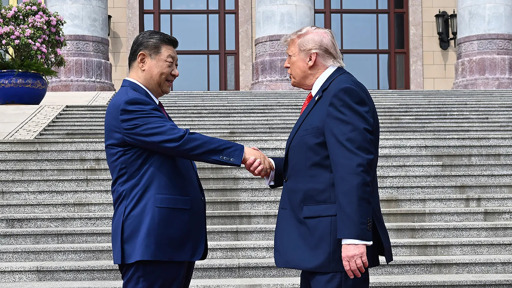
Donald Trump visited China to meet with Xi Jinping in 2017, just before launching his first trade and technology war against the Asian giant. Almost 10 years later, his return to Beijing could not have been more different. This time, it was Xi, not Trump, who set the tone and direction of the meeting.
Beijing hosted Trump from a position of strength. China holds a hegemonic advantage in the rare earth trade — as demonstrated when Xi forced Trump to backtrack on a renewed trade war in Busan, South Korea — and benefited from Trump’s weakened position following military setbacks in the imperialist war against Iran.
The meeting yielded no major agreements but rather a controlled instability. This does not mean the summit was unproductive, especially for China. Xi sought to take advantage of Trump’s self-inflicted difficulties in the Middle East. He secured a peer-to-peer meeting with the United States, reinforcing the policy known as “New Type of Great Power Relations” (xinxing daguo guanxi), which Xi has been trying to impose on Trump since 2017.
Trump had to ask Beijing for help in pressuring Iran into a definitive ceasefire, likely at the expense of violating the Six Assurances, a political pillar of U.S.-Taiwan relations established by the Reagan administration in 1982. This stipulates that any arms sale from Washington to Taipei does not require consulting Beijing.
The contrast was evident in the meeting’s opening remarks. Trump praised the Chinese leader. “Such respect for China, the job you’ve done,” he said. “You’re a great leader. I say it to everybody. You’re a great leader. Sometimes people don’t like me saying it, but I say it anyway because it’s true.” He described the relationship between the United States and China as “fantastic” and called it “an honor” to have known Xi for so long.
Xi took a different tone:
Can China and the United States overcome the Thucydides trap and create a new paradigm of great power relations?1The Thucydides trap is a concept popularized by political scientist Graham Allison, describing the structural tendency toward war when an emerging power threatens to supplant a dominant power, as noted by the Greek historian regarding Athens and Sparta. Can we jointly face global challenges and bring greater stability to the world? Both China and the United States have something to gain from cooperation and something to lose from confrontation. Our two countries should be partners instead of rivals.
It is all the more humiliating for Trump, who leads the most powerful army in the world, to hear a Chinese warning about the possibility of war between powers while he suffers a military defeat in Iran — an event that neoconservative analyst Robert Kagan describes as possibly the worst defeat the United States has suffered in recent history, one that will be difficult to reverse. In the blunt words of economist Paul Krugman, Trump’s visit to Beijing is “a field trip by a failing, flailing would-be autocrat pleading with a real strongman, who leads a much more serious country, to bail him out of the mess he’s made.”
Thus, the disparity at the meeting revealed the situation of both rivals. Trump courted China’s collaboration to solve immediate, short-term problems, while Xi aimed to redefine the strategic parameters of the long-term hegemonic dispute between the powers. Xi felt comfortable stating that the project of the “great rejuvenation of the Chinese nation” was equivalent to Trump’s “Make America Great Again” policy.
This is, first and foremost, a symbol of the historical decline of U.S. imperialism. China is a rising geopolitical power, despite its many internal problems (which include a demographic crisis, a declining working-age population, an unbalanced economy, dependence on unsustainable trade surpluses, high youth unemployment, internal dissatisfaction with authoritarian and Bonapartist policies, and a crisis in the armed forces). In contrast, the United States is in decline, losing prestige and deterrent power in an increasingly chaotic capitalist world.
This was evident at the meeting. For Trump, Iran was the central issue. He needs Beijing’s cooperation to secure a ceasefire and end the war against Iran, a country willing to exact a high price for the destruction it has suffered. The paradox is that China has supported Tehran’s military efforts behind the scenes.
Beijing has become a key supplier of perchlorates, essential for producing solid missile propellants, microelectronics, and BeiDou 3 satellite modules (the Chinese GPS system for precision strikes), enabling Iran to target U.S. and regional allies. Furthermore, according to the Financial Times, the Islamic Revolutionary Guard Corps’ Aerospace Force secretly acquired a Chinese spy satellite, TEE-01B, enabling the Islamic Republic to strike U.S. military bases throughout the Middle East.
In response, Trump decided to retaliate and sanctioned five Chinese refineries for continuing to buy Iranian oil — Hengli Petrochemical, Shandong Jincheng Petrochemical Group, Hebei Xinhai Chemical Group, Shouguang Luqing Petrochemical, and Shandong Shengxing Chemical. None complied with the sanctions, which were directly blocked by Xi.
Therefore, it is unlikely that Beijing will “deliver” a solution to Washington, since it benefits from U.S. problems in the Middle East, particularly the depletion of ammunition and military equipment (such as THAAD antiballistic missiles and difficult-to-build Patriot interceptor missiles) in a secondary theater of operations. But China has its own reasons for helping end the conflict. Its economy is affected by rising energy prices, and a global recession would harm Chinese exports, a key driver of its growth. Its strategic oil reserves, while helpful, are not unlimited. China has been urging Iranian authorities to negotiate with the United States. Even if it does not engage militarily, China may be willing to work with the United States to reopen the Strait of Hormuz, a crucial maritime route through which up to 40 percent of China’s oil imports pass (China imports more than 70 percent of the oil it consumes, totaling 11 million barrels a day).
The price of collaboration, however, is high. The key difference now is that the United States needs China to deal with Iran. It’s unclear what kind of agreement could be reached, but Chinese influence over Tehran is well known — Iranian minister of foreign affairs Abbas Araghchi was received by his Chinese counterpart, Wang Yi, who reaffirmed the alliance with Iran and defended its right to possess enriched uranium for civilian purposes. This marks the first time China has played such a significant role in a crisis involving the White House in the Middle East. And China exacted its price in Taiwan.
Taiwan was a central topic for China. Xi warned Trump that mishandling Taiwan could lead to “shocks and even conflict, putting the entire relationship at great risk,” according to the Chinese Foreign Ministry. In the official Xinhua newspaper, Xi was quoted as saying that “safeguarding cross-Strait peace and stability is the biggest common denominator between China and the United States,” and that “‘Taiwan independence’ and cross-Strait peace are as irreconcilable as fire and water.”
Specifically for China, Trump will have to back down from arms sales to Taipei if he wants assistance in Iran. In December 2025, Trump announced arms sales worth about $11 billion to Taiwan, including advanced rocket launchers, self-propelled howitzers, and various missiles. The Chinese government hopes to pressure Trump to alter his military-trade relationship with Taiwan, overriding the stipulations of the 1982 Six Assurances.
U.S. Treasury Secretary Scott Bessent said that “Trump understands the issues [regarding Taiwan] and understands the sensitivities surrounding all of this.” Secretary of State Marco Rubio indicated that U.S. policy remains “unchanged” after the talks between Trump and Xi. Washington formally severed ties with Taiwan decades ago but remains committed to defending the island under the 1979 Relations with Taiwan Act.
William Yang, senior analyst at the International Crisis Group, noted that senior officials in Taiwan, as well as in Japan and the Philippines, were “anxious” about how Trump would handle any requests from Xi related to Taiwan. Trump may be willing to make further concessions, although the Taiwanese government has reported that the talks yielded no surprises.
Similarly, China seeks stability and the continuation of the trade truce, desiring no more tariffs, export controls, or sanctions imposed on its companies. In light of the country’s economic slowdown, exports have regained significant importance in national revenue, generating a surplus of $1 trillion in 2025.
Although no clear agreement has been reached, Trump appears to have accepted a de-escalation on tariffs, signaling greater U.S. openness to Chinese investment. Recently, China has increased restrictions on the export of rare earth elements, crucial for sectors such as defense, electric vehicles, semiconductors, and artificial intelligence. For Trump, securing some relief in this area is fundamental, as demonstrated by his aggressive pursuit of strategic mineral resources in Latin America — both in Venezuela through a neocolonial policy and in Brazil, negotiating with Lula for the handover of rare earth elements.
The summit thus reflected Trump’s relative weakness against his biggest rival. When an imperial power can no longer transform its military strength into lasting political subordination, its hegemony is undermined. China seized the opportunity presented by the Iran war to demand geopolitical favors from the United States. Its advances, even amid internal and external challenges, sharply contrast with Washington’s lack of vitality. As the Chinese say, “Running water doesn’t rot, moving axles don’t rust.”
This article was first published in Portuguese in Esquerda Diario on May 14.
Notes[+]
Notes
| ↑1 | The Thucydides trap is a concept popularized by political scientist Graham Allison, describing the structural tendency toward war when an emerging power threatens to supplant a dominant power, as noted by the Greek historian regarding Athens and Sparta. |
The post Xi Jinping Called the Shots at the U.S.-China Summit while Trump Displayed His Weakness appeared first on Left Voice.
From Left Voice via This RSS Feed.