

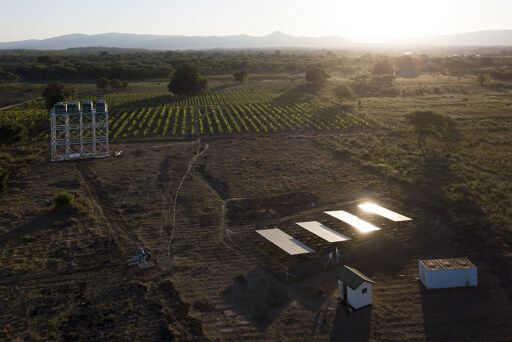
Prosper Chanda, 18, does not shy away from big problems. At the age of 3, he dived into algebra, and then as an adolescent he turned his attention toward advanced physics. At a time when most youth his age are dealing with late-stage teen angst, Chanda is awaiting the publication of a research paper that attempts to reconcile classical and quantum physics frameworks. Chanda, who hails from Kasama in Zambia’s Northern province, is also applying the conceptual frameworks of theoretical physics to the practical problem of accurate weather prediction. The model is based on what he calls Prosper’s Unified Position Equation, or PUPE. For this initiative, he was shortlisted along with four other teams from Africa for this year’s Earth Prize, which recognizes the efforts of 13-to-19-year-olds offering innovative solutions to pressing environmental challenges. Aerial view of solar-powered drip irrigation scheme in Tauya village, Zambia. In Zambia, the majority of rural communities depend on rain-fed agriculture. However, erratic weather patterns, including drought, often lead to significant crop damage and livestock losses. Food security remains a pressing issue. Photo by Enoch Kavindele Jr/UNDP Zambia via Flickr (CC BY-NC 2.0). Chanda noticed the growing challenge in Zambia of not having precise weather predictions in times where the impacts of global warming are becoming increasingly devastating. “Communities are not well-informed about weather events and climate systems,” Chanda told Mongabay via voice note. “Those things tend to affect the people and the communities due to misinformation, and they are not informed fast.” Currently, most…This article was originally published on Mongabay
From Conservation news via This RSS Feed.