

Drop Site is a reader-funded, independent news outlet. Without your support, we can’t operate. Please consider becoming a paid subscriber or making a 501©(3) tax-deductible donation today.
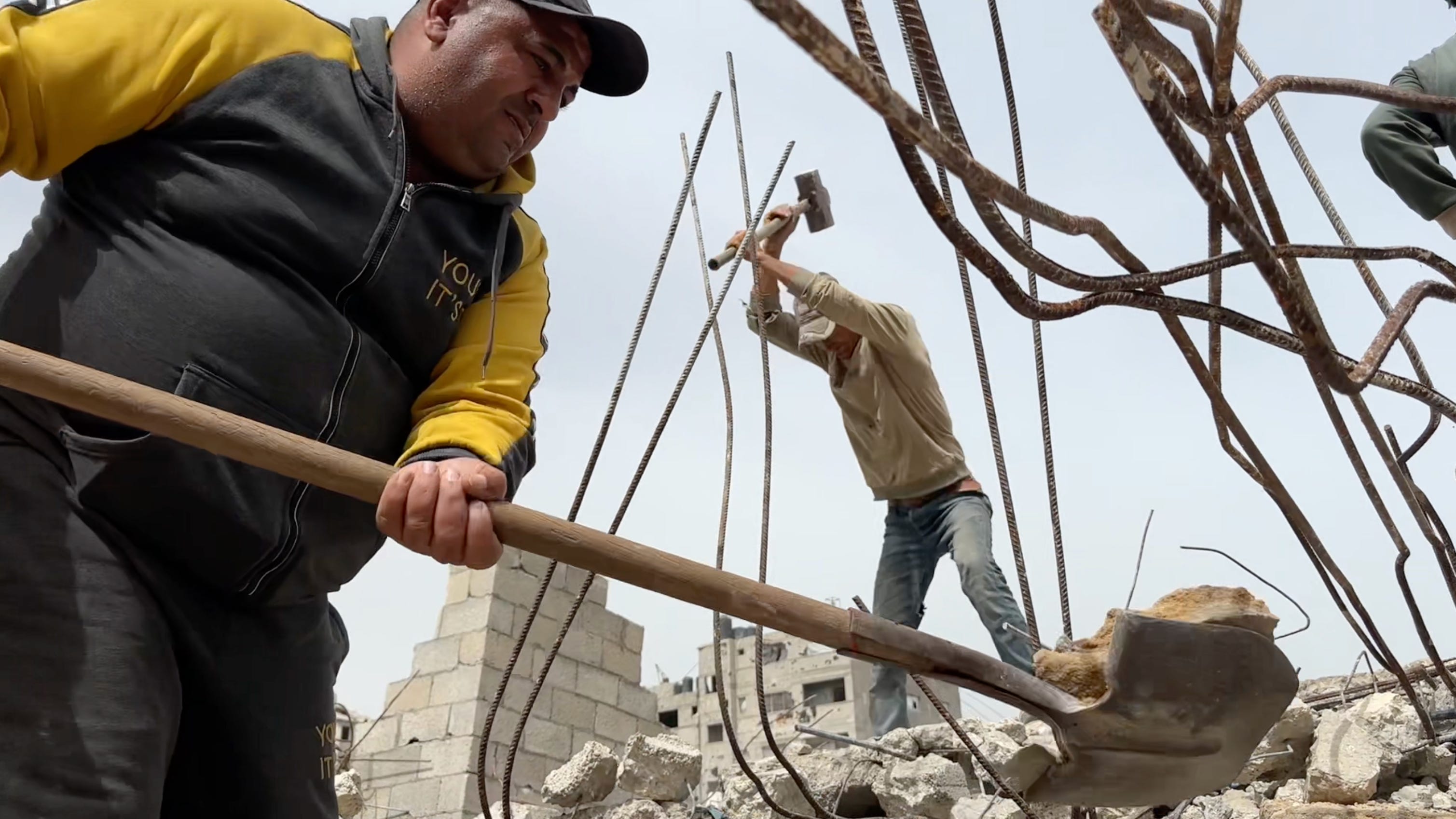
Mahmoud Khilla and relatives dig through the rubble of his family homes to retrieve the remains of his family killed in an Israeli airstrike on December 21, 2023. May 12, 2026. Screenshot of video by Mohammed Ahmed.
Story by Mohammed Ahmed
GAZA CITY—Mahmoud Khilla waited for nearly two and half years for the remains of his family to be retrieved from under the rubble of their home before he decided to take matters into his own hands. The Israeli military bombed the five story building in Jabaliya, north of Gaza City, on December 21, 2023, demolishing it with two missiles and killing all 39 people inside. Mahmoud had gone out just 10 minutes earlier to get some food for dinner. He returned to find a massacre.
“There was no warning strike, no call, no prior warning,” Khilla told Drop Site News. “There were 24 children in the house under the age of 17. They killed them all.” Eighteen of the bodies were pulled out in the immediate aftermath, but 21 remained buried, including his wife, children, father, brother, sisters-in-law, nieces, nephews, and other relatives.
“For nearly 30 months, we repeatedly called on Civil Defense, the municipality, and local institutions to come and clear the rubble so we could retrieve the bodies. There was no response,” Khilla, 40, told Drop Site. “We appealed to everyone but there is no equipment, no tools. They couldn’t clear the rubble.”
Khilla spoke sitting in a chair on top of the wreckage of where his family home once stood—a small mountain of broken concrete with tentacles of twisted rebar protruding outward at awkward angles.
“I had a son who was just 40 days old. My brother Ahmed had a daughter who was 8 months old. His eldest daughter was 7 years old. My brother Mohammed’s son was in second grade, and the older one was in tenth grade,” he said. “There is no peace of mind. You always think—in winter you think, in summer you think—what has happened to them? You keep thinking about it 24 hours a day, it becomes an obsession. One eventually reaches his limit.”
Six months into the so-called ceasefire, Khilla gave up hope Israel would ever allow excavators and other equipment into Gaza for Palestinians to retrieve the thousands of the missing dead. Last week, he along with several relatives decided to embark on the seemingly impossible task of digging through the massive pile of rubble with nothing more than hammers and shovels. “We had had enough, so we said we would bring them out ourselves,” he said. “But all we have is broken equipment and broken tools. We don’t even have anything to cut metal.”
Mahmoud Khilla and relatives dig through the rubble of his family homes to retrieve the remains of his family. May 12, 2026. Video by Mohammed Ahmed.
With the ever present sound of Israeli drones buzzing overhead, two men wielding simple sledgehammers took turns hammering away at the packed concrete. Others used their bare hands to try and pry away pieces. Khilla shoveled the broken shards into a small metal bucket. The work was slow and arduous. “We break and clear and break and clear,” he said. “It’s very difficult. My hands are all blood.”
On Tuesday, after four days of digging, they managed to find the remains of two people. Bone fragments, larger bones, a broken skull, and decomposed clothes were carefully collected in a burlap sack. An identity card was found among the clothes. The name: Mohamed Mohamed Salem Khilla. Born January 9, 1970. It was Khilla’s uncle. Another pile of bones, far smaller pieces this time, with no skull or clothes, were collected in a large can. The identity remains unknown.
Three Civil Defense workers in white protective suits, fluorescent orange vests, helmets, gloves, and surgical masks eventually arrived on the scene. They placed each pile of bones in a plastic body bag before sealing it up. The two body bags were carried around the corner and laid side by side on the ground in an alleyway. Khilla, flanked by two dozen men and boys, including the two Civil Defense workers, stood facing the remains and performed the traditional funeral prayer. Then they carried them through the rubble-lined streets to a small cemetery where they were buried and laid to rest.
“The ones who belong to me are not out yet,” Khilla said. “I will keep digging until I recover my children, my wife and my father,” he said, before also listing his nieces and nephews and other family members. “It’s difficult but we will retrieve them.”
Mahmoud Khilla and Civil Defense workers collect the remains of two relatives and bury them in a nearby cemetery. May 12, 2026. Screenshot of video by Mohammed Ahmed.
Between 8,500 and 10,000 bodies remain buried under the wasteland of Gaza. Many had hoped that a ceasefire agreement between Israel and Hamas that went into effect on October 10 would put an end to the Israeli military’s relentless attacks and brutal siege. Neither turned out to be true. Israel has killed at least 857 Palestinians in Gaza and wounded almost 2,500 in near daily attacks since the “ceasefire,” bringing the total toll since the start of the genocide to nearly 72,800. Israel has also drastically escalated its attacks on Gaza in the five weeks since halting its joint bombing campaign against Iran, carrying out 35% more strikes in April than in March, according to conflict monitor ACLED.
Along with the continued killing, Israel has also not allowed the agreed upon number of aid trucks into Gaza and has prevented the entry of construction and recovery equipment. Emergency workers have been left ill equipped and unable to cope with the scale of the devastation. Only 771 bodies have been recovered since October, according to the Ministry of Health.
“We continue to say that the world must realize the seriousness of this issue,” Mahmoud Bassal, the spokesperson for the Civil Defense, told Drop Site. “Rescue and intervention operations must begin, and resources, supplies, and heavy equipment must be brought in so that we can properly resolve this matter, otherwise these bodies will remain and there will be no capacity for the Civil Defense to retrieve them.”
Bassal spoke as he stood in front of a badly scratched Civil Defense truck, its windshield cracked in several places. “Many citizens are now resorting to taking matters into their own hands—intervening without notifying the Civil Defense. We find families working to break down concrete blocks to search for their children under the rubble.”
Bassal pointed out the dangers inherent in these endeavors, including the risk of disease transmission, unexploded ordnance, or the collapse of badly damaged structures as families dig for their loved ones.
Many bodies may have disappeared forever. Palestinians killed in areas like Shujaieya or Beit Hanoun that have been completely razed by the Israeli military may never be located. “The buildings have been swept away. The bodies have been bulldozed. It will be very difficult to know the whereabouts of these families and many of them will not be found,” Bassal said.
Israel has also prevented the entry of DNA kits to help identify the remains that are recovered. “There is an effort to identify them as much as possible visually but we cannot confirm their identities properly without DNA kits,” Bassal said.
Standing next to the rubble, Mahmoud Khilla scrolled through photos of his dead family on his phone. A smiling baby. Two young girls standing beside each other. A closeup of a woman’s face. A man grinning, holding an infant. Khilla vowed to continue digging until he recovered them from the wreckage and gave them a proper burial.
“This is the situation in Gaza. But we will continue and we will find them, God willing,” he said.
* Sharif Abdel Kouddous contributed to this report. Sami Vanderlip edited the video.
From Drop Site News via This RSS Feed.