

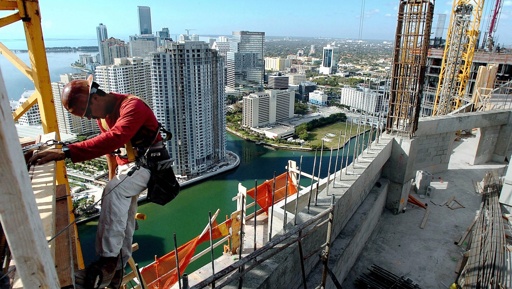
Democrats and Republicans agree on virtually nothing at this point, except the desperate need to build more housing in the United States. Depending on your viewpoint, the country needs new domiciles because it puts people to work and stimulates local economies, or because it creates affordable homes and drives down housing costs, thus reducing homelessness. Affordability, including in housing, is now one of the biggest political issues in America.
Neither party, though, is talking about the secret superpower of new apartment buildings: They’re much better for the planet than constructing single-family homes. According to a new report, these units are “an almost automatic form of building decarbonization,” because three-quarters of new apartments are heated electrically. That means they can run on rooftop solar panels or tap into grids humming with clean energy, instead of burning plant-warming natural gas in furnaces or boilers.
While the Trump administration and the Republican Party at large try to roll back as much climate progress as they can, they’re inadvertently bolstering that progress by calling for new construction. Deep-red Montana, for instance, recently passed a flurry of bills to get more multi-family housing built. “Apartments are the climate solution hiding in plain sight,” said Alan Durning, executive director of the nonprofit Sightline Institute, which authored the report.
Nothing against single-family homes, but apartment buildings and condos are much more efficient for a number of reasons. For one, residents share walls, floors, and ceilings with their neighbors, surrounding them with excellent insulation. Secondly, the square footage of each unit tends to be smaller than detached homes, so there’s less air to manage. Accordingly, it takes less energy to climate-control apartment units and keep people comfortable: The typical resident of a downtown high-rise emits one-third as much greenhouse gases as a resident of a detached house in the suburbs.
Because of this inherent efficiency, apartment builders have for decades opted to install what’s called electric resistance heating, like baseboard heaters, instead of gas furnaces. That’s because wiring them up is cheaper than piping in all that methane. “If I am building something with the intention of renting it, I really want to minimize my upfront costs,” said Amanda D. Smith, senior scientist at the climate solutions nonprofit Project Drawdown, who studies the built environment but wasn’t involved in the new report. “Often electric water heaters and electric heaters for space heating make sense from that perspective.”
Economic forces, then, have long encouraged the adoption of such systems: 68 percent of apartments built since the early 1970s have been heated with electricity, the report notes. Half a century ago, no one was campaigning to decarbonize buildings to fight climate change — going electric was just the better option. Today, if you live in an apartment, you’re 60 percent more likely to be all-electric than your neighbor living in a house.
And apartments can get even greener. Heat pumps — which move warmth from outdoor air inside, instead of generating it like a gas furnace does — are around three times more efficient than space heaters. Over the past few decades, the technology has gotten more powerful, capable of extracting heat from even freezing outdoor air. That’s helped heat pumps proliferate across even the chilliest climes: Maine installed 100,000 of the appliances two years ahead of schedule, and almost two-thirds of households in Norway use them. Heat pumps are increasingly popping up in American apartment buildings, too: While quite rare in the decades after the 1950s, heat pumps have been incorporated into 18 percent of these structures in the Northwest since 2010, the report notes. (Overall, heat pumps have outsold gas furnaces in the U.S. for several years now.)
While traditional electric heat pumps work like air conditioners, in that you need an outdoor unit that connects to an indoor one, new varieties are easier to incorporate into apartments and condos. One from a company called Gradient fits like a saddle over a window sill and plugs into a regular outlet, with installation taking less than a half hour. (Think of it like those old-school AC units jutting out of city apartment windows, only much cooler looking.) Another launching this winter combines the two units into one attached to an interior wall, where it exchanges air with the outside. “Making retrofits simpler will be a game-changer,” Smith said.
If new buildings in hotter parts of the U.S. rely upon gas heating, they’d still need an air conditioning system. The beauty of a heat pump is that it can reverse in the summer to fill a home with cool air. As temperatures rise across the country, heat pumps will not only work more efficiently than space heaters and gas furnaces to warm apartments, but to provide invaluable cooling to keep people healthy. Already in the U.S., heat kills more people every year than all other forms of extreme weather combined.
Making a building’s heating fully electric encourages the adoption of another appliance critical for reducing greenhouse gas emissions: the induction stove. “If you’re building a building and you’re heating and cooling with heat pumps, it doesn’t really make sense to hook it up to the gas system to pipe a tiny bit of gas in for people to cook on their gas stoves a couple of times a week,” said Matt Casale, managing director of states and regions at the nonprofit Building Decarbonization Coalition, which wasn’t involved in the report.
All this electrification could potentially slot into a burgeoning technology known as networked geothermal. Instead of a building’s heat pump using outdoor air, it uses liquid pumping underground. Because the earth’s temperature remains a more consistent temperature year-round than the air, these heat pumps are even more efficient at warming a space. If all of an area’s buildings — apartments or otherwise — are hooked into a networked geothermal system, there’s no need to pipe gas into the neighborhood at all. “It’s a real community-based energy system, and you’re using energy that’s literally homegrown,” Casale said. “It’s right under your feet.”
Beyond their superior energy efficiency and tendency to go electric, apartment buildings provide denser housing, fitting far more people into a footprint than a single-family home could manage. If located near daily essentials, like grocery stores, residents can walk instead of drive, further reducing greenhouse gas emissions. Ideally, robust public transportation systems can get those apartment-dwellers anywhere they can’t walk to.
Building big apartment buildings of just apartments, though, just won’t cut it, said Cécile Faraud, head of the clean construction program at C40, a global network of climate-focused mayors. These structures need mixed uses, where living spaces sit atop commercial spaces, like markets and doctors’ offices. “So you can access care, you can access education, you can access your needs in terms of shopping,” said Faraud, who wasn’t involved in the report. “But also in terms of health, so being able to exercise in parks, etc., and access to nature.”
Indeed, what surrounds these apartment complexes matters too. Green spaces reduce temperatures, boost residents’ mental health, and provide habitats for native plant and animal species. Better yet, “agrihoods” surround working farms with multi-family housing, generating nutritious produce for residents to enjoy or sell. (Faraud stresses that in addition to creating more housing, cities need to retrofit existing buildings to be more energy efficient, like with double-paned windows and better insulation.)
Constructing apartments, though, is often way more difficult than it should be, housing advocates say. The new report notes that “apartment buildings of at least four stories are currently allowed on less than 1 percent of the residential land in all but 10 Oregon cities” — even in progressive Portland, that figure is 14 percent. “The main thing that we need to do is re-legalize apartments in a much larger area of our cities,” Durning said.
Cities and states are responsible for that, not the feds. But the growing national push from both parties to get more units built will be a win-win for people and the planet. “Even across a political landscape that’s as fractured and divided and as contentious as what we’re seeing now,” Smith said, “I think most people are willing to say: We want people to have homes.”
This story was originally published by Grist with the headline The surprising climate fix that Democrats and Republicans both love on May 15, 2026.
From Grist via This RSS Feed.
You might like this article too about how the urban and rural areas support each other but suburban areas are a drain on the system.
https://www.buzzfeed.com/meganeliscomb/why-suburbs-are-problematic