

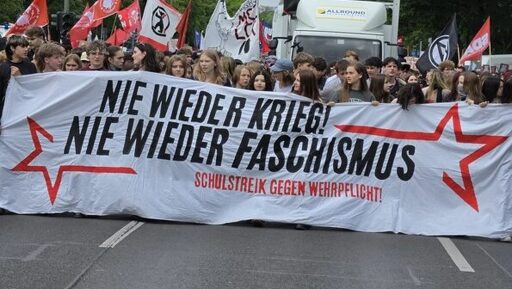
On May 8, 45,000 students joined a school strike against conscription and militarization in 150 cities across the country. The strike was held on the 81st anniversary of Victory Day, which brought peace to Europe at the end of World War II. This was the third school strike since December 5, 2025, the day the new conscription law was passed unanimously by the German parliament, the Bundestag.
In Berlin, around 7,500 students marched from Brandenburger Tor to the headquarters of the Christian Democratic Party (CDU), the party of current Chancellor Friedrich Merz. The demonstration passed next to one of the memorials to the fallen Soviet soldiers of World War II, where people holding Ukrainian flags were gathered – while flags of the Soviet Union were banned by the police. Students chanted the internationally known phrase “We are all antifascist” (“Siamo tutti antifascisti”), commemorating antifascist movements of the past while taking a strong stance against growing fascism in Germany and Europe today.
Read more: Trump administration ponders withdrawing 5,000 troops from Germany: a reason for celebration?
The rally included performances by German rappers, for example Guterzogene Asis, addressing the struggles young people face today – the price of housing, the lack of funding for schools, universities, and social programs, and the rapid militarization. Speakers included representatives from the Berlin Coalition Against Weapons (Berliner Bündnis gegen Waffen), who encouraged students and attendees to participate in events July 10-11, discussing strategies to fight against ammunition production in Berlin. One student read a message of support received from Greek dockworkers.
Students organized so-called feeder demonstrations (Zubringerdemos), which assembled students from different parts of Berlin into the main demonstration’s meeting point. One of these, collecting students from various schools in East Berlin, is called The East Refuses (Der Osten verweigert) – referring to the refusal to be recruited, especially for young men, into the military. This organizing approach breeds unity and community among young people within their city.
German re-militarization
May 8-9, 1945, marked the day the Wehrmacht signed its unconditional surrender to the Allied forces. Choosing this date for the strike was a deliberate act: Germany’s culpability in World War II has long meant that its remilitarization has been viewed critically by its neighbors, and has historically been sanctioned within Europe.
In recent years, however, the German government – with the help of news outlets and the education system – has managed to minimize public awareness of the role the Soviet Union played in the liberation of Germany. This erosion of memory has a political dimension: the conflation of the Soviet Union with present-day Russia is used to justify the urgency of rearmament, while the shared antifascist history that once grounded German restraint is quietly erased.
Against this backdrop, German remilitarization is accelerating. Although military service is still officially voluntary, the German government has made clear that this will not be enough: Minister of Defense Boris Pistorius has set a goal of reaching 460,000 soldiers by 2029, up from the 370,000-soldier ceiling imposed when Germany was reunified. Additionally, the Rheinmetall factory in Berlin-Wedding is being primed to restart ammunition manufacturing.
Challenges of the school strike
One of the main challenges the movement currently faces is the perceived lack of urgency around the issue of conscription. While the laws exist, they are not yet being enforced. The mainstream media is perpetuating a narrative that seeks to downplay the threat to students, and has in some cases helped demobilize people that were outraged at the mandatory conscription legislation.
State repression has also played a significant role. At a previous strike, an 18-year-old was arrested for carrying a sign reading “Merz licks balls” (“Merz leck Eier”) – a phrase that, while slightly vulgar, is common youth slang. The police reaction caused widespread media outrage due to the triviality of the supposed offense. The wilful misrepresentation of youth culture and language deepens the generational divide and lays bare the disdain the government holds towards young people and their fight for a better future.
Read more: Peter Mertens: “We have to restore people’s confidence in collective strength”
The persecution of students for “insulting” the Chancellor has continued. Ahead of the May 8 demonstration, police publicly announced they were prepared to forcibly enter the peaceful demonstration if the chant “Merz leck Eier” was heard. Fortunately, they did not follow through – as the chant has become one of the movement’s central slogans. Nevertheless, such announcements deter especially younger students from getting involved, instilling fear not only in them but in their parents.
The repression appears to be escalating. Some students were questioned by agents of the domestic intelligence service and officers of the federal criminal police about their involvement in planning school strikes. The same fear for their future that initially drew students to the movement is now being weaponized to intimidate them. Unfortunately, these tactics appear to be having an effect: the movement is no longer growing at the pace it originally was. The intimidation is visibly reshaping who participates – the school strike is increasingly dominated by those who are already politically organized and active, while the broader student body is being alienated.
Students in 150 cities have joined the movement
Despite the challenges, there are real grounds for optimism. Though fewer students attended the strikes overall, the significantly greater number of cities involved – 150 across Germany – is a powerful sign of the movement’s potential for growth. The organizers have succeeded in building a decentralized structure that fights together across the country, including in smaller towns where the far-right Alternative für Deutschland (AfD) has gained a strong foothold.
This decentralized model is well-suited to the task at hand. School is the one place where all young people convene, regardless of geography, background, or political conviction. It is therefore a uniquely powerful site of mobilization – bringing young people from rural areas and cities alike into the fight. As the movement matures and the laws begin to be enforced, the infrastructure already built across 150 cities may prove to be its greatest asset.
Henriette Kleineris a secondary student in Germany.
The post German students expand their strike against conscription and militarization to 150 cities appeared first on Peoples Dispatch.
From Peoples Dispatch via This RSS Feed.