

John Palameda | Red Phoenix guest correspondent | Illinois–
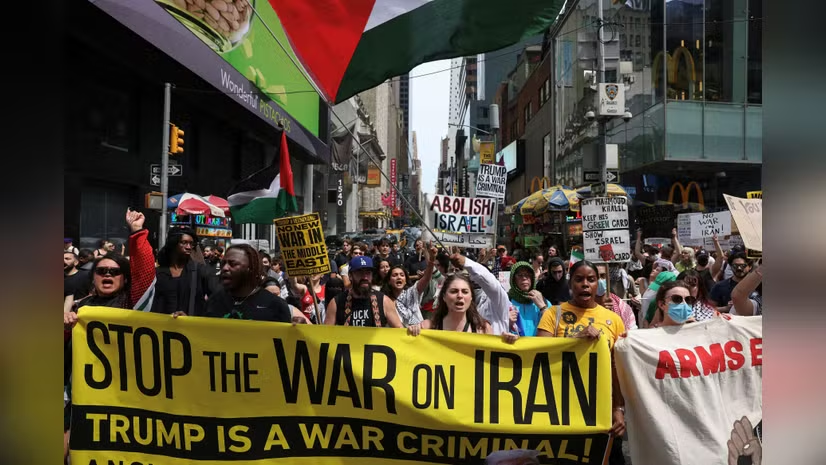
Demonstrators protest against the United States joining with Israel in attacks on Iranian nuclear facilities, in New York City, NY. June 22, 2025. (Reuters)
The movements against the wars in Iraq and Afghanistan were watershed moments for the left movement in the United States at the time and are worth revisiting as the U.S. continues its illegal war in Iran. At that point in the early 2000s, leftism had retreated even further to the margins of society than it is today. The Soviet Union had recently been destroyed, communist parties were scattered and divided, and “centrism” was winning elections across Europe and the United States. Liberals dreamed of peace in our time with American imperialism shepherding the world. But these dreams came crashing down in the blood-soaked war on terror, and the subsequent 2008 financial crash. The American left saw a significant resurgence with the Occupy and anti-war movements: millions marched in the streets across the country, and disillusionment with the status quo grew. But the war went on, and Obama rode a wave of hope into drone strikes and more “collateral damage.”
The long-standing problem of the American anti-war movement since Iraq is that these movements have been focused on ending a particular war, not the system that necessitated war in the first place. It should be educational for us that the anti-war movements that were most targeted by the U.S. government were those that began to consider class antagonisms, and the need for international working-class revolution, such as with the Black Panther Party. Among other factors, Fred Hampton, Malcolm X, and Martin Luther King Jr. were all killed after turning towards internationalism.
The most threatening thing to the capitalist, militarist class is an anti-war movement that targets the root causes of war: the need for the capitalist class to find new markets and new hegemonies as domestic profitability reaches its inevitable growth limits and imperialist powers compete for continued redivision of the world.
Why haven’t popular anti-war movements of our day moved in this direction and made capitalism the core of their agitation? It isn’t that previous and current anti-war movements are ignorant or full of bad actors. I, personally, spent many years in the streets with various coalitions that fueled the anti-war movement during the Iraq and Afghanistan wars, as well as during Obama’s drone strikes and Trump’s current wars. The people want real change.
The problem, as usual, lies in the public-relations politics of many big-tent organizations. Why alienate anyone with internationalist calls for solidarity and socialism? The main goal of most actions is to be able to give a big number of participants to the press and influence popular opinion by agitational peer pressure. This is not totally ineffective: the Vietnam War was no doubt hampered somewhat by massive popular protests that meaningfully challenged imperialism, racism, sexism, and American culture at large. Yet, millions of Vietnamese people were still murdered.
As we look today at Israel’s ongoing U.S.-backed genocide of Palestinians, the clear resource grabs by Trump in Venezuela, and the self-admitted “holy war” on Iran, the goalposts continue to shift. I find it almost intolerable to sit at No Kings protests under the same American flag that was painted on the jet that brutally murdered 156 Iranian girls. I hear this from organizers all the time: I went to the march, but I felt isolated. It is the same powerless feeling I felt at protests against the Iraq War that were saturated with Obama leaflets.
As our history as Marxists reminds us, though, the working class always has power, and it is up to us to exercise it. True, we may have to endure a few awkward, sparsely-attended protests as we continue building the infrastructure and connections for a working-class alternative. We may face state persecution, attacks from moderates, and accusations of “purity politics.” But for the dead, the countless lives consumed for the American military-industrial complex and war profiteers, from Wounded Knee to Tehran, we must take a principled stance that only through socialism can war be ended.
So long as profit is the main catalyst for development in society, war will happen. No individual president or elected official can stop this permanently; only we can.

An oil painting depicting the Battle of Poitiers of 1356, by Ferdinand Victor Eugene Delacroix, 1830.
And in times like this, it’s always good to remember that the capitalist class exposes its weak points when it wages wars. The same was true for the feudal order as well. Feudal lords battled in the Hundred Years’ and Thirty Years’ Wars over several centuries in an attempt to maintain their dominance. They failed. The capitalist class warred throughout the 19th and early 20th centuries against the labor movement, and in 1917 saw its first ultimate defeat in Russia. American capitalism rose triumphant over the ashes of radicalized capitalism in the form of fascism, destroying the revisionist Soviet Union in its wake to the suffering of hundreds of millions in Eastern Europe.
Today, the ruling class of imperialist nations continue their wars to maintain the existing social order of dominance over the laboring masses and smaller capitalist states. We see the price in Venezuela, Palestine, and Iran. History tells us that wars cannot solve the fundamental contradictions of a social order, they can only worsen them. War will not save the capitalist class from a working-class reckoning, and it is our duty to work together to usher in this next stage.
From The Red Phoenix via This RSS Feed.