

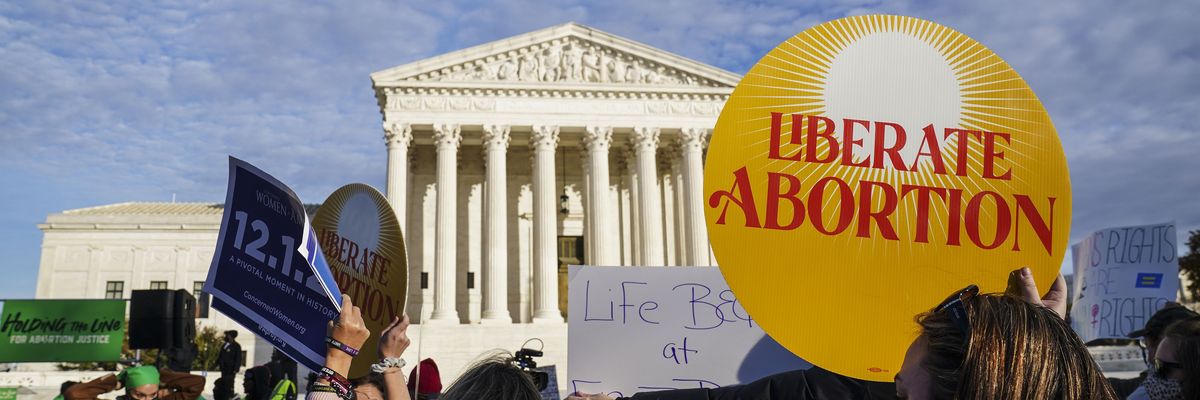
While welcoming that the US Supreme Court on Thursday blocked restrictions on dispensing mifepristone—a medication commonly used in abortion and miscarriage care—as a legal battle over it moves forward, rights advocates also continued to sound the alarm about attacks on reproductive freedom and argue that “temporary relief isn’t enough.”
At issue is the 2023 Food and Drug Administration (FDA) decision to permanently lift mifepristone’s in-person dispensing requirement, which has enabled doctors to serve patients nationwide via telehealth and the mail, as forced pregnancy advocates have intensified the fight for state laws cutting off access to abortion care since the Supreme Court reversed Roe v. Wade in 2022.
Louisiana sued over the FDA’s move, and early this month, the notoriously right-wing US Court of Appeals for the 5th Circuit halted the agency’s rule easing restrictions. Drugmakers Danco Laboratories and GenBioPro appealed, and Justice Samuel Alito, a member of the high court’s right-wing supermajority, issued a one-week stay, which he then extended to Thursday evening.
With that deadline looming, the court ultimately blocked the 5th Circuit’s ruling. Alito and Justice Clarence Thomas, another right-winger, dissented.
“While it is good news that, for now, patients can continue to get this safe medication by mail and at pharmacies as they have for more than five years, we all know abortion opponents are continuing their unpopular and baseless attacks,” Julia Kaye, senior staff attorney for the ACLU’s Reproductive Freedom Project, said in a statement.
“And let’s be clear about the Trump administration’s role here: When nationwide access to a critical abortion and miscarriage medication was on the line, the Trump administration refused to defend the FDA’s action and threw patients under the bus,” Kaye noted. “The American people have made clear time and again that they oppose political efforts to interfere with their ability to make their own healthcare decisions—and the ACLU will keep fighting with them every step of the way.”
Advocates stressed that the fight is far from over. Monica Simpson, executive director of SisterSong: Women of Color Reproductive Justice Collective, said that her organization “is relieved that the Supreme Court granted the emergency appeal to keep mifepristone accessible through telehealth and mail nationwide.”
“This decision ensures that people, especially Black, brown, queer, trans, immigrant, poor, and people living in rural communities who already face barriers to healthcare, can continue accessing essential reproductive care,” she noted. “While today’s decision prevents immediate harm, people’s lives shouldn’t hang in the balance between back-and-forth litigation.”
“Attacks on mifepristone have never been about safety or medicine,” Simpson added. “They are about power and control—about who gets to make decisions about their body, their family, and their future.”
All* Above All president Nourbese Flint also welcomed the decision while arguing that “the fact that patients and providers were forced to endure the confusion and disruption of care because of yet another court ruling on whether basic healthcare would remain available is unacceptable.”
“This legal whiplash is exhausting, dangerous, and completely disconnected from science,” Flint continued. “We know that mifepristone is safe and effective, and has been for over 25 years. People should not have to navigate a week-to-week roller coaster just to find out if they can still access basic healthcare and medication they need.”
Serra Sippel, executive director of the Brigid Alliance, which helps people forced to travel for abortion care, similarly said that “we are relieved that access to mifepristone remains protected for now, but this should never have been on the table in the first place. Patients and providers should not be forced to wait on court rulings to know whether people can access critical healthcare.”
“The back-and-forth of this case does have a cost. Confusion and uncertainty can delay care, and every day makes a difference. When people are pushed later into pregnancy, care becomes harder to access, more expensive, and many more miles further from home,” Sippel explained. “We’re seeing this firsthand. Last year, the Brigid Alliance helped 1,879 people travel for abortion care—a 35% increase from the year before—and those numbers will continue to rise as state abortion restrictions force more people to cross state lines for care.”
From Common Dreams via This RSS Feed.