

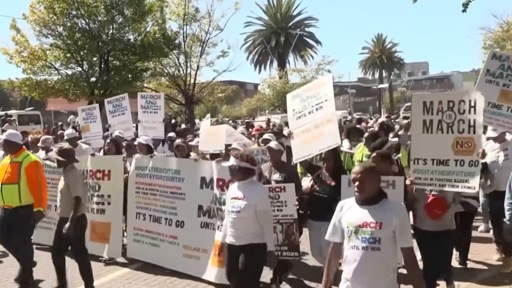
For several weeks now, anti-immigrant protests have taken place across different cities in South Africa, a country grappling with deep economic and historical contradictions rooted in its apartheid past and uneven post-liberation transformation. What began as localized demonstrations led by the March & March movement, often framed around concerns of unemployment, crime, and access to basic services have, in some instances, escalated into violent attacks against migrants from other African countries, sparking outrage across the continent.
Anti-immigrant demonstrations and violence have taken place in cities such as Johannesburg, Pretoria, Durban, and the Eastern Cape. Several videos have circulated online showing incidents of assault and violence on men accused of being undocumented immigrants. At least seven people have reportedly been killed as a result of these attacks since March 2026.
South Africa’s minister for international relations responded on X: “We must not lose our sense of humanity when we confront the problems we have as a nation.”
There is no justification for taking the law into your own hands, our laws must be adhered to by citizens and visitors. We do not at all condone illegal immigration we are determined to address this by strengthening the capacity of the law agencies and our legal instruments. And crucially we will continue engaging all the stakeholders, including our partners on the continent and beyond about the root causes that lead to some of the immigration challenges we face.”
In townships and urban centers already strained by poverty, inequality, and limited economic opportunities, migrants have increasingly been cast as competitors for scarce jobs and social resources by movements and political parties like Patriotic Alliance, ActionSA and uMkhonto we Sizwe who are against immigration. Small businesses owned by foreign nationals have been looted or destroyed, and individuals have faced harassment and assault. These acts are often justified through narratives that blame migrants for rising crime or economic hardship.
The circulation of disturbing videos on social media has amplified the crisis, drawing reactions from across Africa. Governments in countries such as Ghana, Mozambique, and Nigeria have formally protested, summoning South African envoys and demanding accountability. Ghana has gone further to formally write to the African Union requesting that the South African xenophobic attacks targeted at Africans be placed on the agenda at the upcoming Mid-Year Coordination Meeting to be attended by Heads of State and Government. While Kenya and others have issued advisories to their citizens during these protests.
A structural crisis beneath the violence
Analysts argue that this redirection of anger reflects a broader structural crisis. The failures of economic policy, persistent inequality, have created fertile ground for frustration. In many working-class communities, the promises of liberation remain unfulfilled, jobs are scarce, public services are overstretched, and inequality continues to widen. But instead of confronting these systemic injustices and the political-economic structures that sustain them, sections of political discourse and public sentiment have turned inward, toward fellow Africans who are themselves victims of displacement, underdevelopment, and global inequality.
AbM resistance to xenophobia
Importantly, voices from within South Africa’s grassroots movements have strongly rejected this dangerous trajectory. The shack dwellers’ movement Abahlali baseMjondolo has been unequivocal in its stance against xenophobia. In its statements, the movement emphasizes that the anger of the poor must not be misdirected toward other marginalized groups. To do so, they argue, only deepens divisions within the working class and fragmented communities, ultimately benefiting those who profit from inequality and exploitation. Their intervention reiterates that the struggle for dignity and justice cannot be won through division, but through solidarity grounded in a shared understanding of the structural roots of oppression.
They frame their position as a critical truth; by turning the frustrations of the poor against one another, xenophobia weakens the possibility of collective struggle and obscures the real sources of economic hardship. AbM stresses that migrants are not the architects of unemployment or economic stagnation; they are, more often than not, victims of the same global and local systems of dispossession, systems shaped by unequal development, neoliberal restructuring, and the enduring legacies of colonialism and apartheid.
The South African government has also publicly condemned the violence, asserting that xenophobic attacks will not be tolerated. However, activists say condemnation alone is insufficient without addressing the underlying conditions that give rise to such unrest. Security responses may contain immediate violence, but they do little to resolve the deeper crises of livelihood, dignity, and justice.
The post Anti-immigrant protests and violence escalate in South Africa appeared first on Peoples Dispatch.
From Peoples Dispatch via This RSS Feed.