

By William Serafino – May 10, 2026
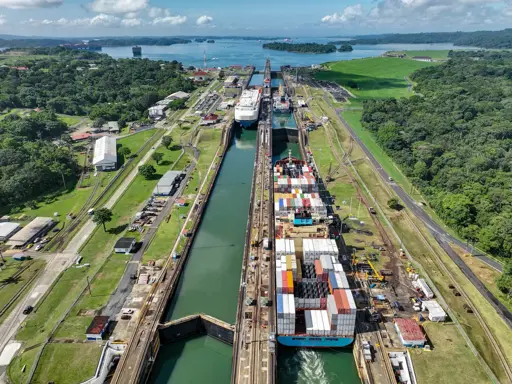
From vital artery of international trade to geopolitical battleground between the US and China. The Panama Canal is today an arena of contest between the world’s two leading powers where rivalry over trade, security, and the balance of power is condensed into an 80-kilometre navigational passage.
Crossfire between Washington and BeijingContrary to what many had expected, the decision by Panama’s Supreme Court in February of this year—annulling the concession granted to Hong Kong company CK Hutchison Holdings to operate the Balboa and Cristóbal terminals at both ends of the Panama Canal—did not represent the definitive closure of the geopolitical plot set in motion by the US in 2025, when Trump himself, barely back in the Oval Office, put the recovery of this maritime route forward as a strategic foreign policy objective.
Rather than an epilogue to the conflict, the judicial action aligned with Washington’s interest in excluding China from canal operations appears to be more of an opening cliffhanger to a new saga, with no clear ending in sight.
Washington’s offensive was seen by Beijing as a crossing of the Rubicon. Within that framework, the diplomatic approach characterized by caution, patience, and strict adherence to the law to which the People’s Republic of China has accustomed us has begun to show some notable changes.
As I highlighted in an article on the subject at the end of March, Beijing responded with inspections of Panama-flagged vessels in Chinese ports as a countermeasure against the attack on CK Hutchison, according to reports in international media. Also, according to the Financial Times, Chinese authorities pressed European shipping companies Maersk and MSC—which replaced the Hong Kong conglomerate’s operation—to abandon the management role assigned to them by the Panamanian government.
According to international reports, China has continued with the inspections, hitting president José Raúl Mulino where it hurts most: in the existential link between the canal and the Panamanian economy. Given that China is a key destination for vessels flying the Panamanian flag, the inspections generate uncertainty, raise insurance premiums, and discourage use of the Panamanian flag, thereby weakening the revenue generated by commercial shipping registration.
The mounting economic pain inflicted prompted a Monroeist US response on 29 April. In a press statement issued by the US government and published by Secretary of State Marco Rubio, backed by Bolivia, Costa Rica, Guyana, Paraguay, and Trinidad and Tobago, the signatories expressed solidarity with Panama, citing concern over “China’s targeted economic pressure following the decision on the Balboa and Cristóbal terminals.”
From Beijing, China’s Foreign Ministry spokesperson Lin Jian denied Washington’s accusations, stating that China’s authorities carry out “routine vessel inspections in accordance with existing laws and regulations” and asserting that the People’s Republic of China would firmly defend its legitimate rights and interests in the interoceanic route.
Jian also laid bare Washington’s hypocrisy in the following terms: “Who exactly exercised prolonged forcible control over the Panama Canal, invaded Panama, and trampled on its sovereignty and dignity? Who covets the Panama Canal, attempting to appropriate an international waterway that should be permanently neutral and disrespecting the sovereignty of countries in the region?” The answers to those questions require no great effort of imagination.
The clash revealed a tendency to raise the stakes, with Washington attempting to build an anti-China bloc in the region, without much qualitative impact, and Beijing becoming more assertive and forceful in defending its geoeconomic interests while maintaining its port pressure levers on the Mulino government in Panama—which is forced into a dangerous balancing act to avoid sacrificing the considerable Chinese investment in the country.
Indeed, the US statement is clear evidence that China’s countermeasures are working. In a context where the Strait of Hormuz remains disrupted, the Panama Canal has gained greater commercial relevance, undergoing, at the end of April, a worrying congestion of vessels anchored in the Pacific and Atlantic awaiting a slot to transit—a situation further aggravated by the Chinese inspections.
The economic pain for Panamanian commercial actors could intensify if the Hormuz disruption worsens.
A platform for interventionismThe geopolitical blows and counterblows in the Central American maritime passage reveal the remodelling of the region driven by the so-called Donroe Doctrine but also the growing military dimension of critical ports and maritime routes as the US–China confrontation intensifies. The clearest symbol of this trend is the conflict over control of the Strait of Hormuz.
Trade is merely the tip of the iceberg of the dispute given that the US remains the canal’s principal beneficiary and that China is not challenging that position. There is something far deeper at stake than container ships, access quotas, and transit fees.
For the People’s Republic of China, Washington’s determination to dominate the interoceanic route forms part of what analyst Richard Medhurst refers to as a global blockade plan, designed to strangle China’s energy and commercial supply routes—beginning in the Caribbean through the naval energy blockade of Venezuela, extending through Hormuz, and projecting towards Malacca and the Arctic. This is very probably the source of China’s vigorous response.
Washington claims that China’s growing influence over the canal will at some point be used to project military force in the region. Although this narrative is not borne out by the facts, it serves as a pretext to instrumentalize Panama and its maritime route for security and explicitly military purposes.
In April of last year, US Secretary of War Pete Hegseth and Panama’s Security Minister Frank Ábrego signed a memorandum of understanding to “strengthen canal security.” The agreement included an increase in the presence of US military personnel at the Sherman, Rodman, and Howard US military bases and also permitted US warships to navigate through the canal.
That memorandum made clear that the narrative of the “Chinese threat” to the canal served as a propagandistic device functional to the interest of amplifying Panama’s role as a military outpost in the region—elevating it to a key platform for regional intervention within the recolonizing framework of the empire’s new Holy Trinity: the Trump Corollary, the Shield of the Americas, and Greater North America.
Accordingly, excluding China from Central American commercial infrastructure is a strategic step to reduce the constraints that Chinese investment would place on the scheme to weaponize the Panamanian route and territory.
While Rubio hypocritically presents himself as a defender of Panamanian sovereignty over the canal, the US Southern Command is capitalizing militarily on the Supreme Court ruling against CK Hutchison Holdings through naval and air training courses, jungle military exercises, and the operational strengthening of US military bases in the country.
On April 1, General Francis Donovan, head of the US Southern Command, visited Panama and met with Mulino and canal administrator Ricaurte Vásquez Morales. Speaking from one of the locks, he declared that the “security” of the canal and of the region and the fight against narco-terrorism are all part of a single objective. A word to the wise.
Trump Demands ‘Military Options’ To Control Panama Canal – Media
William Serafino is a political scientist and historian. Researcher and analyst specializing in geopolitics. Simón Bolívar National Journalism Prize, investigation category (2019).
Translation: Orinoco Tribune
OT/CB/SL
From Orinoco Tribune via This RSS Feed.