

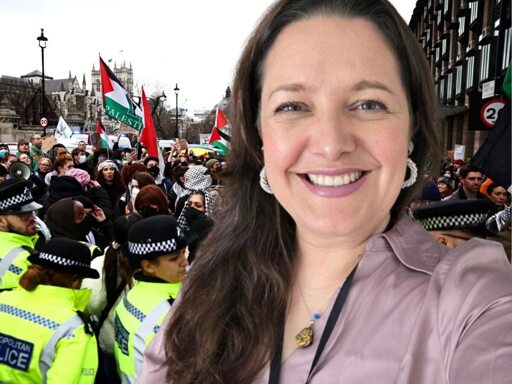

As the Met police tool up ahead of a big day of protest in London on Saturday 16 May, the UN has warned that the UK is eroding people’s rights.
The UN special rapporteur on the rights to freedom of peaceful assembly and of association, Gina Romero, has called on the UK to uphold its international human rights obligations.
This follows the adoption of restrictive legislation and political calls for a blanket ban on pro-Palestinian demonstrations.
Romero said:
The entry into force of the UK Crime and Policing Act on 29 April introduces provisions fundamentally incompatible with international human rights obligations regarding the rights to freedom of peaceful assembly, association, and expression, and the right of participation.
Of primary concern is the vague concept of ‘cumulative disruption,’ which grants law enforcement excessive discretionary powers to restrict assemblies, disregarding the standard that peaceful protests inherently entail a level of disruption that must be accommodated.
The Act’s criminalisation of face coverings is especially problematic amidst intensified surveillance, as anonymity is often essential to protect privacy and prevent chilling effects.
By imposing further restrictions on mobilisations near places of worship, the State risks creating ‘no-go zones’ for dissent, undermining its duty to facilitate assemblies within ‘sight and sound’ of their target audience.
Yes, Starmer does take a ‘two tier’ approach to protest
On 29 April, following multiple stabbings in Golders Green, London, UK prime minister Keir Starmer said that he would consider banning some pro-Palestinian protests due to the “cumulative” effect that they were having on the UK Jewish community.
This statement followed Tory calls for a moratorium on all pro-Palestinian protests. The (allegedly) independent reviewer of terrorism legislation Jonathan Hall echoed these calls and:
claimed that it was ‘clearly impossible at the moment’ for such demonstrations not to ‘incubate’ antisemitism.
However, Romero called on the UK government to refrain from stigmatising and banning pro-Palestinian marches in the name of preventing antisemitism:
Antisemitism is a serious problem that must be addressed through targeted and lawful measures. It cannot justify a blanket prohibition on peaceful protest.
Romero expressed concern that the government’s approach appears to apply heightened security scrutiny to protest activity associated predominantly with Muslim communities. But it doesn’t apply equivalent scrutiny to other forms of protest with direct links to antisemitic and racist incidents.
International human rights law prohibits discrimination in the enjoyment of the right to peaceful assembly on grounds including religion and race. Romero said:
Where restrictions are framed around conduct, such as antisemitism, but are applied in a manner that disproportionately burdens one community defined by religion or ethnicity, this may amount to discrimination.
The freedom to assemble is foundational to a democratic society. Banning pro-Palestinian protests would be an affront to democracy. This is especially important ahead of the Nakba mobilisations that will take place on 16 May.
The special rapporteur has previously raised these concerns with the government.
Featured image via the Canary
By The Canary
From Canary via This RSS Feed.