

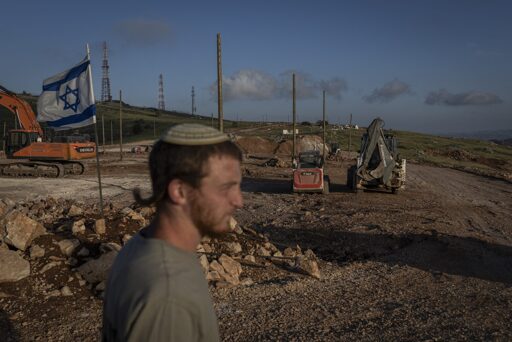
While the world’s focus has shifted to the war in Iran, Israel’s ethnic cleansing of Palestinians has continued, and Israeli settlers are rapidly and violently expanding illegal land seizures across the occupied West Bank, with the full backing of the Israeli government, military, and police. In this episode of The Marc Steiner Show, Marc speaks with award-winning Israeli journalist, political commentator, and photographer Oren Ziv about how settler violence, land seizures, and the dismantling of the Oslo Accords-era boundaries are accelerating Israel’s efforts to permanently confine Palestinians and erase the possibility of a Palestinian state.
Guests:
- Oren Ziv is an award-winning Israeli journalist, political commentator, photographer, and reporter for Local Call and +972 Magazine. Ziv the co-founder of The Activestills Collective.
Additional links/info:
- Oren Ziv & Ariel Caine, +972 Magazine, “‘Erasing the lines’: How settler outposts are seizing new regions of the West Bank”
Credits:
- Producer: Rosette Sewali
- Studio Production: David Hebden
- Audio Post-Production: Stephen Frank
Transcript
The following is a rushed transcript and may contain errors. A proofread version will be made available as soon as possible.
Marc Steiner:
Welcome to the Marc Steiner Show here on the real news. I’m Marc Steiner. It’s great to have you all with us as usual. And my guest today, Oren Ziv, has written an incredibly powerful piece called “Erasing the Lines: How Settlers are Seizing New Regions of the West Bank” and it is published in the Nation Magazine and in +972. Oren is a reporter photographer, co-founder of The Activestills Collective and since 2005, has documented social and political issues in Israel-Palestine and has joined us numerous times before and joins us once again with his new work. And Oren, welcome. Good to have you with us.
Oren Ziv:
Thank you for having me.
Marc Steiner:
So just to begin as we talk, before we start our conversation formally here, just to describe as an Israeli, as somebody living in the midst of all this madness taking place, what it’s like and what changes have taken place since the news even that you were just describing a moment ago to me.
Oren Ziv:
Yeah. So even since we published this article over a month ago about how Israeli settlers are taking over Area A and B areas that according to the Oslo Accords in the mid ’90s and even since we published the article, the Israel government had approved 34 new settlements, many of them based on those kind of outpost or outposts that are officially even illegal by the Israeli law, although they get all the support from the Army police. And the government, of course, settlers have continued their attacks since the beginning of March. 13 Palestinians have been killed in the West Bank doing settlers raid on Palestinian villages, some of them by civilians, some of them by settlers who serve in the army. And even while we’re speaking during the last 24 hours while Israel is marking its Independence Day, free Palestinians have been killed by settlers in two different incidents.
So what we can see is that the situation is escalating. All the activities on the ground, doesn’t matter if it’s civilian settlers, if it’s settlers who were recruited to the Israeli Army to reserve duty. All this is A, very coordinated and working according to a plan of the Israeli government. They don’t hide it, they say it openly. And B is supported by all the different authorities from the simple soldier on the ground. And in our investigation, we also spoke to soldiers who served in the West Bank in the last two and a half years too high up to the government who give those settlers the tools to carry on these attacks from the weapons to the ATVs they drive into Palestinian villages and of course the facilities, the outposts they establish.
Marc Steiner:
A couple of things here. Even though it’s not directly in the article, which is really a very thorough and interesting piece, what is the connection between Israel attacking the West Bank at this moment and trying to seize territory and close things down and what happened with Iran? What’s the connection?
Oren Ziv:
So I think as we saw after October 7th, the Israeli settlers and of course also the government are taking advantage that the international attention, also the Israeli attention, everybody’s attention is to something else and they really know how to identify those moments and really escalate the situation and create facts on the ground. So for example, after October 7th, really in the first days after it, before the genocide escalated in the way we’ve seen it afterwards, settlers have been pushing Palestinian communities out. So they started with Area Sea that is under fullysraeli control in the West Bank, pushing herding communities, farmer communities on the open areas between Ramallah and the Jordan Valley in other areas. They managed to force out around 60 or 70 communities. And what we’ve seen now during the war against Iran is the same policy of escalating in this situation when nobody’s looking to the West Bank erecting new outpost, raiding Palestinian villages, killing it always come those outposts.
It’s the same method. Sometimes it happens in the course of a few months. Sometimes it’s very fast and it happens in a few days, but they establish a new outpost. They prevent Palestinian from going out and grazing
With their sheeps, with their animals, and then they start invading to the houses, to the communities, stealing sheep, terrorizing the village. If it’s a herding community, if it’s a Bedouin community, many times they managed to force people out even though those are refugees, many times from the Nakba from 48 that had to relocate to the West Bank. They were forced to the West Bank and many times it’s a fourth or fifth time they’re being displaced. If it’s villages, they focus in the beginning of the outskirts of the village, taking over houses, farming area, making people afraid to go out because we’re talking about proper villages with houses, municipality, schools, buildings of sometimes thousands of people and the settlers and they openly say it, now they’re targeting the big villages. And the idea is very similar to what Smotich, Minister Smotich spoke about is that there will not be, of course, a Palestinian state, that Israel will control all the area.
And Palestinians will be concentrating six or so areas in the West Bank that are the big Palestinian cities and settlers are taking this policy into action on the ground forcing people to hide in their homes.
Marc Steiner:
This was not necessarily article, but I’m really curious as to what’s the reaction inside of Israel? I mean, are there movements of any size, groups of Israelis saying no to this action? What’s the struggle like on the ground in Israel?
Oren Ziv:
So on the ground, you have very small group of radical left doing activists that protest this both inside Israel and more important, also go and do protective presence in those communities, in those villages together with international activists together, of course, with Palestinian activists and community organizers. They’re doing something that is called protective presence that is just being in places in communities that are being attacked again and again by settlers in the army, by army with the settlers or by settlers followed by the army. They sleep there, they spend the nights and days there. In the past, they would help Palestinians go out to the farming areas to the open lands to graze their sheep. Nowadays, it’s more focusing on protecting the community, documenting, trying to call the police or the army, though many times they would come and arrest the Palestinians and the activists. And we know also it’s effective because settlers and the police and army have been targeting those activists arresting them, issuing closed military areas that force them not to be there.
And then it’s easier for the settlers to push Palestinian out and also targeting them physically. We’ve seen escalation in the recent months in the attacks. In the past, Israeli or international activists had some kind of protection that settlers were afraid to attack them. Now we’ve seen since the war of Gaza began and escalation that also they’ve been attacked same as Palestinians. Just one day on the 27th of March, one day before the attack against Iran, two Israeli activists, one of them, 50-year-old, 51, 172, went to the village of Kustalan in Nablus to help Palestinian to go back to his house where settlers forced them out. And Israeli settlers on this famous ATV that the government gave them came a mask with clubs and attacked them and injured them so badly Israeli medics had to take them with a helicopter to a hospital inside Israel. They foster almost dead.
And of course, even though the Israelis, and it was widely published even in Israel media who usually doesn’t cover these kind of things, some settlers were arrested. It’s a very small outpus. It’s outputs in Area B. It’s very easy to find who did it. Settlers were arrested for two or three days and then released. I contacted the police just last week regarding this. Nobody’s arrested since nobody
Marc Steiner:
Is
Oren Ziv:
Held accountable. And of course, this is not an isolated incident from this output. Later a Palestinian was killed attacks against the villages around continue and the army sometimes evicts the tent or the structure the settlors living off, but a few hours later they built it again. And of course, as I said, it serves the Israeli official policy because it’s also convenient for the official Israel, for the army to say, no, these are settlers. It’s not the official policy, but on the ground, this is the official policy. Also, many, many, many mainstream Israelis from the so- called center left, the Zionist center left. They might not like what settlers are doing. Definitely when there’s more extreme violence, they oppose it, but a lot of them and also the mainstream media separate between the extreme settlers and then just the settlers in the West Bank and their leadership and the army and the police and they refuse to see it as one system in the end of the day, the extreme, the so- called extreme settlers and the most violent one, the few hundreds or few thousands that are in the frontline attacking Palestinian, killing them, pushing them out, they’re serving the rest, but more important, they’re getting backup because at the end of the day, each output have support from a nearby settlement that is legal according to the Israeli law.
When they attack, they go out from a settlement, they come back. In many attacks, we see more than five or 10 settlers. We see dozens or even hundreds who come from all around the area, not just from illegal outposts according to the Israeli, but also from very well established settlements. Settlements
Marc Steiner:
That are in the West Bank you’re talking about, not in Israel.
Oren Ziv:
No, we’re talking about the West Bank. When we’re talking about outposts, it’s settlements that were established by settlers without prior permission by the Israeli government and are authorized later. So at the time they’re even illegal according to the Israeli government. Of course, they get the support from the army many times from the government, but they’re illegal even according to the Israeli law and by time the government recognized them.
Marc Steiner:
Before we go on, I wish you could explain to people listening to us now when you describe the zones of A, B, and C, what they mean, how they would derive, and what they have to do directly with the oppression of the Palestinians in their land.
Oren Ziv:
Yeah, definitely. So the Oslo Accord signed by Israekabin and Niasar Alfat in the mid ’90s were supposed to be a path to a Palestinian state. Many argue today that this was never the intention and it was used by Israel just to expand the control over the West Bank, but I’ll put it aside for the moment. And in this agreement, there are three zones in the West Bank. One is Area C where the settlements are, the areas near the border of Israel, where many of the open areas are, the Georgian Valley, many of the agriculture areas. And these areas are according to the accord still are under full Israeli control, both security-wise and municipality and planning-wise. Then you have Area B, which is under Israeli security control and under planning and municipality control, civil control of the Palestinians. And then you have area A, the big cities, Ramallah, Hebron, Lucaram, Jenin, Jericho, Nablus, that they are supposedly under full Palestinian control, meaning the Palestinian police is there, the Palestinian governments is there.
Of course, Israel violates the also accords and goes into this Palestinian areas area A and conduct arrests and searches and other actions. But I’m talking about the agreement. It’s important to say that in the future, all this should have been a Palestinian state. Now, as we hear from soldiers and settlers, Area C, they decided, although you have hundreds of thousands of Palestinians living in area seats, the vast majority of the open areas in the West Bank, Israel settlers in the Army decided that area sees all Israelis. So the Palestinians who live there under strict restrictions, house demolitions, searches, checkpoints, and they’re not allowed to build without permits. And in general, Israeli is trying to push Palestinians from Area C to Area B and A, so they can enact, if not officially, enact the facto area A to Israel. And on the ground, it’s almost like that.
Then you have Area B, which as I said, there’s over 12 outposts in the outskirts of Palestinian towns and villages. And even in recent months, we’ve seen some changes in the discourse of Israeli politicians after an Israeli settler died during what Palestinians describe as a car accident. Some settlers claim it was an attack. A settler and his brother were so- called touring with ATV supplied by the government in Area A and near their illegal outpost. This settler died in this accident/other event. And since then, his family, but later also right-wing politicians have announced this campaign of erasing Oslo. A, B, and C is all Israel, it’s all ours. Just now settlers after his death, settlers established five settlements in Area B, they let it evicted because it’s where the CNN crew was attacked last month incident that got a lot of attention in the US and worldwide.
And in general, Israeli settlers and the government are trying to erase this separation between the areas and to make sure that even the very symbolic and very small Palestini authority that exist will be erased.
Marc Steiner:
So what you’re describing, I was thinking about this. I was reading your article and what you’re saying now. What you’re describing really is a push by the Israeli government to seize control of every aspect of what is now Palestinian life and the West Bank make it actually part of Israel to stop the charade that it’s some kind of other place that can be negotiated, that actually they take it over. And so talk a bit about that and what you think the political reality is around that and what would happen if that actually happens. If they keep this push and they do that and they take over the West Bank completely and build these new syllables.
Oren Ziv:
Yeah. So as we look on the map of the settlements and since the establishment of this extreme government three and a half years ago, we’ve seen approval of more than 100 settlements. And if you look on the map, it really fits A, the outputs that we describe in our article and B, it really fits Smartridge plan to concentrate the Palestinian in specific areas across the West Bank in very, very small and limited areas. So the settlements are all around them. The official settlements the government approve are not only Area A and B, but they’re really limiting the movement between Palestinian citizen towns and together with the Israeli checkpoints, roadblocks, metal gates, this really makes it hard for the movement of Palestinians and even any imagination of a Palestinian state. That’s of course the official Israeli plan, but as always with Netanyahu and its partners, they don’t want officially to announce the West Bank.
They had the plan in 2018, this was put outside and they don’t want to fully enact the West Bank. They don’t want to, of course, talk about one democratic state and to give rights to those Palestinians who they announce. I’m not talking about if Palestinians choose it or not, but on the Israeli side, of course, they’re not talking about annexation even with the limited rights. For example, the Palestinians in East Jerusalem have that they have a residence card and they can move freely all across the territory. So of course they’re not talking about that, but on the ground they’re making changes that even in half a year there will be elections and some less extreme government will be elected. It will be very hard to reverse. Now, of course, everything is changeable. Everything can be removed. We’ve seen it
Across history. We’ve seen it also in Israel and Palestine that this engagement from Gaza in 2005 and before that, the withdraw from Southern Lebanon and from Sinai desert in Egypt. So things can change, but they’re kind of making sure that this will be hard. And from past experience with center right governments, we see that not so quickly they cancel or reverse decisions by previous governments. It’s not so easy for them to do it politically and publicly and especially when the extreme right and the settlers of the West Bank, if they will be under position, I think they will make it very, very hard to reverse anything. So they’re creating facts on the ground and for them, they want to make sure there’s no Palestinian state. I think Netanyahu said it in his own voice in recent years and they want to make sure that no matter what, the West Bank will be under Israeli control.
Marc Steiner:
Forever.
Oren Ziv:
Yes, correct.
Marc Steiner:
So as I was reading your article, and I would encourage everybody, we’re going to link to it, it really gives very thorough analysis of what’s happening on the West Bank, what’s happening in the Palestinian villages. This might be an absurd question, but I’ll ask it anyway. Go
Oren Ziv:
Ahead.
Marc Steiner:
So what do you think the future holds then? I mean, all the things you wrote about in terms of dismantling Palestinian life, taking over villages, pushing people out, and then often taken over by very right wings and Orthodox settlers moving in to take more control. And you’ve been involved in this and standing up to it as of other Israelis. So where do you think this goes? What do you think the future holds for Israel and the Palestinians if this continues?
Oren Ziv:
Yeah, it’s a very hard question. And of course on one hand, from what you look now, it’s very pessimistic. On the other hand, on the ground, they don’t manage to push Palestinians out of the West Bank as they want. So after the genocide begin in Gaza, we’ve seen across the West Bank billboards with a photo from Gaza, one of the famous photo of Palestinians from Northern Gaza being forced out into South Gaza with all the belongings, this photo that reminds the 48 Nakaba and was written in Arabic, there’s no future in Palestine. So the settlers, maybe answers a bit your previous question, the settlers do see connection between what happened in Gaza and what’s happening in the West Bank. And at least a year or two ago when they still thought they can force Palestinians out of Gaza, that at least from parts of Gaza, at least from Gaza city.
And the Northern part of Gaza, they fought they can duplicate it to the West Bank in Gaza despite the horrific genocide that Israel committed there. They didn’t manage with the plan that we wrote also in 1972. It was a governmental plan to push Palestinians out to Egypt or to other countries. And we’ve seen many reports about these attempts of Israel by plains by Jordan through Egypt, this failed. And I think also in the West Bank, despite the horrific price, Palestinians are paying daily. The big plan is not working. People don’t live. Maybe they’re pushed, I hope, for short time, but they’re pushed to the big cities and towns and out of the farming area, the grazing area, but the push, but the plan to push them out of the West Bank is not working. And it’s important to say that many of the tactics we’ve seen in Gaza, the army is also implemented in a much smaller scale in the West Bank, in the refugee camp, in Ghanina refugee camp, Tulkarian refugee camp, and Nurasham’s refugee camp after years of pressure from Israeli settlers and Israeli right wing politician, they took over a year ago, they forced all the residents out.
We’re talking about over 40,000 residents that are refugees from 48 Israel from the Nakaba and started demolishing houses, open roads, not demolishing all the camp, but making it a place that people cannot live at least till they allow them to come back and demolishing dozens of houses with the excuse of opening new roads and shaping in. And same like in Gaza and same like in the war of Israel against the UN, against Unra, also against the refugee camps, they really want to raise the refugee issue and you could say the Palestinian issue in general, but also the fact that so many people in Gaza and in the West Bank are refugees from 48.
Marc Steiner:
So as you describe in verbally here, but also in your writing, when people resist what’s happening, both Palestinians and Israelis have gone in to help Palestinians to resist, it’s become pretty violent.
Oren Ziv:
Yes. So before October seven, we’ve seen many protests across the West Bank from the historically, of course, but also in recent years against new settlements two decades ago against this apartheid separation war for prisoner in solidarity of prisoners for many things. And since October 7th, the Israeli army and also the police made it very clear that it’s too dangerous to protest that and people will play enormous price. So we haven’t seen across the West Bank many protests, but as I said, people find alternative ways to show Sudarit is if it’s with the protective presence being on the ground, Israeli international activists, we know we also published on Plus 972 magazine how Bangville formed a special unit in the West Bank police police that doesn’t function when it comes to killing of Palestinians, attacks against human right defense and so on. They have a special unit in the West Bank police to locate arrest and deport international activists.
So in their eyes, the problem is not the violence or the human rights violation. It’s the fact that people come to witness it, document it and when they go back also to spread it to their France family and of course wider community. So we’ve seen really a escalation against activists. We’ve seen in numerous villages that activists have been present twenty four seven. The army comes issues a closed military area that theoretically should also limit settlers from going in and arresting the Palestinians. But de facto, it’s not being enforced on settlers and just the activists cannot be with the Palestinians. And unfortunately, at least in a few cases, it forced the Palestinians to leave because they were left with no protection. So it’s an interesting thing to look at how on the ground in very simple and small tools, but the army and the police are assisting those attackers to evict Palestinian communities.
And we’re talking about the most vulnerable communities. But as you said, people are present in dozens of villages across the bank. Also, there’s other villages that the Palestinians are organizing to night shifts, tours around the village to protect with … Of course, they’re not allowed to have any weapons to protect themselves, but with flashlights and cars patrolling around the village being present in the most vulnerable families who live in the outskirts, if they live in a farm, if they live in the last houses.
And also against that, we’ve seen the army arresting people who are involved in that, demolishing tents that are made as an outpost to look where settler race. But people on the ground are trying to resist in all the methods they have.
Marc Steiner:
You said one thing I’m curious, so Palestinians are not allowed to have weapons of any kind?
Oren Ziv:
The Palestinian authority and the Palestinian security bodies have weapons in Area A. They’re not allowed to travel with it to Area
C and B. And no, of course not, they’re not allowed to have weapons, but even when they go out to protect themselves from settler raids with stones or stick, they’re being shot and arrested. So we’ve seen many examples that settlers raid a village attack it. When people go out, the army comes to assist the settlers and then shoot or arrest Palestinians. So yeah, Palestinians, of course, they’re not allowed legally to have weapons. They’re not allowed to protect themselves in the most basic tools, even to go out and to stand in front of a settler who’s trying to graze their land or to steal their land. The army might come and say, “You’re not allowed to block this person.” I’m not talking about with a stone or everything just standing and trying to tell the settler you’re not allowed in. Many times the army would come and with orders from the settlers will arrest the Palestinians saying you blocked them, you disturbed them and many other claims.
So yeah, the fact is that Palestinians, and this is, I think, is the purpose also that they’re not safe even in their garden in their home. This is the reason settlers establish those outputs so close or sometimes in Palestinian communities, invade the communities days after day to tire the people and harass them when trying to make them live. In many places, people refuse to leave despite the high price they pay.
Marc Steiner:
Let me just read a line here from your article, which we’ll be attaching to so people can really see what’s going on because you’ve written a really important piece here. When you quote Smart Rich, one of the right wing leaders of the Israeli government saying, “We will erase the lines, the demarcations, the letters. We will settle our land in all its parts.” And then you have local activists saying in response, “Two years authorities have been closing off the village and tightening control over it as much as possible. The last village remaining in Ramallah area that borders the Jordan Valley, the West Bank’s Eastern flank of which Israel is rapidly consolidating control.” I mean, it sounds like a 1984 dystopian nightmare that’s taking over in the West Bank. And as an activist, as somebody who’s Israeli and standing up to this, I’m curious how you maintain your sense of struggle and your optimism in this fight to build a land for all.
I mean, I’ll disclose, I have this poster in my study at home that I got in 1968. It has a map of all of the Holy land. It says one state, two people’s three faiths, well, the Palestinian flag on one side and Israeli flag on the other, which I think is a dream of some of us, which probably may never happen. So I’m curious just how do you maintain the sense of struggle in standing up to all this?
Oren Ziv:
Yeah, I think it’s a good question. One answer that I think about it a lot is that I’m on the ground when I visit those villages, those communities and you see Palestinians that I’m privileged, I have a press card, I have Israeli citizenship. Of course, I can be attacked. I can be harassed. We’ve seen escalation also against us in recent years, but still we’re much, much, much, much more safe and protected than the Palestinians on the frontline on those communities on this town. So when I see them A, standing there and insisting of staying despite all the obstacles, and really they have zero protection. A settler can decide that he comes and opens the outputs in their garden, the army will come, the police will come and might arrest the Palestinian. And then these are daily examples. So that gives me a lot of hope.
And also as I mentioned before, when I see the activists, the Palestinian, Israeli international that go there and stay there twenty four seven for weeks, for months. Now because those attacks happen daily, when you stay in a village for every week, when you come often, it just unfortunately, it’s a matter of statistic till you will get attacked. It might be severe, it might be something like, but as we show in the article, and as we talked, settlers nowadays have no border, no lie, no red line because they get support from the government, the army and the police, so they can do almost everything and they will not be held accountable. So when I see those brave activists, when I see those brave families, unfortunately, I documented many, many communities leaving and one of them was a community of Rasanel Uja near the Jordan Valley that has been there for decades and were forced to leave a community of over 1,00 people, refugees also from the negative NACAB in Israel 48.
And today the settlers made it a touristic area with the water spring that was used for Palestinians. Now it’s like a touristic site for the settlers. So when I talked to them, they said that without the presence of activists there, they wouldn’t survive this two years and a half of war. They would leave long time ago. So even from the lowest point where somebody has to pack their home and they smelled their home and leave really a second of third Nakba, the hardest thing you can photograph, in my opinion, harder than funerals sometimes or other things, when you hear it from people that it does mean for them that people come and stand with them and Send in solidarity and we are still in contact with many of the families that had to displace to other areas. So it does give you some hope and does give you hope that one day they will be able to return to their land and to their homes and live in some kind of peace and in better conditions.
Marc Steiner:
It’s always powerful and interesting to talk to you. I really appreciate the time you took and we’re going to link to the articles, people can read it and we’re going to link to your photographs as well so we can see the work that you do and understand exactly what’s going on and look forward to many more conversations with you over the time as we face all this together. And I hope you stay safe. I hope your friends, everybody with you stays safe and thank you so much for your work and your writing and taking your time to be with us today.
Oren Ziv:
Thank you so much for having me. Thank you.
Marc Steiner:
Once again, let me thank Oren Ziv for joining us today and we’ll link to his work to his photographic work and writing at orenziv.net. That’s O-R-E-N-Z-I-V.net. And we’re also going to his article that inspired today’s conversation. And thanks to David Hebden for the program today, audio editor Steven Frank for working his magic who was at Sowali for producing the Mark Steiner Show and the title is Kayla Rivera for making it all work behind the scenes and everyone here at The Real News for making this show possible. Please let me know what you thought about what you heard today, what you’d like us to cover. Just write to me at mss@realers.com and I’ll get right back to you. Once again, thank you to Oren Ziv for joining us today and for the work he does, you can see his photography and writing in the links below.
So for the crew here at The Real News, I’m Marc Steiner. Stay involved, keep listening and take care.
From The Real News Network via This RSS Feed.