

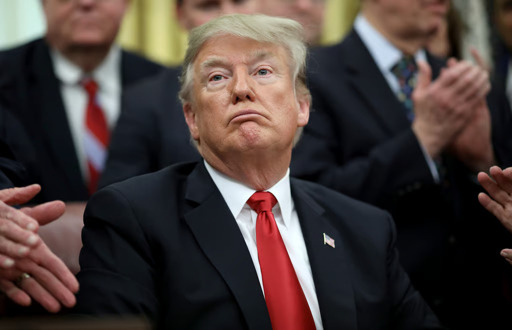
The war in Iran — launched by a U.S. administration desperate to reassert imperial authority with bonapartist methods — has unleashed a political and economic shockwave inside the United States. The result is not national unity but rising anger, deepening polarization, and a crisis of legitimacy for the entire regime. Far from projecting strength and as Juan Chingo argues, this war is exposing the weakness of an empire in decline and the failure of Trumpism to impose a bonapartist solution.
Inflation and Economic Pressure on Workers
U.S. inflation has climbed sharply since the beginning of the Iran war, driven above all by skyrocketing energy costs. According to The Guardian, inflation jumped to 3.8 percent in April, with energy prices acting as the primary accelerant. The Washington Post reports the same figure, noting it is “the highest rate in nearly three years” as gasoline prices surge in response to the conflict. CBS News underscores that “searing U.S. energy prices are driving the hottest inflation in years,” and economists expect further increases even if the war ends immediately, because “the tail of the impact will last for months.”
The clearest pressure point for working-class households has come through fuel and energy bills. Economists are warning that the risk of $5 gasoline (in California it’s already above $6) can no longer be dismissed, driven by supply disruptions and market uncertainty after the U.S. blockade of Iranian ports. The New York Times reported oil at $115 a barrel in late March, a level that has since kept refining and transportation costs elevated, while the Wall Street Journal notes that the war’s “economic shock wave is expected to get even bigger” as tighter global oil supply squeezes both businesses and consumers. These increases feed into electricity and heating costs, which are rising across multiple regions as utilities pass higher fuel prices onto customers.
While the U.S. economy remains more insulated than Europe or Asia, the domestic effects — higher prices, rising energy bills, and persistent uncertainty — are politically corrosive. The University of Michigan’s consumer sentiment survey showed growing pessimism as households connect their cost-of-living problems directly to the war. In short, the economic consequences of the Iran War are already hitting U.S. workers, and the pressure is likely to intensify in the months ahead.
Against the War and Against Authoritarianism
NPR summarizes accurately the mood of the American population: “The war in Iran has not been popular with the American public, according to polls.”
This includes cracks within Trump’s coalition, including MAGA. The promise that this war would be quick, cheap, or strategically decisive has fallen apart. Instead, many of Trump’s allies on the right are worried that the war could escalate and lead to further instability and price spikes. MAGA “survived” the 12-Day War, where the United States was able to score what appeared to many to be a decisive victory. But Iran’s willingness to fight to the end and the absence of a quick, cheap, or decisive American victory has brought the crisis of U.S. hegemony out into the open. In the absence of a quick victory or withdrawal, the war is opening the cracks in Trump’s own coalition, including the MAGA wing, where there’s increasing criticism that the United States is spending billions on a “war for Israel.”
This is the domestic political cost of imperialism: a population that sees its own living standards deteriorate as yet another administration drags the country into yet another war.
In this context, although Trump was forced to back down from the most fascistic aspects of his agenda after being confronted by the working class of Minneapolis, the imperialist offensive in Iran has its authoritarian counterpart in the United States. Not only does ICE continue to patrol the streets of major cities, expanding its infrastructure to resemble the Gestapo and collaborating with local police, but Trump and the GOP are also attempting to mount a Bonapartist voter suppression effort ahead of the midterm elections, which includes smashing the Civil Rights Act and redistricting electoral maps in states across the country in an effort to maintain control of congress. The Brennan Center for Justice for example, a liberal think tank, warns that “wartime conditions create opportunities for executive overreach.” In a country already marked by intense polarization, voter suppression, and a reactionary judiciary, this warning is not abstract. War can often become a pretext to expand surveillance, repress political enemies, and further erode democratic rights.
Republicans on the Defensive
Republicans are increasingly alarmed about the political fallout of the Iran war. The conflict has triggered a strategic crisis inside the party, and there is a widespread fear that everything will fall apart unless Republicans shift their midterm messaging away from celebratory rhetoric and toward economic reassurance. GOP strategists acknowledge that the war is hurting Trump politically, as voters associate the conflict with higher costs and instability. Politico captures the growing panic inside the party. As one Republican adviser said bluntly: “We lose the midterms” if the economic effects of the war continue, reflecting a widespread fear that the conflict has already damaged their chances in competitive districts.
To counter these headwinds, Republicans are scrambling to adjust their campaign strategy while also trying to blunt the electoral impact of voter anger. GOP senators are even pressuring Trump to find an exit plan from the conflict: “the clock is ticking” as energy prices rise. At the same time, local campaigns are steering away from foreign policy and doubling down on pocketbook messaging — an abrupt reversal from the early months of the war, when the administration expected a patriotic rally effect that never materialized.
Facing worsening polls, Republicans have leaned heavily on redistricting to protect their congressional majority and to further suppress voting rights with the complicity of the Supreme Court.
The Louisiana Supreme Court decision effectively dismantled one of the last remaining protections of the Voting Rights Act and allowed the state to adopt a congressional map that reduces Black political representation despite Black residents making up nearly a third of the population. By voiding a map that included two majority‑Black districts and permitting a new map that collapses this representation, the court sidelined the principle of racial equality in voting. In practice, this means that politicians are literally choosing their own constituencies, entrenching one‑party control and violating basic democratic standards of fair representation.
Democrats Face Their Own Crisis of Credibility but They Could Regain the House
Democrats have responded to the Iran war with hesitation, fragmentation, and procedural criticism, rather than a unified political stance. Many establishment Democrats have defaulted to narrow institutional language — demanding “briefings,” “plans,” and “legal justifications.” Democrats are being cautious since a broad majority of Americans want the war to end creating pressure on the party to oppose the conflict without appearing militarily weak.
As the midterms draw closer, Democrats are trying to turn the war’s economic fallout into an argument against Republican leadership. Democratic politicians in competitive states have the space to avoid talking about the War because voters blame the administration for inflation and soaring energy prices, opening space for Democrats to attack Trump on domestic affordability rather than foreign‑policy. But Democrats are far from unified. Some of them like Sen. Ruben Gallego, have condemned the war outright as “wrong,” while others maintain a more hawkish or procedural posture. This split has complicated Democratic messaging: centrist Democrats want to frame the war as mismanaged but “necessary,” while progressive Democrats want to question its legitimacy.
This puts the social democrats like Bernie Sanders and Zohran Mamdani noticeably apart from the Democratic leadership from the perspective of voters who oppose the war. Mamdani said the Iran war reflects a “broken kind of politics.” Sanders has publicly opposed the war, reflecting his attempt to balance anti‑war rhetoric with remaining inside the Democratic Party. Both politicians occupy an uneasy space: they acknowledge discontent with the war but remain tied to a party whose establishment refuses to confront its underlying causes since the “Iran problem” is a bi-partisan one. As a result, the Democratic reaction is defined not by clear opposition but by fragmentation — procedural critique at the top, cautious dissent in the middle, and anti-war appeals from its social-democratic wing that is unable to offer any alternative to imperialism.
Imperialist War and Class Struggle at Home
The Iran war has worsened economic conditions for U.S. workers, deepened public discontent, and destabilized even further the political system ahead of what is one of the most crucial mid-term elections in recent history. Republicans and Democrats both defend a foreign-policy doctrine that feeds endless war, and both accept that workers must bear the cost. Indeed, that’s what’s behind the mammoth $1.5 trillion defense budget request that Trump and the Pentagon have asked Congress to approve in order to replace the huge portion of munitions already used in the war.
From below though, massive repudiation against the war has taken to the streets through the No Kings demonstrations that explicitly were called under the slogans of “No War, No Kings, No ICE.” Among the masses, a radicalized vanguard has brought an anti-imperialist struggle to those demonstrations, denouncing not only the billions that are going to the war machine but also the illegitimate, imperialist war against Iran and U.S. complicity in the genocide of the Palestinian people.
At the same time, the living conditions of the vast American working class are deteriorating every day, and our democratic rights are under attack. It is clear to thousands that the bombs killing girls in Iran are paid for by the people, and that the bullets killing activists like Renee Good and Alex Pretti are aimed at the people.
The real alternative will not come from either capitalist party. It must come from below — through the independent organization of workers, youth, and oppressed communities who refuse to pay for imperialism, whether in Iran or at home.
An anti-war movement rooted in the working class — militant, democratically organized from below, and explicitly internationalist — is the only force capable of confronting not only the war abroad but the crisis unfolding inside the United States.
The post The Iran War at Home: Inflation and Discontent Ahead of the Midterms appeared first on Left Voice.
From Left Voice via This RSS Feed.