

Bullets:
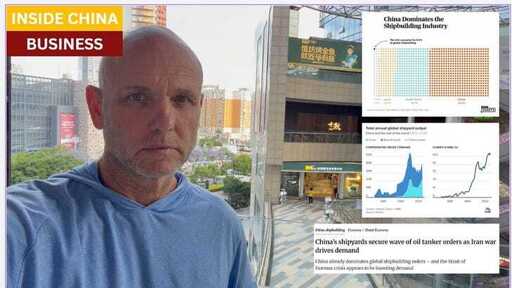
In just three decades, China’s shipbuilding industry went from zero, to today building more vessels than the rest of the world combined.
The White House, the War Department, and leading lawmakers have promised billions of dollars in new investment, and enacted policies to rebuild American shipbuilding and pull business awaay from China.
But China’s dominance in the industry continues to boom, and the growth is even accelerating.
The War on Iran has sharply pushed up demand for ships from the energy industry, and Chinese shipyards alone have the capacity to take new orders for VLCC’s and LR ships.
Inside China / Business is a reader-supported publication. To receive new posts and support my work, consider becoming a free or paid subscriber.
Report:
Good morning.
In 1985, China’s shipbuilding industry didn’t exist. It is now the biggest in the world, and is larger than the rest of the world, combined.
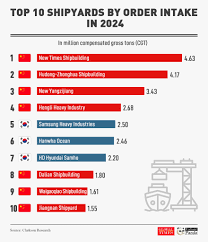
These were the largest shipyards in 2024, and Chinese shipbuilding companies own seven of the top 10 spots. China’s largest shipbuilder built more vessels in 2024—in just one year—than the entire US shipbuilding industry built in the past 80 years.
Last year the White House issued new strategies to “restore America’s maritime dominance”, and to rebuild the maritime industrial base in the United States. Lots of new investment was promised for the expansion of commercial shipbuilding, and for the military, and to beef up supply chains, ship repair, and to build new ports and shipyards.
All that is going to be expensive, and so the Trump Administration announced high fees on any Chinese-owned or Chinese-built ships making port visits in the United States. This is from October, and those high fees were expected to bring in over $3 billion this year—in 2026 – from just the top 10 ocean shipping companies. Those funds would go to helping pay to revive US shipbuilding.
Non-Chinese operators, of ships built in China, would also be charged under a different formula. Those fees add up to millions of dollars for each ship heading to the US, if it either is owned by a Chinese company, or was built by one, so shipping companies started shifting their delivery schedules and logistics around.
In this report, we detailed how the shipping companies responded. Their first idea was to shift cargo to non-Chinese ships wherever possible, but those ships filled up, fast, and so costs their went up, anyway. The delivery times to the US also went up.
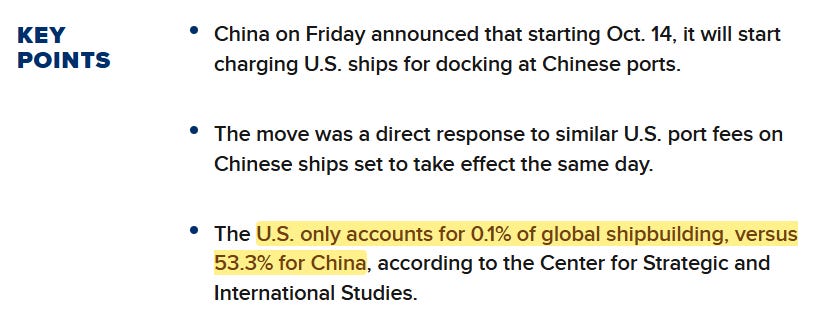
Then Chinese regulators retaliated, and announced high port fees for any US ships heading to ports here. China had one problem, which is that the US shipbuilding industry doesn’t really exist at all. It’s not possible to charge port fees based on whether the ship was built in the US, because none of them were.
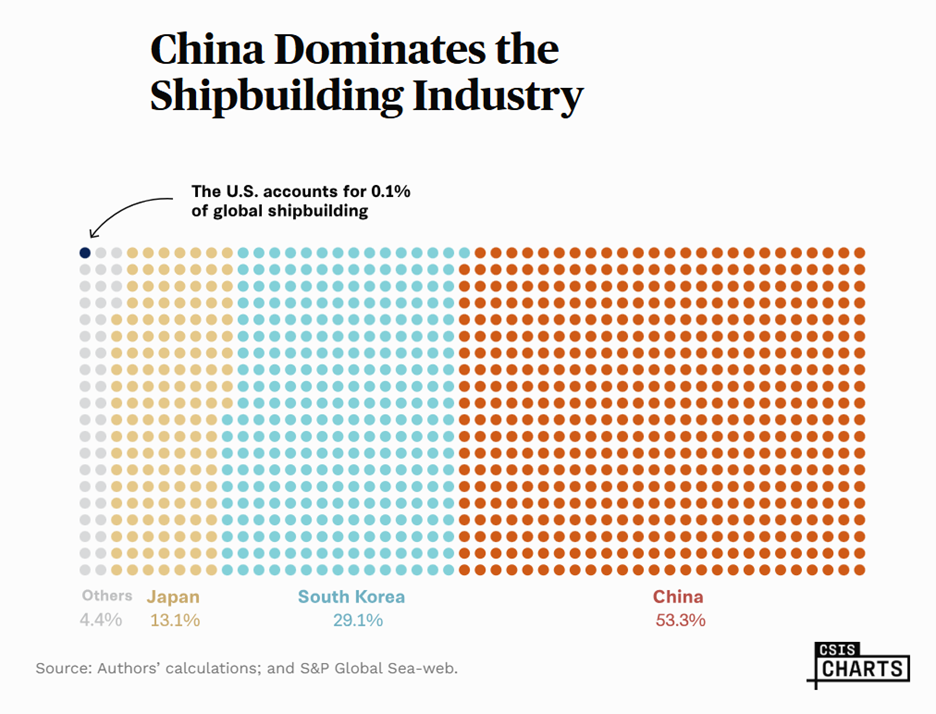
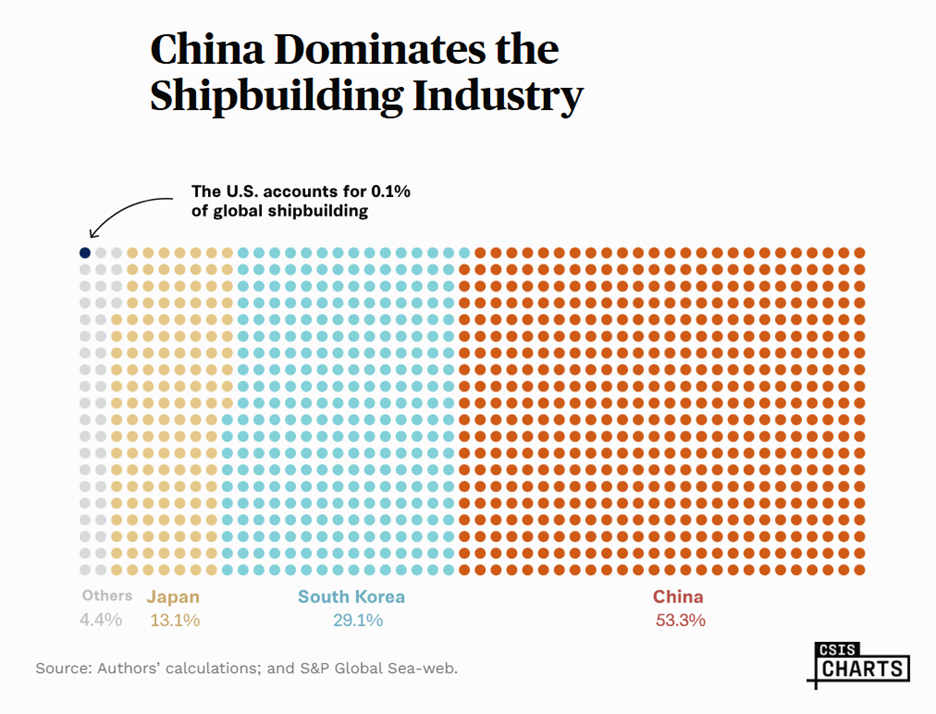
The United States is 0.1% of global shipbuilding, which means that American shipbuilders are one one-thousandth of the world market. Here’s how that looks on a chart, of one thousand dots. It’s 50 across by 20 high. The Japanese shipbuilding industry is over 130 times bigger than the United States’. China’s is bigger by over 500 times:
So China instead targeted ships with US owners. These are Wall Street firms, trading companies, and entities in offshore jurisdictions holding equity in ships that are flagged in other countries.
That directive, from China, was dated 10 October, and was written to hit American investment firms and shell companies with billions of dollars of fees, on any of their ships coming this way. Exactly one month later, the Trump Administration announced that the policy would be scrapped for one year, on both sides. 10 November, implementation of the Section 301 policy would be suspended for one year, and Chinese retaliatory measures would also be removed.
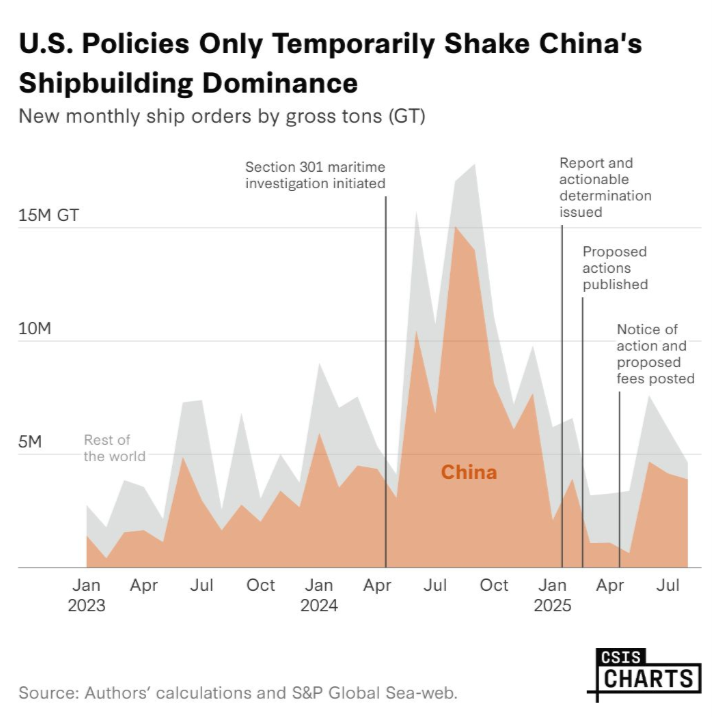
At year-end, we were able to look back and see what effect, if any, all those policy moves actually had on the market. And it wasn’t much. China’s shipbuilding order book is in orange, and the entire rest of the world is in gray.
In April of 2025, the new fees were proposed which would come into effect by October, but orders to Chinese shipyards went up again, anyway.
For full-year 2025, China saw a slight drop in market share, of 4.6%. China continued to have the top share in 16 out of 18 major vessel types, and 2025 was the 16th year in a row that China led the world in vessel completions, new orders, and work in progress. Looking at that, right there, another way—in 1985, China didn’t have a shipbuilding industry. By 2009—just 25 years later, China was building more ships than anybody.
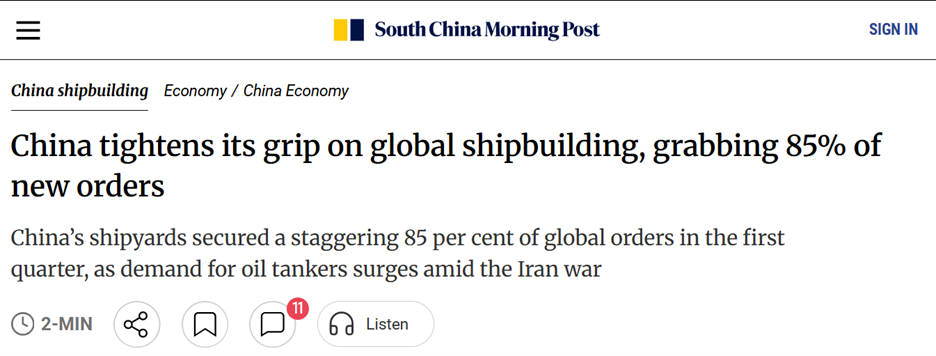
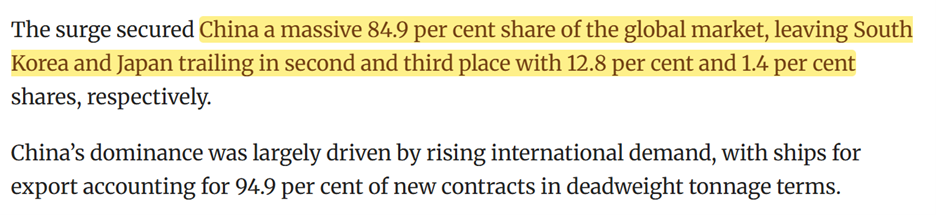
And now the first quarter of 2026 is done, and new orders for Chinese ships doubled, year over year. Now China has an 84.9% share of the global market. South Korea is at 12.8. Japan at 1.4. Looking at THAT another way, if we did this chart again after Q1, we need 849 red dots for China. The Koreans dropped by more than half, Japan gets only 14 dots, instead of 131:
Lots of those new orders in the first quarter came from the oil industry. Chinese shipyards are benefiting from the US-Israeli war on Iran. There are two blockades now at the Strait of Hormuz, and shipping companies need to buy a lot of new ships. Very large crude carriers (VLCCs) can haul 2 million barrels of oil. Out of Switzerland Advantage Tankers out of Switzerland previously contracted solely with South Korea, but placed a new order for 2 VLCC’s from China. Mercuria Energy ordered four crude carriers, and 2 long-range product tankers. A group out of Singapore ordered 8 VLCC’s. Just those three companies are buying a total of 15 tanker ships.
This is the most recent plan from the White House, and it runs 35 pages. It’s a new “Maritime Golden Age”, which will expand commercial shipbuilding and work with allied countries to pull of that business away from China. But those oil tanker orders from Mercuria was for six ships—four VLCC’s and two LR2’s. They will take delivery by 2029, for all-in contract price of $650 million. The order for the other Swiss group was for two ships; one will be delivered in Q2 of 2028, and the other in 2029. Singapore will get their ships from 2028 to 2030.
China’s shipyards are online, right now. They also have enormous capacity and can scale up to meet giant new, and sudden, demand from the oil industry. China’s so-called “overcapacity” that Washington and European politicians are always on about means, in this case, that they can build ships that nobody else can, not even the big shipyards in Korea and Japan.
Some senators wrote a letter to Trump that dropped before his big visit, urging the President to “stand strong” on shipbuilding, and to hold China accountable and reverse the losses felt over the past twenty years by the American shipbuilding industry. “To level the playing field and deliver for American workers and shipyards.”
But we don’t have a shipbuilding industry. We don’t have American workers and shipyards that make commercial ships. They’re either building for the Pentagon, or not at all. That’s what that single tiny dot means at the top left corner of that chart. Fewer merchant ships are built in the United States, than in China, or in South Korea, or in Japan.
Or in Vietnam, or the Philippines, or Taiwan, or Italy, or Germany.
Be Good.
Resources and links:
US port fees, and $3 billion in costs, loom for owners of Chinese-built ships
https://www.reuters.com/world/china/us-port-fees-3-billion-costs-loom-owners-chinese-built-ships-2025-10-07/
With U.S. port fees on Chinese-built ships coming, ocean freight carriers scramble to avoid surprise financial hit
https://www.cnbc.com/2025/10/10/ocean-freight-carriers-port-fees-china-shipbuilding-vessels.html
US senators urge Trump to ‘stand strong’ on shipbuilding in talks with Xi
https://www.reuters.com/world/us/us-senators-urge-trump-stand-strong-shipbuilding-talks-with-xi-2026-05-11/
China retaliates against U.S. port fees with new charges on American ships
https://www.cnbc.com/2025/10/10/china-retaliates-against-us-port-fees-with-charges-on-american-ships.html
China tightens its grip on global shipbuilding, grabbing 85% of new orders
https://www.scmp.com/economy/china-economy/article/3353147/china-tightens-its-grip-global-shipbuilding-grabbing-85-new-orders
Senators Baldwin, Kelly, Young, Scott Call on Trump to Stand Up to China and Prioritize U.s. Shipbuilding at Summit With President Xi
https://urbanmilwaukee.com/pressrelease/senators-baldwin-kelly-young-scott-call-on-trump-to-stand-up-to-china-and-prioritize-u-s-shipbuilding-at-summit-with-president-xi/
China navigates US threats to anchor global shipbuilding dominance in 2025
https://www.scmp.com/economy/global-economy/article/3342091/china-navigates-us-threats-anchor-global-shipbuilding-dominance-2025
RESTORING AMERICA’S MARITIME DOMINANCE
https://www.whitehouse.gov/presidential-actions/2025/04/restoring-americas-maritime-dominance/
Maritime Golden Age
https://www.whitehouse.gov/maritimemight/
China Dominates the Shipbuilding Industry
https://www.csis.org/analysis/china-dominates-shipbuilding-industry
U.S. policies target China’s shipbuilding dominance
https://www.linkedin.com/posts/csis/_new-us-policies-aimed-at-curtailing-china-activity-7385661079961628672-AqML
China’s shipyards secure wave of oil tanker orders as Iran war drives demand
https://www.scmp.com/economy/global-economy/article/3350872/chinas-shipyards-secure-wave-oil-tanker-orders-iran-war-drives-demand
Fact Sheet: President Donald J. Trump Strikes Deal on Economic and Trade Relations with China
https://www.whitehouse.gov/fact-sheets/2025/11/fact-sheet-president-donald-j-trump-strikes-deal-on-economic-and-trade-relations-with-china/
US-China Port Fee Truce: One-Year Suspension Commencing 10 November 2025
http://north-standard.com/insights-and-resources/resources/news/us-china-port-fee-truce
The Shipping Mess, Part 1: Global fleets shift routes, raise costs, slow deliveries to US markets
The Shipping Mess, Part 2: New Chinese regulations may be targeting Wall Street, US investors
Inside China / Business is a reader-supported publication. To receive new posts and support my work, consider becoming a free or paid subscriber.
From Inside China / Business via This RSS Feed.
You must log in or # to comment.