

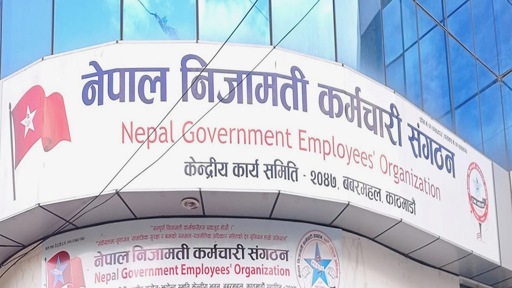
Nepal’s Supreme Court issued an interim stay on the move by the newly-elected government, led by Prime Minister Balendra Shah, to ban and dissolve party-affiliated trade unions for government employees.
The court also stayed a similar ban on student unions, issued on the very first day of the Shah government’s formation.
The SC’s decision came as a relief to thousands of civil servants and students in the country who have been protesting against the decision.
On May 3, the Shah government issued an ordinance amending various clauses of the country’s Civil Services Act of 1992, which allowed the formation of unions, their registrations, and activities, including collective bargaining.
The amendments also removed any role for such unions in raising professional demands and resolving issues through hearing grievances.
Based on the ordinance, Nepal’s Department of Labor and Occupational Safety cancelled the registration of 12 trade unions of government employees on May 6.
The issuance of the ordinance sparked protests by professional unions and political parties, with government employees terming the move draconian and a violation of their constitutional right to form associations.
The protesters had demanded the immediate withdrawal of the anti-democratic move.
The government tried to argue that politically-affiliated unions compromise the political neutrality of civil servants and government employees and encourage them to engage in political activities affecting their delivery of service.
Shah himself took to social media to justify the decision, dismissing workers’ claims that the move would defy their rights. He alleged that party-affiliated trade unions have become a source of corruption and inefficiency among government employees and weakened the “public trust” in the system.
Even after the SC’s stay on Monday, the government has remained defiant, claiming that the restrictions on party-affiliated trade unions would have strengthened the “professional freedom” of civil servants.
Violation of constitutional rights
The Shah’s government had tried to justify the ban on student unions on similar grounds as well. However, professional groups, political parties, activists and international organizations have rejected such claims, indicating a tendency in the newly-elected Rastriya Swatantra Party (RSP)-government to find superficial reasons for deeper, systemic problems.
Reacting to the government’s move to ban the trade unions, the Confederation of Nepalese Professionals (CONEP) issued a press release on May 4, condemning the “ban on trade unions”.
CONEP called it an “anti-democratic action” which “has worked against the Human Rights Declaration and Convention of the International Labor Organization (ILO).”
It demanded the withdrawal of the decision, claiming the move defies Nepal’s commitments to the ILO conventions apart from violating the constitutional right to form associations.
The move has also been criticized by Public Services International (PSI).
Our “experience globally tells us that governments attack public service unions when they intend to privatize and reduce public services,” Kate Lappin, PSI’ Asia Pacific regional secretary, said in a statement on Monday.
She rejected the Shah’s allegations of inefficiency on trade unions, claiming instead that “higher trade union density reduces inequality, limits billionaire power, improves public health and increases access to public services.”
The World Federation of Trade Unions (WFTU) also wrote a letter to the Nepalese Prime Minister criticizing his government’s decision and demanding that the government ensure “the rights of teachers, civil servants, and workers to form organizations and engage in collective bargaining” rather than trying to limit them.
Both the WFTU and PSI reminded the Nepalese government of its obligations to protect the ILO convention, which guarantees all workers the right to form unions without any interference, as well as the relevant articles of Nepalese constitutions (article 17, 34, and 35), which guarantee the right to form organizations and engage in collective bargaining.
The post Nepal’s top court halts government’s attempts to ban trade union for civil servants appeared first on Peoples Dispatch.
From Peoples Dispatch via This RSS Feed.