

“Even if the Philippines is no longer a state party to the ICC, the Philippine government owns the continuing obligation to cooperate in any investigation conducted by the ICC since it is the essence of Article 27 that survives even after the withdrawal.”
MANILA — The recent scandal at the Senate has repercussions that extend to the United Nations (UN) and the Association of Southeast Asian Nations (ASEAN).
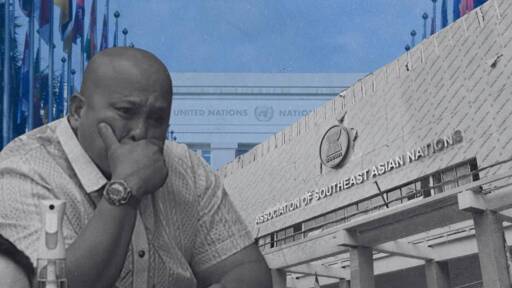
As the Philippines campaigns for a seat on the UN Security Council (UNSC) and presides over the ASEAN, human rights defenders said that the government faces a credibility crisis at home as the Senate harbors international fugitive Sen. Ronald “Bato” dela Rosa who is being pursued by the International Criminal Court over his role in the “war on drugs” campaign under the Duterte regime.
“We are here to remind the Marcos, Jr. administration and the Senate that they are harboring an international fugitive. He is not a simple criminal,” said Cristina Palabay, secretary general of human rights group Karapatan. “In public, you are presenting yourself as someone who has the moral ascendency to assume chairship and run for a seat. It deserves outrage.”
The Philippines assumes the ASEAN Chairship this year. The Marcos, Jr. administration also asked for a non-permanent seat on the UNSC, a principal organ that issues binding resolutions and imposes sanctions with 15 permanent members and 10 non-permanent members.
The ICC confirmed the issuance of an arrest warrant againstes Dela Rosa for his alleged criminal responsibility as an indirect co-perpetrator of former president Rodrigo Duterte’s crimes against humanity of murder. Dela Rosa was the chief of the Philippine National Police (PNP) and implemented Duterte’s so-called war on drugs.
Read: Drug war victims’ kin demand Senate’s surrender of Bato to ICC
“This will set a dangerous precedent for all those identified co-perpetrators,” said Jojo Lacanilao, convenor of Duterte Panagutin Campaign Network. “The protective custody granted to Bato has no basis in law. It is an irony and disrespect, hypocrisy on steroids made by the senators.”
Following a power shift in the Senate that installed Alan Peter Cayetano as Senate President on May 11, Dela Rosa was placed under what they described as “protective custody” after six months of hiding.
Tensions escalated on May 13 when a standoff erupted inside the Senate building over the pending ICC arrest warrant against Dela Rosa. Journalists reported hearing at least 10 gunshots. As of this writing, authorities have not reported any casualties. On May 14, Dela Rosa reportedly left the Senate building, his whereabouts currently unknown.
“The compromised safety of the journalists, employees, and officials in the Senate’s premises last night is precisely the reason why the Senate should and Bato should be made accountable,” Palabay said. “They are not just putting their lives in danger but also the lives of ordinary people who are just doing their jobs in the line of fire.”
The Supreme Court (SC) did not grant the temporary restraining order (TRO) requested by Dela Rosa. However, he was ordered to comment on the motion within a non-extendible period of 72 hours, starting on May 13.
Legality and illegality
National Union of Peoples’ Lawyers (NUPL) President Ephraim Cortez said that the Philippine government has a continuing obligation under Article 27 of the Rome Statute which states, “Immunities or special procedural rules which may attach to the official capacity of a person, whether under national or international law, shall not bar the Court from exercising its jurisdiction over such a person.”
The ICC Appeals Chamber earlier ruled with finality that the Court has the power to exercise its jurisdiction pursuant to the Article 127 (2) of the Rome Statute. Based on this provision, the State shall not be discharged from any obligations by the reason of its withdrawal and that it shall not affect any criminal investigations and proceedings of the ICC, especially crimes committed prior to the withdrawal.
On February 8, 2018, the ICC Prosecutor announced that there will be a preliminary investigation about the situation in the Philippines. A year after, on March 17, 2019, the withdrawal of the Philippines from the Rome Statute took effect.
Read: Duterte defeated twice on ICC jurisdiction challenge
“The warrant is valid,” Cortez said. “Even if the Philippines is no longer a state party to the ICC, the Philippine government owns the continuing obligation to cooperate in any investigation conducted by the ICC since it is the essence of Article 27 that survives even after the withdrawal. The Philippine government agrees to recognize the residual jurisdiction of the ICC.”
He said that there is a universal jurisdiction over heinous international crimes under Republic Act 9851 (Philippine Act on Crimes Against International Humanitarian Law, Genocide, and Other Crimes Against Humanity). “In the interest of justice, the relevant Philippine authorities may dispense with the investigation or prosecution of a crime punishable under this Act if another court or international tribunal is already conducting the investigation or undertaking the prosecution of such crime,” Section 17 of the provision read, noting that the authorities may surrender the accused in the appropriate international court.
Cortez criticized the statements of the Department of Interior and Local Government (DILG) and the Philippine National Police (PNP) for claiming that the warrant of arrest should go to the Philippine Center on Transnational Crime (PCTC).
He said that the crimes against humanity are not within the purview of PCTC’s mandate and powers as it is limited to drug trafficking, money laundering, terrorism, arms smuggling, human trafficking, piracy, and other crimes that have impact on stability and security of the country.
“The authority of PCTC is very limited to transnational crimes as enumerated. It cannot be expanded to include crimes against humanity. So the warrant of arrest can be implemented even without going to PCTC,” Cortez said.
Lacanilao said that blocking the impending ICC arrest of Dela Rosa is an obstruction of justice. “If we really want to show authority in the international community, we are expected to be a rules-based country abiding by international law.”
Outcry
Dela Rosa has appealed to the Marcos, Jr. administration to block the impending arrest. He continues to deny any wrongdoing, insisting that there is no formal case filed against him in the domestic courts.
Llore Pasco, a member of Rise Up for Life and for Rights whose two sons were killed at the height of the anti-drug campaign in 2017, said that they could not file a legal case since the police said that the operations were legitimate under Oplan Tokhang. “We cannot even claim police reports and autopsy reports. Sometimes, even the death certificates are fabricated. Our families were killed through gunshots but the declared causes of death were unrelated like pneumonia.”
Sally Ramos, another member of Rise Up for Life and for Rights whose elder daughter Criseta was killed in 2017 by four unidentified men, recalled that not even the barangay officials and police officers helped investigate the case of her daughter’s killing. “We are poor. We did not receive any ounce of support from the government, not even for the burial of my daughter. She was shot four times. Since then, I never hoped that justice will be served here in this country.”
Dahlia Cuartero, whose son was also killed at the height of the drug war, said that Dela Rosa’s enjoyment of legal remedies and protection from the Senate paint the glaring inequality that they have suffered as poor Filipinos. She said that their families were not given due process.
Dela Rosa is the second Filipino issued with a confirmed ICC arrest warrant. But the court also identified other Duterte co-perpetrators including Sen. Christopher “Bong” Go, former justice secretary Vitaliano Aguirre II, Vicente Danao, Camilo Cascolan (deceased), Oscar Albayalde and Isidro Lapeña.
The ICC found reasonable grounds to believe that he had contributions to the common plan in enforcing widespread and systematic attacks against all persons designated as involved in criminal activities, especially drug-related ones, in his official capacity as former Philippine National Police (PNP) chief and Davao City Police chief. (DAA)
The post UN, ASEAN and the Senate scandal appeared first on Bulatlat.
From Bulatlat via This RSS Feed.